
Quick Summary: How do you visit Basgo Fort and Monastery ruins by motorcycle from Leh?
Quick Answer: Basgo Fort and Gompa (10,800 ft / 3,292 m) is situated 40 km west of Leh along the paved Srinagar-Leh National Highway 1 (NH1). The ride takes approximately 45 to 60 minutes on smooth, two-lane military asphalt, followed by a 1.5 km winding paved spur leading directly to the monastery parking terrace. Dating to the 15th century, Basgo was the historic capital of Lower Ladakh, famed for withstanding a legendary three-year siege by Tibetan-Mongol forces between 1679 and 1682. The complex houses the sacred Chamba Lhakhang with its colossal 30-foot copper-gilt Maitreya Buddha and vibrant 16th-century Indo-Tibetan frescoes. Open daily from 08:00 AM to 06:00 PM with a nominal ₹50 entry fee. No Inner Line Permit is required, making it the perfect low-altitude cultural day excursion from Leh.
The Citadel That Defied the Mongol Hordes: History, Royal Palaces & the Great 1680 Siege
Answer-First Summary: Perched atop jagged clay crags, Basgo's mud-brick ramparts resisted a three-year Tibetan-Mongol siege from 1679 to 1682.
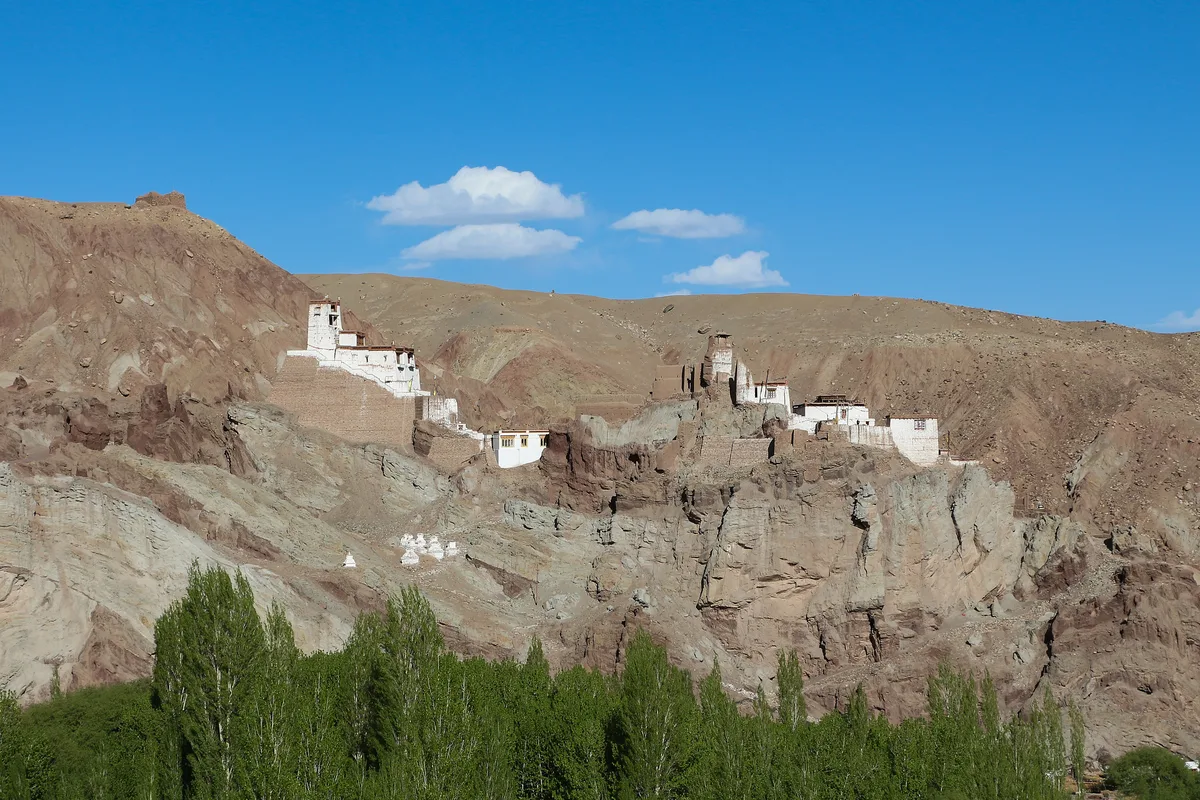
Riding 40 km west of Leh along National Highway 1, the smooth tarmac passes the confluence of the Indus and Zanskar rivers at Nimmu and rounds a dramatic bend into the Sham Valley. Suddenly, the barren landscape erupts into a surreal amphitheater of jagged, eroded orange-red clay pinnacles crowned by the crumbling ramparts, watchtowers, and temple roofs of Basgo Fort. Resting at an elevation of 10,800 ft (3,292 m), this ancient mud-brick citadel blends so seamlessly into the weathered geological crags that it appears to have grown organically from the living rock.
Historically, Basgo was one of the most vital political and military strongholds in the Western Himalayas. In the 15th century, when the Kingdom of Ladakh was divided between two royal brothers, King Drakpa Bumde chose Basgo as the capital of Lower Ladakh (Sham), constructing a formidable royal palace, granaries, and perimeter fortifications along the knife-edge ridge.
Basgo's defining moment in Himalayan history occurred during the Tibet-Ladakh-Mughal War (1679-1682). A massive joint army of Tibetan and Mongol troops invaded Ladakh, sacking Leh Palace and forcing the Ladakhi king, Deldan Namgyal, to retreat behind the impenetrable battlements of Basgo. For three grueling years, the garrison at Basgo withstood continuous bombardment and siege warfare, sustained by subterranean water tunnels connected to the valley stream and vast grain reserves stored within deep cliffside chambers.
The siege was finally broken in 1682 when King Deldan Namgyal formed an alliance with the Mughal Empire. Emperor Aurangzeb dispatched a 6,000-strong cavalry army from Kashmir that routed the Mongol invaders on the Basgo plains. Today, the dramatic ruins stand as a testament to medieval military architecture, honored by the World Monuments Fund on its Watch List of endangered cultural heritage.
The Sacred Chamba Lhakhang: The Colossal 30-Foot Gilded Maitreya & World Monuments Preservation
Answer-First Summary: Housing one of Ladakh's oldest and most magnificent clay and copper-gilt colossal Maitreya Buddhas.
While much of the residential royal citadel has weathered into evocative ruins, Basgo's sacred temples remain exquisitely preserved. The crowning jewel of the complex is the Chamba Lhakhang (Maitreya Temple), commissioned around 1540 by King Tsewang Namgyal.
Stepping through the carved wooden doorway into the dimly lit, incense-scented sanctuary, visitors are confronted by a breathtaking sight: a colossal two-story-high statue of Maitreya (the Future Buddha) seated in the European posture (bhadrasana) upon a lotus throne. Rising over 30 feet from floor to ceiling, the statue is fashioned from clay over a timber frame and coated in brilliant copper gilding, adorned with precious stone inlays and a towering five-leaf crown.
The surrounding walls are covered in magnificent 16th-century tempera murals executed in the classic Indo-Tibetan style, depicting the celestial realms, historical kings in traditional silk robes, and intricate multi-armed tantric mandalas. The artistic mastery bridges the ancient Kashmiri-influenced iconography of Alchi with the formal Tibetan styles that blossomed in Central Ladakh.
WORLD MONUMENTS WATCH RESTORATION: In the late 1990s, torrential high-altitude rains threatened the structural integrity of Basgo's earthen walls. Recognizing its global significance, the World Monuments Fund and the UNESCO-supported Basgo Welfare Committee initiated a comprehensive structural stabilization project. Master Ladakhi artisans used traditional rammed-earth, mud-straw mortar (markalak), and poplar timber reinforcement to preserve the temples for future generations, earning the prestigious UNESCO Asia-Pacific Heritage Award for Culture Heritage Conservation.
The Cham-Chung & Serzang Temples: Gold-and-Silver Manuscripts & Royal Prayer Halls
Answer-First Summary: Exploring the smaller twin temples housing sacred Buddhist texts inscribed in precious metals.
In addition to the main Chamba Lhakhang, the Basgo fortress complex includes two other deeply sacred chapels perched on adjacent rocky terraces:
1. THE CHAM-CHUNG TEMPLE: Situated on the lower saddle of the fortress ridge, this compact temple was originally constructed as a private royal prayer chapel by Queen Gyal Khatun in the early 16th century. It features beautiful wall frescoes depicting the Thousand Buddhas and scenes from the Jataka tales (the previous lives of Gautama Buddha), painted with vibrant lapis lazuli blues, malachite greens, and mineral ochres.
2. THE SERZANG LHAKHANG: Perched on the highest accessible point of the fortress crag, the Serzang ('Gold and Copper') Temple was built to commemorate the victory of the Basgo kings. It historically housed a priceless collection of the Tibetan Buddhist canon (Kangyur and Tengyur) inscribed entirely in letters of pure gold, silver, and copper ink on hand-pressed mulberry paper. Standing on the exterior flagstone terrace outside the Serzang Lhakhang offers a dizzying 360-degree panoramic view over the verdant green ribbon of the Indus Valley contrasted against the jagged peaks of the Zanskar Range.
Motorcycle Route Logistics: The Scenic 40 km Highway Cruise on NH1
Answer-First Summary: Navigating from Leh via Spituk, Gurudwara Pathar Sahib, Magnetic Hill, and Nimmu to the Basgo spur.
The 40 km motorcycle ride from Leh to Basgo is one of the most relaxing, visually captivating half-day excursions in Ladakh. Departing Leh along NH1, you cruise past Spituk Monastery and the wide desert plains of Phyang on impeccable multi-lane military asphalt.
At km 25, you pass the golden spire of Gurudwara Pathar Sahib, followed shortly by the famous Magnetic Hill gravity phenomenon at km 30. Continuing past the Sangam Indus-Zanskar confluence viewpoint at Nimmu (km 33), the highway crosses a sturdy bridge across the Indus River and enters the lower Sham Valley.
At km 39, keep an eye out for a prominent green BRO signboard indicating 'Basgo Gompa / Palace'. Turn right off the main highway onto a well-paved, winding single-lane village road. The spur road snakes up through traditional Ladakhi whitewashed farmhouses, apricot orchards, and willow groves for 1.5 km before ascending a gentle 10% incline to terminate at the wide, paved monastery parking terrace directly below the fortress walls.
PARKING & WALKING ACCESS: The parking terrace offers ample space for motorcycles and support vehicles. From the parking lot, a short 5-minute walk along a stone-paved footpath and traditional steps leads you directly to the entrance gate of the Chamba Lhakhang. The climb is gentle and accessible to riders of all fitness levels.
Mechanical Advice & Low-Altitude Acclimatization Benefits: Why Basgo is Ideal for Day 1-2
Answer-First Summary: Senior Mechanic Stanzin Dorje explains cooling efficiency, carb tuning, and easy saddle conditioning.
From a physiological and mechanical perspective, Basgo is one of the smartest destinations to include in your initial Ladakh itinerary.
THE 10,800-FOOT ALTITUDE PROFILE: When flying into Leh (11,562 ft), your body requires time to acclimatize to high altitude. While climbing over high mountain passes (such as Khardung La at 17,982 ft or Chang La at 17,688 ft) stresses your heart and lungs, riding down to Basgo actually takes you 760 feet LOWER in elevation than Leh city center. At 10,800 ft (3,292 m), the air is denser and richer in oxygen, making this excursion completely safe from Acute Mountain Sickness (AMS). It allows you to log 80 km of round-trip saddle time without physical exhaustion.
MACHINE COOLING IN THE SHAM VALLEY: Unlike the freezing winds of the high passes, the lower Sham Valley experiences warm, radiant midday temperatures between June and September (25°C to 30°C). Air-cooled and liquid-cooled engines operate at optimal thermal efficiency along this flat, smooth highway. Check your radiator coolant levels and engine oil dipstick in Leh before departing; maintaining proper oil levels ensures smooth heat dissipation as you cruise at 60 to 70 km/h along the Indus.
TIRE PRESSURES & BRAKE WEAR: The tarmac from Leh to Basgo is smooth and free of sharp shale hazards. Set your cold tire pressures to standard street touring specs: 22 PSI front and 32 PSI rear (solo) or 36 PSI rear (with luggage/pillion). Because there are no steep downhill hairpins on this stretch, brake rotor temperatures remain low, ensuring crisp hydraulic braking response.
Fuel Planning & Roadside Facilities: Exploring the Sham Valley Corridor
Answer-First Summary: Mapping fuel from Leh, village tea stalls, and fresh apricot juice stands.
Planning fuel and sustenance for the Basgo excursion is simple and stress-free.
FUEL LOGISTICS: The round-trip distance between Leh and Basgo is exactly 80 km. A standard motorcycle like the Royal Enfield Himalayan 450, Scram 411, or Hero XPulse 200 consumes less than 3 liters of petrol for the entire journey. You do not need external jerry cans. Fill your tank in Leh or at the Spituk IOCL station before departure.
If you decide to continue west past Basgo toward Saspol, Alchi Monastery, or Lamayuru Moonland, remember that the next official commercial petrol filling station is at Khaltse - located 55 km west of Basgo.
VILLAGE FOOD & REFRESHMENTS: Basgo village is renowned for its organic apricot and walnut orchards. Along the village road and near the highway junction, local family-run dhabas offer fresh, cold-pressed Ladakhi apricot juice, piping hot vegetable noodle thukpa, and freshly steamed momos. It is an ideal spot to stop for an authentic, unhurried lunch in a peaceful rural setting.
Photography Timing, Drone Prohibitions & Cultural Etiquette
Answer-First Summary: Capturing golden-hour light on the mud battlements, drone restrictions, and temple manners.
To capture the full visual drama of Basgo's eroded cliffs and medieval towers, timing and lighting angles are paramount.
GOLDEN HOUR PHOTOGRAPHY WINDOW: Because the fortress ruins face south and southwest, the optimal photographic window occurs during late afternoon between 03:30 PM and 05:30 PM. As the sun dips toward the horizon, its low-angle golden rays illuminate the textured mud-brick ramparts, casting deep, dramatic shadows across the eroded clay gorges and setting the entire cliffside ablaze in rich shades of amber, rust, and crimson.
DRONE REGULATIONS: The operation of civilian camera drones is strictly prohibited across the Basgo and Nimmu sectors without explicit written authorization from the Kargil/Leh District Magistrate and the Indian Army. The highway corridor is a strategic military supply route, and unauthorized drone operation will result in immediate confiscation and legal prosecution.
TEMPLE PROTOCOL: Remove your riding boots and gloves before stepping onto the wooden floorboards of the Chamba Lhakhang. Photography without flash is generally permitted inside the temple for a small donation, but always ask the resident monk for permission before taking close-up photos of sacred murals or statues. Circumambulate the central Maitreya Buddha clockwise, and maintain a quiet, respectful demeanor within the prayer halls.
Itinerary Architecture: The Complete Sham Valley Heritage Loop
Answer-First Summary: Crafting a seamless 1-day cultural itinerary combining Basgo, Likir, and Alchi.
For motorcyclists who want to explore Ladakh's ancient art and monastic heritage without enduring punishing high passes, the 'Sham Valley Cultural Circuit' is unmatched:
09:00 AM - Depart Ride & Fire Rentals in Leh along NH1.
09:45 AM - Brief stop at Gurudwara Pathar Sahib (km 25) for warm chai and langar.
10:45 AM - Explore the historic mud-brick citadel and 30-foot gilded Maitreya at Basgo Fort (km 40). Spend 1.5 hours wandering through the ancient ruins and viewing the Indus Valley panorama.
12:30 PM - Ride 12 km further west and take the scenic detour up to Likir Monastery (12,100 ft) to admire the colossal 75-foot outdoor gilded Maitreya Buddha statue.
02:00 PM - Descend to the Indus River and cross to the southern bank to visit Alchi Monastery (km 66 from Leh). Savor a relaxed lunch in an apricot garden restaurant and inspect the world-famous 1,000-year-old Kashmiri wood carvings and micro-frescoes.
04:00 PM - Optional extension: ride 22 km west along NH1 to explore the 13th-century cliffside murals of Saspol Rock Caves, visit to explore the silent canyon sanctuary of Rizong Monastery, or venture 15 km southwest across the river terrace to view the untouched 11th-century clay masterpieces of Mangyu Monastery before returning to Leh.
05:30 PM - Smooth, relaxed highway cruise back to Leh along NH1, arriving comfortably before dusk.
Route Milestones, Elevation & Road Conditions
| Milestone | Elevation (ft / m) | Distance from Leh | Key Facilities & Highway Telemetry |
|---|---|---|---|
| Leh Main Market | 11,562 ft / 3,524 m | 0 km | Ride & Fire Rentals, full-service workshop, IOCL pumps, ATMs. |
| Spituk Monastery & Airport | 10,830 ft / 3,301 m | 8 km | Ancient Kali temple, runway views, last fuel pump leaving Leh. |
| Phyang Valley Junction | 11,200 ft / 3,414 m | 16 km | Smooth dual-lane highway, wide plains, crosswind zone. |
| Gurudwara Pathar Sahib | 11,500 ft / 3,505 m | 25 km | Historic Sikh shrine, 24/7 hot langar, parking, restrooms. |
| Magnetic Hill Landmark | 11,000 ft / 3,353 m | 30 km | Gravity illusion road, cafes, adventure quad bike zone. |
| Sangam Confluence Viewpoint | 10,400 ft / 3,170 m | 33 km | Indus-Zanskar confluence, river rafting camps, viewpoints. |
| Nimmu Village Market | 10,350 ft / 3,155 m | 35 km | Major transit village, tea stalls, momo shops, river bridge. |
| Basgo Highway Turnoff | 10,450 ft / 3,185 m | 39 km | Green BRO signboard, turn right onto paved village spur. |
| Basgo Village & Orchards | 10,600 ft / 3,231 m | 40 km | Traditional farmhouses, apricot orchards, roadside dhabas. |
| Basgo Fort Parking Terrace | 10,800 ft / 3,292 m | 41.5 km | Paved parking lot, stone footpath entrance, ticket booth. |
| Chamba Lhakhang & Serzang | 10,850 ft / 3,307 m | 41.6 km | 30-ft gilded Maitreya Buddha, ancient frescoes, 360° views. |
Ready for Your Ladakh Motorcycle Adventure?
Navigating the complex checkpoints and steep elevations of UT Ladakh requires both legal compliance and mechanical reliability. At Ride & Fire Rentals, we offer locally registered motorcycles with the mandatory LA-02 yellow commercial plates, ensuring you clear every military and union checkpoint seamlessly. Our fleet is 100% fuel-injected and thoroughly checked before every handover at our Changspa Road workshop.
For external travel planning references, you can check the official Ladakh Tourism Portal or apply for permits via the LAHDC Leh Permit Portal.
Season Launch Offer
Book your motorcycle direct from our Changspa Road facility. Get a standard 25% direct booking discount, plus enter coupon code LADAKH5 at checkout for an extra 5% off (saving nearly 30% total) on your entire rental! This promotion is active until June 30.
Architectural Marvel of Basgo's Mud Mortar: Markalak Engineering & Aqueduct Channels
Answer-First Summary: How medieval Ladakhi builders constructed enduring 500-year-old cliff citadels using rammed earth, straw, and glacial aqueducts.
What makes Basgo Fortress an enduring wonder of Himalayan architecture is not merely its dramatic military history, but its sophisticated medieval engineering that allowed earthen buildings to survive over five centuries in a high-altitude desert environment.
THE MARKALAK RAMMED-EARTH TECHNIQUE: The towering multi-story battlements and palace towers of Basgo were constructed using a regional rammed-earth technique known locally as markalak. Master builders mixed fine lacustrine clay excavated from ancient riverbeds with chopped barley straw, river gravel, and mineral-rich binders. This slurry was poured into wooden shuttering forms and compacted with heavy wooden rammers.
Once dried under the blazing high-altitude sun, these thick earthen walls acquired stone-like compressive strength while retaining natural elasticity that absorbed the tectonic shocks of frequent Himalayan seismic tremors. The immense thermal mass of the walls also provided passive thermal regulation, keeping interior living chambers warm during freezing winter blizzards and cool during blistering summer afternoons.
SUBTERRANEAN AQUEDUCT ENGINEERING: The primary reason Basgo was able to withstand the catastrophic three-year siege by Tibetan and Mongol forces (1679-1682) was its secret subterranean water engineering. While the invading armies encamped on the barren outer plains, Ladakhi royal engineers carved concealed vertical shafts and subterranean stone-lined tunnels deep into the cliff face, tapping directly into the perennial glacial meltwater stream flowing through the lower gorge.
This hidden water lifeline supplied the royal palace, monastic chapels, and military barracks with fresh drinking water and permitted the cultivation of small terraced gardens within the inner ramparts, rendering the fortress completely self-sufficient and invincible to starvation.
CHAMBER ILLUMINATION & CONSERVATION PROTOCOLS: Visitors exploring the interior shrine of Chamba Lhakhang will notice the natural, indirect skylight illuminating the towering face of the Maitreya Buddha. Traditional Ladakhi temple architects engineered small, angled ceiling clerestory openings that channel soft ambient sunlight directly onto the golden statue's brow without exposing ancient tempera wall murals to destructive direct ultraviolet radiation. Preserve this pristine microclimate: do not touch the clay reliefs, do not burn artificial incense inside the shrine, and ensure all photography is conducted strictly without electronic flash assistance.
Frequently Asked Questions
What are the visiting hours and entry fee for Basgo Fort and Monastery? +
Basgo Monastery is open daily from 08:00 AM to 06:00 PM. A nominal entry fee of ₹50 per person is collected at the ticket counter to support the ongoing preservation of the ancient earthen temples and murals. There is no charge for motorcycle parking.
Do I need an Inner Line Permit (ILP) to visit Basgo? +
No. Basgo is situated just off National Highway 1 (the Srinagar-Leh Highway) in the Sham Valley, which is an open public transit highway. Neither Indian domestic travelers nor foreign international tourists require an Inner Line Permit (ILP) or Protected Area Permit (PAP) to visit.
How far is Basgo Fort from Leh, and how long does the ride take? +
Basgo is located approximately 40 km west of Leh along NH1. The ride takes 45 to 60 minutes on a motorcycle at relaxed highway cruising speeds of 50 to 65 km/h on smooth military asphalt.
Why is Basgo considered an ideal Day 1 or Day 2 acclimatization ride? +
At 10,800 ft (3,292 m), Basgo is actually 760 feet LOWER in altitude than Leh city center (11,562 ft). Because the route has no mountain passes, it exposes riders to richer oxygen and milder temperatures, allowing for safe saddle conditioning with zero risk of Acute Mountain Sickness (AMS).
Where is the nearest petrol pump to Basgo Fort? +
The nearest fuel stations are in Spituk and Leh (32 to 40 km east). If continuing west toward Kargil, the next commercial filling station is 55 km away at Khaltse. A full tank in Leh easily covers the entire 80 km round-trip ride.
Are outside rental bikes (DL, HR, HP) permitted to ride to Basgo? +
Yes. Commercial rental motorcycles licensed outside Ladakh (such as DL, HP, or HR plates) are legally permitted to ride along National Highway 1 between Srinagar, Kargil, and Leh, which includes access to Basgo Fort.
What is the historical significance of Basgo Fort? +
Constructed in the 15th century, Basgo was the capital of Lower Ladakh. It is historically famous for withstanding a legendary three-year siege (1679-1682) by combined Tibetan and Mongol armies, repelling the invaders until Mughal forces from Kashmir intervened to liberate the citadel.