
Quick Summary: Why is Mangyu Monastery considered Ladakh's best-kept artistic secret?
Quick Answer: Erected in the late 11th century by the legendary Tibetan translator Lotsawa Rinchen Zangpo, Mangyu Monastery (10,500 ft / 3,200 m) is one of the only four remaining temples from the Western Himalayan artistic golden age - contemporary with Alchi, Sumda Chun, and Tabo. Tucked away 8 km up an isolated side valley south of the Indus River near Saspol, Mangyu preserves colossal two-story unpainted clay sculptures of Vairochana, Avalokiteshvara, and Maitreya, untouched early Kashmiri-influenced micro-murals, and experiences a fraction of Alchi's commercial tourist footprint.
The Forgotten Golden Age: Discovering 11th-Century Mangyu
Answer-First Summary: Unveiling the remote Sham Valley temple complex that shares an artistic lineage with Alchi and Tabo.
Across the arid expanse of Ladakh, thousands of travelers visit the world-famous UNESCO-tentative temple complex of Alchi Monastery to marvel at its 11th-century Kashmiri wood carvings and delicate miniature frescoes. Yet, fewer than one in a thousand tourists know that just 15 kilometers to the west, hidden deep inside a narrow, jagged canyon south of the Indus River, lies its direct sister temple: Mangyu Monastery.
Dating to the late 11th century, Mangyu (10,500 ft / 3,200 m) was founded during the legendary 'Second Diffusion of Buddhism' (Chodar) in Tibet and the Western Himalayas. Attributed to the great Tibetan translator Lotsawa Rinchen Zangpo and commissioned under the patronage of the King of Guge-Purang, Mangyu was erected as one of 108 sacred monastic establishments designed to spread Buddhist philosophy and Indian artistic sophistication across the trans-Himalayan plateau.
Unlike Alchi, which has experienced heavy commercialization, concrete parking lots, and souvenir shops, Mangyu remains an untouched, living village sanctuary. Accessible only via an 8-kilometer winding mountain road branching off the Leh-Srinagar highway near Saspol, the village is an authentic pastoral enclave of stone-and-timber farmhouses, weeping willows, and ancient apricot orchards. For riders touring with Ride & Fire Rentals, a motorcycle journey to Mangyu is an adventure into the deep soul of medieval Ladakh.
Colossal Clay Masterpieces: Inside the Vairochana & Avalokiteshvara Chapels
Answer-First Summary: Exploring monumental two-story stucco sculptures, Kashmiri micro-murals, and 1,000-year-old wood carvings.
Entering the dim, sacred precincts of Mangyu Monastery is like stepping inside a time capsule sealed nine centuries ago.
THE VAIROCHANA TEMPLE (TSUKLAKHANG): The oldest and most sacred sanctuary of the complex is dedicated to Sarvavid Vairochana (the Cosmic Buddha of Light). Dominating the central altar is an awe-inspiring, two-story-tall stucco sculpture of Vairochana, surrounded by the four directional Dhyani Buddhas. Unlike later Tibetan Buddhist images that are brightly gilded with gold leaf and acrylic paints, the ancient clay sculptures of Mangyu preserve their original mineral-pigment finishes and delicate, flowing drapery inspired by classical Kashmiri and Gandharan sculpture traditions.
THE AVALOKITESHVARA & MAITREYA CHAPELS: Flanking the main temple are two towering chapels housing colossal standing images of eleven-headed Avalokiteshvara (the Bodhisattva of Compassion) and Bodhisattva Maitreya. Rising over 14 feet in height, these monumental clay figures feature slender waists, sensuous postures, and intricate jewel garlands that reflect the zenith of medieval Indo-Tibetan bronze and clay craftsmanship.
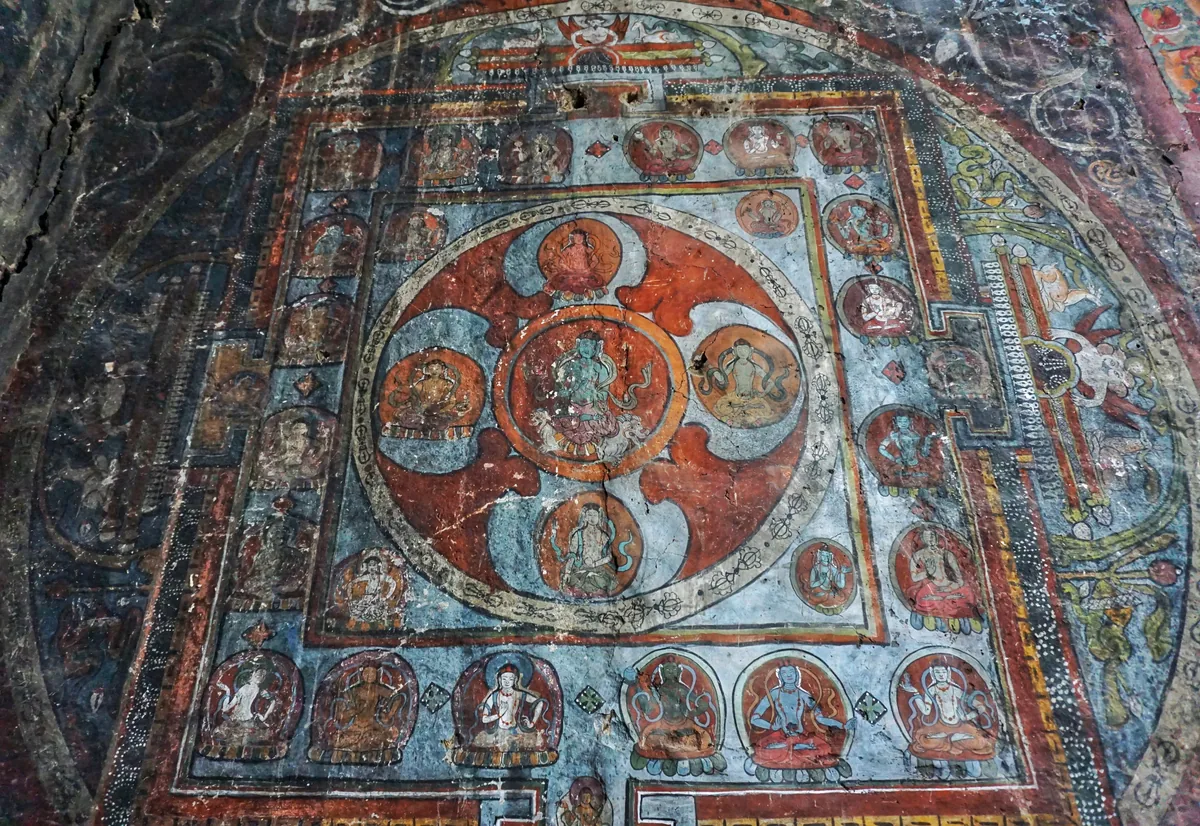
EARLY KASHMIRI-STYLE MICRO-FRESCOES: The walls surrounding the sculptures are adorned with thousands of miniature Buddhist deities, celestial dancers (apsaras), and historical donor figures painted with extraordinary brushwork. In recent years, international conservation teams supported by the World Monuments Fund and the Austrian Academy of Sciences have stabilized these delicate clay walls and timber beams, ensuring that Mangyu's artistic treasures survive for future generations.
Motorcycle Route Logistics: The 75 km Journey from Leh to Mangyu
Answer-First Summary: Detailed highway telemetry along NH1, crossing the Indus at Saspol, and navigating the 8 km canyon ascent.
The motorcycle ride from Leh to Mangyu is an exceptional 75-kilometer journey that blends high-speed highway cruising with intimate canyon exploration.
NH1 HIGHWAY TELEMETRY (KM 0 TO KM 62): Leaving Ride & Fire Rentals in Leh, ride west along National Highway 1 past Spituk, Nimmu, and the dramatic mud fortress of Basgo (km 40). Continue cruising along the broad, desert tarmac past the Likir turnoff until you reach the scenic riverside settlement of Saspol at km 62.
CROSSING THE INDUS AT SASPOL (KM 62 TO KM 67): At Saspol, turn left off NH1 and descend across the steel girder bridge spanning the rushing Indus River. On the southern bank, the road passes through the peaceful farming hamlets of Alchi and Gyu before reaching the marked turnoff for Mangyu at km 67.
THE MANGYU CANYON SPUR (KM 67 TO KM 75): Turning south into the side valley, the road transforms into a narrow, winding single-lane paved track following the course of the turbulent Mangyu stream. The road winds between towering cliffs of folded red shale and grey granite, climbing 450 vertical feet through 8 kilometers of gentle switchbacks before bursting into the wide, tranquil green bowl of Mangyu village (10,500 ft).
PILOT CAUTION - ROCK SHALE & WATER DRIFTS: During early morning hours or after summer rainstorms, loose shale fragments frequently wash down from the steep canyon walls across the road. Ride with relaxed wrists, maintain 35 to 45 km/h, and keep your vision focused well through the turns.
Senior Fleet Mechanic Advice: Suspension Damping on Mixed Canyon Tarmac
Answer-First Summary: Stanzin Dorje explains low-speed suspension action, avoiding rim strikes, and managing chassis roll.
At Ride & Fire Rentals, our lead technicians tune motorcycles specifically for the secondary roads of the Sham Valley. The 8 km canyon spur to Mangyu presents a classic combination of smooth paved patches, gravel transitions, and broken rock aprons.
SUSPENSION ACTION OVER IRREGULAR BITUMEN: Modern adventure motorcycles (like the Royal Enfield Himalayan 450 with 200 mm of front Showa USD fork travel) are engineered to soak up terrain imperfections. However, if your rear monoshock preload is set too soft, the motorcycle will wallow through fast compressions, scraping the bottom of your center-stand or engine bash plate on protruding rock transitions. Increase rear shock preload by 1 notch when carrying side panniers to maintain optimal chassis attitude.
TIRE PRESSURES FOR MIXED TARMAC & SHALE: Maintain 22 PSI in your front tire and 32 PSI in your rear tire. Never drop your front tire pressure below 20 PSI on this route; sharp, fallen shale stones along the canyon walls can pinch-flat an under-inflated tube or dent a cast alloy rim under sudden impact.
THROTTLE DISCIPLINE IN VILLAGE STONE LANES: Upon entering Mangyu village, the road narrows into centuries-old stone-walled lanes used by local farmers and livestock. Keep your motorcycle in 1st gear, maintain light throttle, and be prepared to yield to donkeys, sheep, and elderly village residents walking along the path.
Senior Fleet Mechanic's Water Crossing & Stream Splash Protocols
Answer-First Summary: Mastering shallow stream runoffs, airbox sealing, and brake pad drying after canyon water splashes.
During June and July, rapid snowmelt from the 16,000-foot ridges flanking the Mangyu canyon frequently overflows shallow concrete culverts, creating several minor water crossings across the roadway.
APPROACHING CANYON STREAM RUNOFFS: Always reduce your speed to 10-15 km/h before rolling into shallow water crossings. Hitting moving water at 40 km/h creates explosive water splash that drenches your riding boots and sprays directly into your radiator core and engine crankcase.
PRESERVING AIR FILTER INTEGRITY: On machines with low-slung air intakes, splashing forcefully through standing water can allow water droplets to be drawn through the airbox snorkel onto the paper air filter element. A damp air filter element chokes off airflow, causing the engine to sputter and lose power. Maintain a smooth, constant throttle in 1st gear to keep positive exhaust pressure and glide cleanly through the water.
BRAKE ROTOR DRYING TECHNIQUE: After rolling out of a stream crossing, your brake pads and discs will be coated with cold water and fine sand. Immediately apply gentle, dragging pressure to both front and rear brakes for 50 meters on dry tarmac. The resulting friction evaporates moisture and cleans grit off the rotor faces, restoring 100% braking power before you enter the next downhill corner.
CHAIN LUBRICATION AFTER WATER EXPOSURE: Water crossings wash away conventional chain lube, leaving chain links vulnerable to rust in the dusty alpine air. Inspect your drive chain upon returning from Mangyu; wipe the side plates with a rag and apply a fresh coat of high-tack dry wax lubricant.
Cultural Preservation & Village Homestays: Living with the People of Mangyu
Answer-First Summary: Experiencing organic village agriculture, family homestays, and respectful monastic etiquette.
Visiting Mangyu offers travelers a rare opportunity to connect with authentic Ladakhi village culture far from commercial tourist hubs.
THE TRADITIONAL MONASTERY CARETAKER: Mangyu Monastery does not maintain a large resident population of monks; instead, it is cared for by a resident monk and a hereditary local village caretaker (kon-nyer). The caretaker holds the heavy iron keys to the ancient Vairochana and Maitreya chapels. If the temple doors are locked when you arrive, inquire politely at the village school or ask local residents; the caretaker will gladly escort you into the chapels and unlock the ancient timber portals.
VILLAGE HOMESTAY HOSPITALITY: Several multi-generational farming families in Mangyu offer cozy homestay accommodations. Guests stay in traditional mud-brick rooms adorned with thick Ladakhi wool carpets, enjoy homemade meals prepared with fresh garden vegetables, organic barley (tsampa), and fresh curd, and experience the timeless agrarian rhythm of harvest in the Western Himalayas.
DONATIONS & PRESERVATION: Mangyu charges a nominal ₹50 to ₹100 preservation fee to view the ancient chapels. Because this remote monument receives minimal central government funding compared to Alchi, leaving a generous donation in the temple restoration box directly aids the ongoing conservation of these priceless 11th-century clay masterpieces.
Senior Fleet Mechanic's Pre-Ride Inspection Checklist for Rural Side Gorges
Answer-First Summary: Essential 10-minute check in Leh before heading into remote Sham Valley canyon cul-de-sacs.
Before leaving the safety of the main Srinagar-Leh highway corridor to explore isolated side valleys like Mangyu, perform our senior mechanic shakedown.
1. CLUTCH CABLE FREE-PLAY: Check that your clutch lever has 2 to 3 mm of free-play at the pivot. Riding through tight, winding canyon roads requires frequent clutch feathering; a tight cable without slack will slip under hard acceleration, glazing clutch friction plates.
2. TIRE TREAD & VALVE CAPS: Inspect your tire treads for embedded rock shards or metal wires picked up from highway shoulders. Ensure your metal valve caps are tightly screwed on with internal rubber O-rings intact to prevent fine dust from jamming tire valve cores.
3. FASTENER TIGHTNESS ON ACCESSORIES: The harmonic vibrations of single-cylinder thumper engines loosen un-torqued bolts. Check the tightness of your mirror stalks, luggage rack bolts, and license plate brackets using 10mm and 12mm spanners.
4. BRAKE FLUID CLARITY: Verify that your front and rear brake fluid levels are between the minimum and maximum sight glass lines. Fresh, clear brake fluid ensures crisp braking response when descending steep canyon switchbacks.
5. HEADLIGHT & AUXILIARY LIGHT AIM: Canyon walls cast deep, dark shadows even during bright afternoon hours. Verify that your LED headlight and auxiliary fog lights are working properly to illuminate dark overhang corners along the narrow river road.
Senior Fleet Mechanic's Low-Speed Balance & Center-Stand Safety in Rural Farmsteads
Answer-First Summary: Navigating tight stone masonry village alleys, unpaved threshing floor aprons, and secure kickstand deployment.
At Ride & Fire Rentals, our senior workshop technicians advise riders that the greatest hazard when visiting traditional rural settlements like Mangyu is not high speed, but low-speed balance on centuries-old village pathways.
TIGHT MASONRY ALLEY TECHNIQUE: The approach to the monastery gates winds through narrow domestic corridors flanked by dry-stone walls and low-hanging willow branches. When maneuvering an adventure motorcycle with a wide 34-inch handlebar span through these tight spaces, keep your feet firmly on the footpegs and maintain your speed using clutch slip in 1st gear. Ducking your head or paddling with your feet upsets the motorcycle's balance and increases the likelihood of clipping a side pannier against a stone boundary wall.
TURNING AROUND ON INCLINED THRESHING FLOORS: The public parking area in Mangyu is located adjacent to village agricultural threshing floors on a gentle slope. Turning a heavy 200 kg adventure motorcycle around on loose, straw-dusted silt requires deliberate technique. Never attempt a tight U-turn with the front brake pulled; instead, perform a multi-point turn by paddling backward with both boots while keeping the handlebars straight, or walk the machine around while standing on the uphill side.
PARKING INCLINE SAFETY & SIDE STAND PUCK PROTECTION: Never leave your motorcycle parked facing downhill on loose earth or dry agricultural terrace margins. Always face the motorcycle uphill, leave the transmission firmly engaged in 1st gear, and deploy the side stand onto a flat, wide river stone or a kickstand enlarger puck to prevent the stand from sinking into soft topsoil as the engine warms.
POST-RIDE CHASSIS CLEANING UPON RETURNING TO LEH: After riding through the agricultural irrigation overflows and organic silt of the Mangyu side valley, give your motorcycle a quick rinse with clean water in Leh. Pay particular attention to your rear brake caliper and drive chain, washing away organic silt before it dries into an abrasive crust around your brake slider pins.
Permit Regulations, Document Checkpoints & Combining Mangyu with Alchi
Answer-First Summary: Zero-permit accessibility, highway police checkpoints, and planning the ultimate 11th-century art loop.
Visiting Mangyu is straightforward and unencumbered by bureaucratic restrictions for all travelers.
NO INNER LINE PERMIT REQUIRED: Mangyu Monastery, Saspol village, and the entire Sham Valley sector south of the Indus River are open civilian areas. Neither Indian domestic travelers nor foreign international tourists require an Inner Line Permit (ILP) or Protected Area Permit (PAP) to visit.
THE 11TH-CENTURY TEMPLE TWIN LOOP: The ultimate cultural motorcycle itinerary from Leh combines Alchi and Mangyu in a single day: depart Leh at 08:30 AM, ride 66 km to explore Alchi Monastery during the quiet morning hours, enjoy a traditional Ladakhi lunch at an orchard cafe in Alchi, and then ride 15 km southwest across the rural southern terrace to immerse yourself in the unpainted clay splendor and absolute silence of Mangyu before returning to Leh by sunset.
Route Milestones, Elevation & Road Conditions
| Milestone | Elevation (ft / m) | Distance from Leh | Road Condition & Highway Telemetry |
|---|---|---|---|
| Leh Main Market | 11,562 ft / 3,524 m | 0 km | Ride & Fire Rentals, full workshops, IOCL fuel bunks, ATMs. |
| Spituk Military Outskirts | 10,830 ft / 3,301 m | 8 km | Ancient Gompa, airport runway perimeter, smooth multi-lane NH1. |
| Gurudwara Pathar Sahib | 11,500 ft / 3,505 m | 25 km | Historic Sikh shrine, 24/7 hot langar, water refill, parking bay. |
| Magnetic Hill Straight | 11,000 ft / 3,353 m | 30 km | Gravity illusion marking box, 4-lane open military asphalt. |
| Sangam Confluence Viewpoint | 10,400 ft / 3,170 m | 33 km | Indus & Zanskar river junction, viewing deck, riverside cafes. |
| Basgo Fortress Ruins | 10,800 ft / 3,292 m | 40 km | 15th-century mud-brick royal citadel, Maitreya copper temple. |
| Likir Monastery Junction | 11,200 ft / 3,414 m | 52 km | Detour for 75-ft gilded Maitreya Buddha; stay on NH1. |
| Saspol Village & Indus Bridge | 10,100 ft / 3,078 m | 62 km | Turn left off NH1, cross Indus River concrete bridge to south bank. |
| Alchi / Mangyu Crossroads | 10,200 ft / 3,109 m | 67 km | Left fork leads to Alchi; right fork continues along river toward Mangyu. |
| Mangyu Canyon Stream Turnoff | 10,050 ft / 3,063 m | 68 km | Branch south onto narrow paved canyon spur; clear mountain brook. |
| Mangyu Lower Canyon Crossing | 10,250 ft / 3,124 m | 71 km | Gentle paved switchbacks, red shale rock formations, willow shade. |
| Mangyu Village Apricot Groves | 10,400 ft / 3,170 m | 74 km | Traditional stone farmhouses, terraced barley fields, homestays. |
| Mangyu 11th-Century Monastery | 10,500 ft / 3,200 m | 75 km | Vairochana Temple, colossal clay Avalokiteshvara, 1,000-year murals. |
Ready for Your Ladakh Motorcycle Adventure?
Navigating the complex checkpoints and steep elevations of UT Ladakh requires both legal compliance and mechanical reliability. At Ride & Fire Rentals, we offer locally registered motorcycles with the mandatory LA-02 yellow commercial plates, ensuring you clear every military and union checkpoint seamlessly. Our fleet is 100% fuel-injected and thoroughly checked before every handover at our Changspa Road workshop.
For external travel planning references, you can check the official Ladakh Tourism Portal or apply for permits via the LAHDC Leh Permit Portal.
Season Launch Offer
Book your motorcycle direct from our Changspa Road facility. Get a standard 25% direct booking discount, plus enter coupon code LADAKH5 at checkout for an extra 5% off (saving nearly 30% total) on your entire rental! This promotion is active until June 30.
Frequently Asked Questions
What is Mangyu Monastery, and why is it historically significant? +
Mangyu Monastery is an ancient 11th-century Buddhist temple complex founded by the great Tibetan translator Lotsawa Rinchen Zangpo under the royal patronage of the King of Guge-Purang. Contemporary with Alchi and Tabo, Mangyu preserves priceless two-story unpainted clay sculptures of Vairochana, Avalokiteshvara, and Maitreya, along with untouched early Kashmiri-style micro-frescoes.
How do you reach Mangyu Monastery by motorcycle from Leh? +
Ride west from Leh along National Highway 1 (NH1) for 62 km to Saspol. Turn left off NH1, cross the Indus River bridge onto the southern bank road, and continue 5 km past the Alchi junction. Turn south into the Mangyu side valley and follow the paved 8 km canyon road directly into Mangyu village (total distance: 75 km).
Do I need an Inner Line Permit (ILP) to visit Mangyu Monastery? +
No. Mangyu Monastery and the entire Sham Valley sector south of the Indus River are open civilian areas. Neither Indian domestic travelers nor foreign international tourists require an Inner Line Permit (ILP) or Protected Area Permit (PAP) to visit.
What are the visiting hours and entry fees for Mangyu Monastery? +
Mangyu Monastery is generally open daily from 08:00 AM to 06:00 PM. A nominal preservation fee of ₹50 to ₹100 is charged to view the ancient chapels, which directly supports the conservation and maintenance of these fragile 1,000-year-old clay sculptures and murals.
How do road conditions on the Mangyu spur compare to the main highway? +
While NH1 between Leh and Saspol is broad, double-lane military asphalt, the 8 km spur climbing from the Indus River to Mangyu is a narrow, single-lane paved track. The tarmac is generally smooth, but riders must be alert for loose shale fragments washed onto corners from hillside scree slopes.
Where is the nearest petrol pump to Mangyu Monastery? +
There are no fuel pumps in Mangyu or Saspol. The nearest petrol stations are located in Spituk/Leh (67 to 75 km east) and in Khaltse (25 km west along NH1). A full tank from Leh easily covers the entire 150 km round-trip journey with substantial reserve.
Can I combine Mangyu Monastery with Alchi Monastery on the same day? +
Yes. Because Mangyu is located just 15 km southwest of Alchi on the southern bank of the Indus, they form the definitive '11th-Century Temple Twin Circuit'. You can visit Alchi in the morning, enjoy lunch at an apricot orchard cafe, and spend a serene afternoon exploring the uncrowded clay chapels of Mangyu before riding back to Leh.