
Quick Summary: What makes the Saspol Rock Caves in Sham Valley an extraordinary historical landmark?
Quick Answer: Perched on a sheer conglomerate sandstone cliff above Saspol village (62 km west of Leh at 10,300 ft), the Saspol Rock Caves are a complex of four rock-hewn meditation grottos crowned by the ruins of a medieval fort. Painted in the 13th to 14th centuries CE in the exquisite Kashmiri-Pala art style contemporary to Alchi and Mangyu, the interior caves preserve ultra-rare tantric Buddhist frescoes - including depictions of Hevajra, Samvara, Kalachakra, and Mahasiddhas - created with ground lapis lazuli and mineral pigments that remain vibrant after eight centuries.
Hidden Sanctuaries in the Sandstone: Introducing Saspol Rock Caves
Answer-First Summary: Discovering the cliffside grottos, medieval mud citadel, and the vibrant oasis of Saspol village.
Riding west from Leh along the sweeping, polished bitumen of National Highway 1 (NH1), most motorcycle travelers accelerate through the tranquil village of Saspol on their way to the famous wood-carved temples of Alchi or the moonscapes of Lamayuru. Yet, if you cut your throttle and gaze upward at the towering ochre sandstone cliffs crowning the northern edge of the village, you will spot a series of dark rectangular openings cut directly into the vertical cliff face beneath the crumbling bastions of a medieval mud-brick citadel.
These are the Saspol Rock Caves - one of the rarest, most fragile, and culturally significant Buddhist heritage sites in the entire trans-Himalayan realm. Carved into the soft conglomerate rock between the 13th and 14th centuries CE, these cliffside sanctuaries served as secluded meditation hermitages (ri-khrod) for tantric practitioners and yogis seeking retreat high above the Indus River valley.
Inside these unassuming cave hollows lies an artistic revelation: breathtakingly intricate Buddhist wall paintings executed in the Kashmiri-Pala miniature painting tradition. Sharing stylistic kinship with the masterworks of Alchi Monastery and the hidden temples of Mangyu Monastery, Saspol's frescoes represent the final flowering of Indian classical Buddhist painting before the Islamic transformation of the Kashmir Valley.
For motorcyclists riding machines from Ride & Fire Rentals, an excursion to Saspol combines a breathtaking 62-kilometer ride along the Indus gorge with an unforgettable cliffside scramble into eight hundred years of untouched Himalayan art.
The 13th-Century Kashmiri-Pala Frescoes: Tantric Murals in Mineral Pigments
Answer-First Summary: Analyzing the iconography, lapis lazuli blues, and yogic deities preserved across the four caves.
The rock-cut complex at Saspol consists of four distinct cave chambers, designated Caves 1 through 4 by international art historians and conservation teams.
CAVE 2: THE MASTERPIECE SANCTUARY: Cave 2 is the largest and best-preserved grotto in the complex. Its flat, plastered ceiling and rock walls are covered entirely in miniature tantric deities, cosmic mandalas, and depictions of the Eighty-Four Mahasiddhas (great tantric adepts). The central altar wall features an exquisite image of Prajnaparamita (the Perfection of Wisdom) flanked by Avalokiteshvara and Manjushri. The figures display the classic Kashmiri aesthetic: narrow waists, elongated lotus-petal eyes, delicate double chin contours, and diaphanous dhoti robes adorned with micro-patterns of geometric medallions.
THE TANTRIC WRATHFUL DEITIES: What sets Saspol apart from mainstream monastic gompas is its emphasis on esoteric Anuttarayoga Tantra iconography. Vibrant murals depict multiple-armed, multi-headed yidam deities locked in yab-yum (sacred union) - including Hevajra, Chakrasamvara, and Kalachakra - surrounded by aureoles of leaping orange and crimson flames that symbolize the incineration of dualistic illusions.
MINERAL PIGMENTS THAT DEFIED EIGHT CENTURIES: The astonishing luminosity of Saspol's murals is due to the natural mineral pigments used by the Kashmiri master artists. Lapis lazuli imported from the mines of Badakhshan yielded the profound, non-fading ultramarine blues; malachite and azurite provided vibrant greens; cinnabar and realgar produced fiery reds and warm yellows; while organic lamp soot created deep velvety blacks. In the arid, low-humidity atmosphere of the cave interiors, these mineral pigments have retained their jewel-like brilliance for over 750 years.
THE MICRO-PATTERNS OF DHOTIS AND ROBES: Art historians particularly marvel at the microscopic detail lavished on the textile patterns worn by the deities. Under magnifying loupes, one can observe individual geometric roundels, flying geese motifs, and delicate beaded strings adorning the waistbands of the bodhisattvas. These patterns match the high-end silk textiles woven across Central Asia and the Gangetic plains during the 13th century, illustrating how cosmopolitan trade influenced religious iconography even in remote cliffside caves.
The World Monuments Fund & INTACH Restoration: Saving a Crumbling Masterpiece
Answer-First Summary: How international conservationists stabilized the fragile conglomerate sandstone from structural collapse.
Despite their incredible historical value, the Saspol Rock Caves hovered on the brink of total destruction for decades due to geological weathering.
THE PERIL OF CONGLOMERATE EROSION: The cliff into which the caves were excavated is composed of loose alluvial conglomerate - sand, rounded river pebbles, and clay compressed under geological pressure. Because this rock matrix is water-soluble, flash floods, seismic tremors, and water infiltration from melting snow on the upper fort ridge caused extensive fissures and structural collapse. Portions of Cave 1's outer wall collapsed down the cliff during the 20th century, exposing priceless frescoes to direct sunlight, windborne grit, and bird nesting.
INTERNATIONAL EMERGENCY INTERVENTION: Recognizing the imminent danger of losing this cultural treasure, the World Monuments Fund (WMF) placed Saspol on the World Monuments Watch list of endangered sites in 2006. Working alongside the Indian National Trust for Art and Cultural Heritage (INTACH) and the local village council, conservation engineers implemented structural stone bolting, subterranean drainage channels, and lime-mortar wall grouting to stabilize the rock face without altering the visual integrity of the caves.
COMMUNITY STEWARDSHIP: Today, the caves are lovingly guarded by the villagers of Saspol. A local village caretaker holds the keys to the protective metal safety grilles installed across Cave 2, ensuring that visitors can admire the paintings without touching the delicate plaster surfaces.
The Hilltop Citadel Ruins: Ancient Watchpost over the Indus Trade Route
Answer-First Summary: Exploring the mud-brick fortifications, bastion towers, and the sweeping Sham Valley panorama.
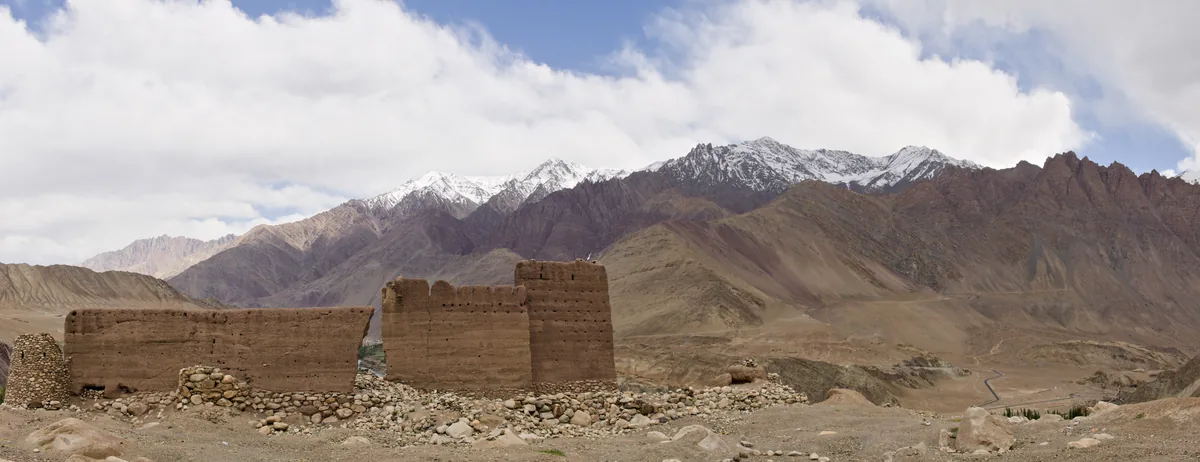
Directly above the rock caves, crowning the sharp crest of the conglomerate ridge, sit the crumbling ruins of the ancient Saspol Fort (Saspol Khar).
A STRATEGIC TACTICAL WATCHPOST: Dating back to the medieval era, this fortified outpost guarded the river crossing where ancient trade routes branched south toward Alchi and west toward Khaltse. Constructed from heavy sun-dried mud bricks and river cobblestones, the fort's watchtowers commanded an unobstructed view for fifteen kilometers up and down the Indus Valley, allowing defenders to signal with smoke and fires to the larger citadels of Basgo Fort to the east.
THE CLIFFTOP SCRAMBLE: Hikers who scramble beyond the caves to the highest parapets of the fort are rewarded with one of the most stunning panoramic views in Sham Valley: the roaring grey ribbon of the Indus River coiling through bright emerald swathes of apricot orchards and poplar stands, framed by the jagged snow peaks of the Ladakh range.
SAFETY WARNING ON THE RIDGELINE: The footing around the fort ruins consists of crumbly scree and loose rounded pebbles. Exercise extreme caution near cliff edges, wear sturdy riding boots with aggressive tread soles, and never step out onto unsupported mud-brick overhangs.
DEFENSIVE ARCHITECTURE AGAINST VALLEY RAIDS: The fort walls feature narrow inward-splayed arrow slits (loopholes) positioned to pour defensive fire downward onto attackers scrambling up the scree slopes. Archaeologists believe the fort was constructed during the reign of the early Namgyal kings or during the turbulent period of Tibetan and Central Asian border skirmishes, functioning as an early warning outpost that protected the agricultural wealth and granaries of the fertile Saspol river basin.
Motorcycle Route Logistics: The Smooth 62 km Cruise from Leh along NH1
Answer-First Summary: Navigating the Indus Highway, village bridge turnoffs, and motorcycle parking at the trail base.
The journey to Saspol is one of the most pleasurable and relaxing motorcycle rides anywhere in the Himalayas.
THE SCENIC NH1 ROUTE: Departing Leh, head west along the wide, double-lane tarmac of NH1. Pass the airport bypass and cruise past the iconic landmarks of Gurudwara Pathar Sahib, the optical illusion of Magnetic Hill, and the dramatic turquoise confluence at Sangam Valley. Continue past the mud-brick towers of Basgo and enter the lush, fertile bowl of Saspol village at km 62.
THE VILLAGE TURNOFF: As you enter Saspol, watch for the marked right turn leading off NH1 into the upper village lane. Ride slowly through the narrow village road lined with stone farm walls and apricot trees for approximately 800 meters until you reach the small village government school and the foot of the hill.
PARKING & THE CLIFF TRAIL: Park your motorcycle on the wide, level unpaved clearing near the base of the access trail. The walk up to the caves involves a short, well-constructed stone staircase of approximately 150 steps, followed by a switchback gravel trail that ascends 60 vertical meters to the cave entrances in roughly 10 to 15 minutes.
Senior Fleet Mechanic Advice: Throttle Roll-Off & Village Road Surface Hazards
Answer-First Summary: Stanzin Dorje explains low-gear speed modulation, cow manure traction loss, and front tire scrub on dusty tarmac.
Transitioning from high-speed highway cruising on NH1 to narrow village lanes requires an immediate change in your riding technique.
SMOOTH ENGINE BRAKING ON VILLAGE TURNOFFS: NH1 encourages brisk 70 to 80 km/h cruising. When peeling off the highway into Saspol village, avoid aggressive, last-second front braking. Downshift progressively through the gearbox (4th to 3rd to 2nd) using engine braking to settle the chassis before leaning into the village entrance ramp.
IRRIGATION WATER & MANURE SLICKNESS: In fertile villages like Saspol, traditional earth irrigation channels (kuhl) frequently overflow across the tarmac. Wet mud combined with dried cow and donkey manure creates an invisible, slick coating that drastically reduces tire friction coefficients. Approach all damp village tarmac with the bike upright, avoiding abrupt throttle twists or sharp lean angles.
DUST COATINGS ON BRAKE ROTORS: The dirt clearing at the trail base generates fine airborne clay dust. Before resuming high-speed riding on NH1, tap your front brake lever and rear brake pedal a few times at 20 km/h to sweep any dust films off the rotor surfaces, restoring crisp pad-to-disc friction bite.
Acclimatization Advantage: Lower Altitude Sanctuary at 10,300 Feet
Answer-First Summary: Why riding down to Saspol represents the ultimate medical 'climb-high, sleep-low' day trip.
One of the best-kept secrets of Ladakh travel medicine is that riding west down the Indus Valley actually lowers your elevation, as explained in our Leh Acclimatization Guide.
THE 1,200-FOOT ELEVATION DROP: Leh sits at an elevation of 11,562 feet (3,524 m). Saspol, nestled further down the Indus canyon, sits at 10,300 feet (3,140 m) - a net drop of more than 1,200 vertical feet. Atmospheric oxygen partial pressure is notably higher here, reducing cardiovascular strain and providing instant relief from mild altitude headaches.
THE 'CLIMB HIGH, SLEEP LOW' PARADOX: Visiting Saspol allows newly arrived riders to experience a gentle, scenic motorcycle ride without ascending into dangerous hypoxic altitudes like Khardung La or Chang La. After spending the morning exploring the caves at 10,300 feet, you return to Leh in the afternoon with refreshed energy and enhanced red blood cell oxygenation.
THE SHORT TRAIL AS AN ACCLIMATIZATION TEST: The 15-minute stone staircase hike to the caves serves as an excellent cardiovascular benchmark. If you climb slowly at a steady, rhythmic pace without heavy gasping or lightheadedness, your body is adapting successfully to high-altitude exertion.
Senior Fleet Mechanic's 5-Point Highway Shakedown Checklist
Answer-First Summary: Stanzin Dorje's quick pre-flight routine before rolling out on the western NH1 route.
Before embarking on the 62 km run from Leh to Saspol, take four minutes to run through our standard highway check:
1. DRIVE CHAIN LUBRICATION: Inspect the drive chain rollers; apply a fresh layer of dry-wax chain lube to prevent chain link binding during extended 75 km/h cruising on NH1.
2. TIRE PRESSURES ON COLD RUBBER: Set cold tire pressures to 22 PSI front and 32 PSI rear. High-speed tarmac riding generates tire heat; proper initial cold pressure prevents carcass squirm and irregular cupping wear.
3. ENGINE OIL WINDOW CHECK: Ensure the engine oil level is centered in the inspection sight glass with the bike standing vertical. The sustained throttle loads of highway cruising require optimal lubricant volume.
4. BRAKE PAD THICKNESS: Inspect the remaining friction material on both front and rear brake pads. There must be at least 2.5mm of pad material above the steel backing plates.
5. LUGGAGE STRAP SECURITY: Ensure all tailbags, bungee cords, and pannier latches are double-checked. A loose luggage strap that dangles into the rear wheel sprocket at 80 km/h will cause an instant, catastrophic rear-wheel lockup.
Crafting the Ultimate Sham Valley Heritage Day Circuit
Answer-First Summary: Combining Saspol Caves with Basgo Fort, Alchi, and Mangyu for an unforgettable day ride.
Saspol fits logically into an extraordinary full-day cultural circuit through Lower Ladakh's Sham Valley.
MORNING CITADELS: Depart Leh at 08:30 AM. Make your first stop at Basgo Fort Ruins to explore the 15th-century mud citadel and the colossal copper-gilt Maitreya statue.
MIDDAY AT SASPOL: Arrive in Saspol at 11:00 AM. Hike up to the rock caves, admire the 13th-century tantric frescoes, and enjoy a picnic lunch under the village apricot orchards.
AFTERNOON AT ALCHI & MANGYU: Cross the Indus bridge to visit the world-renowned 11th-century wood carvings at Alchi Monastery, followed by a scenic detour up the secluded canyon to Mangyu Monastery before a relaxed sunset cruise back to Leh.
Visiting Logistics, Caretaker Keys & Conservation Etiquette
Answer-First Summary: Contacting the village caretaker, nominal entry donations, photography rules, and preservation protocols.
Visiting Saspol Rock Caves requires awareness of local conservation procedures to ensure these fragile murals are protected for future generations.
LOCATING THE VILLAGE CARETAKER: Cave 2 is protected by a locked iron grille to prevent vandalism and bat entry. The key is held by the designated local village caretaker, who usually resides in the whitewashed house near the village school. If the gate is locked upon your arrival, ask any local villager for the 'Gompa Key' (Chot-khang Chabi), and the caretaker will happily walk up with you to unlock the door for a modest tip (₹100 to ₹200).
ZERO MANDATORY PERMITS: Saspol is situated on the open NH1 highway corridor. No Inner Line Permit (ILP) or Protected Area Permit (PAP) is required for either Indian domestic citizens or international tourists.
STRICT NO-TOUCH & NO-FLASH RULE: The 800-year-old plaster is exceptionally delicate. Never touch the painted walls under any circumstances; the natural oils and moisture on human fingers cause irreversible degradation of mineral pigments. Photography is permitted, but FLASH PHOTOGRAPHY IS STRICTLY PROHIBITED as intense light pulses degrade organic binder compounds.
FOOTWEAR INSIDE THE CAVE: Remove your riding boots before stepping onto the clean straw matting inside Cave 2, and step lightly to avoid stirring up abrasive rock dust.
Route Milestones, Elevation & Road Conditions
| Milestone / Location | Elevation (ft / m) | Distance from Leh | Key Facilities & Route Telemetry |
|---|---|---|---|
| Ride & Fire Rentals (Changspa) | 11,562 ft / 3,524 m | 0 km | Rental basecamp, full workshop, gear rentals, tour briefings. |
| Spituk NH1 Junction | 10,800 ft / 3,292 m | 8 km | Entry onto NH1 double-lane highway, petrol pump, airport view. |
| Magnetic Hill Viewpoint | 11,200 ft / 3,414 m | 28 km | Optical gravity phenomenon, paved turnout, tea stalls. |
| Sangam Viewpoint (Nimu) | 10,120 ft / 3,085 m | 32 km | Indus & Zanskar river confluence, raft launch, cafes. |
| Basgo Fort Turnoff | 10,800 ft / 3,292 m | 40 km | Ancient mud fortress ruins, 15th-century copper Maitreya. |
| Saspol Village Entrance | 10,300 ft / 3,139 m | 62 km | Turn right into village lane; apricot orchards, homestays. |
| Cave Trailhead Parking | 10,320 ft / 3,145 m | 63 km | Unpaved clearing near school, level motorcycle parking. |
| Saspol Rock Caves Entrance | 10,500 ft / 3,200 m | 63.3 km | 13th-century rock-cut chambers, tantric frescoes, WMF site. |
| Saspol Fort Clifftop Ruins | 10,650 ft / 3,246 m | 63.5 km | Medieval mud-brick battlements, 360-degree Indus views. |
Ready for Your Ladakh Motorcycle Adventure?
Navigating the complex checkpoints and steep elevations of UT Ladakh requires both legal compliance and mechanical reliability. At Ride & Fire Rentals, we offer locally registered motorcycles with the mandatory LA-02 yellow commercial plates, ensuring you clear every military and union checkpoint seamlessly. Our fleet is 100% fuel-injected and thoroughly checked before every handover at our Changspa Road workshop.
For external travel planning references, you can check the official Ladakh Tourism Portal or apply for permits via the LAHDC Leh Permit Portal.
Season Launch Offer
Book your motorcycle direct from our Changspa Road facility. Get a standard 25% direct booking discount, plus enter coupon code LADAKH5 at checkout for an extra 5% off (saving nearly 30% total) on your entire rental! This promotion is active until June 30.
Frequently Asked Questions
Where are the Saspol Rock Caves located and how do I get there from Leh? +
Saspol Rock Caves are located in Saspol village along the Srinagar-Leh Highway (NH1), approximately 62 km west of Leh (about a 1.5-hour motorcycle ride). From NH1 in Saspol, turn right into the upper village lane for 800 meters to reach the trailhead parking near the school, followed by an easy 15-minute stone staircase climb.
What is the historical significance of the Saspol frescoes? +
The caves contain rare 13th- to 14th-century Buddhist frescoes painted in the Kashmiri-Pala miniature style contemporary to Alchi and Mangyu. They depict esoteric tantric deities such as Hevajra, Samvara, and Kalachakra, executed using vibrant natural mineral pigments like lapis lazuli and malachite.
Is Cave 2 locked, and how do I get the key? +
Yes, Cave 2 is protected by an iron gate to safeguard the ancient murals. The key is kept by a local village caretaker who lives near the base of the hill. If locked, ask any villager for the caretaker, who will accompany you to open the sanctuary for a modest tip (₹100 to ₹200).
Do I need an Inner Line Permit (ILP) to visit Saspol? +
No. Saspol is located along the primary NH1 corridor within open civilian territory. Neither Indian domestic travelers nor international tourists require an Inner Line Permit (ILP) or Protected Area Permit (PAP) to visit.
Is flash photography allowed inside the Saspol caves? +
No. Flash photography is strictly forbidden because intense light pulses damage the 800-year-old natural mineral pigments and organic binders. Non-flash photography using ambient light or mobile phone cameras is generally permitted.
Is Saspol suitable for Day 1 or Day 2 acclimatization? +
Yes, it is one of the best acclimatization rides in Ladakh. Because Saspol (10,300 ft) is over 1,200 feet lower than Leh (11,562 ft), riding down to Saspol increases atmospheric oxygen intake, relieving mild altitude symptoms while providing gentle physical exercise on the short cave trail.
Where is the nearest petrol pump to Saspol? +
The nearest fuel stations are the Indian Oil (IOCL) petrol station at Khaltse (34 km west along NH1) and the IOCL petrol pump at Spituk / Leh (54 km east along NH1). Ensure you have adequate fuel before leaving Leh.