
Quick Summary: How do you visit Gurudwara Pathar Sahib by motorcycle from Leh?
Quick Answer: Gurudwara Pathar Sahib (11,500 ft / 3,505 m) is located 25 km west of Leh along the smooth, paved Srinagar-Leh National Highway 1 (NH1). The ride takes approximately 35 to 45 minutes on flat, two-lane military asphalt. It commemorates the visit of Guru Nanak Dev Ji in 1517 AD and houses the sacred boulder bearing his bodily imprint. Managed by the Indian Army (Ladakh Scouts), the gurudwara is open daily from 06:00 AM to 07:00 PM with zero entry fee. 24/7 hot langar (tea, dal, rice) is served to all travelers. No Inner Line Permit is required, making it the premier Day 1 acclimatization ride from Leh.
The Sacred Legend of 1517 AD: Guru Nanak Dev Ji, the Unmovable Demon Boulder & Indian Army Heritage
Answer-First Summary: Commemorating the second Udasi of Guru Nanak, where a thrown boulder softened into wax upon touching the meditating saint.
Riding 25 km west of Leh along the pristine two-lane military asphalt of National Highway 1 (NH1), the jagged ochre canyon walls of the Indus Valley frame a vibrant sight: fluttering saffron Nishan Sahib flags marking Gurudwara Pathar Sahib. Situated at an elevation of 11,500 ft (3,505 m), this revered Sikh shrine holds a unique place in trans-Himalayan spiritual lore, drawing motorcycle expeditioners, army convoys, and pilgrims of all faiths.
Historical records trace the shrine to the second missionary journey (Udasi) of Guru Nanak Dev Ji between 1515 and 1518 AD. Returning from Tibet, Nepal, and Sikkim across the high trans-Himalayan passes, Guru Nanak arrived in the Ladakh valley in late 1517 AD, camping on the riverbanks near Nimmu to preach righteousness, humility, and meditation to local communities.
According to persistent local legend, a ruthless demon who inhabited the surrounding rocky heights terrorized the valley inhabitants. Enraged by the devotion of the villagers toward the Guru, the demon attempted to crush the meditating saint by pushing a massive granite boulder down from the crest of the hill. As the colossal rock plummeted toward Guru Nanak, it miraculously softened like warm paraffin wax upon touching his back, coming to an immediate halt without causing harm.
Baffled by the failure of his assault, the enraged demon raced down the scree slope and kicked the boulder with his right foot. To his astonishment, his own foot became trapped deep inside the softened stone. Acknowledging the supreme spiritual majesty of Guru Nanak, the demon fell at his feet, renounced his violent ways, and pledged to serve humanity. The sacred boulder, clearly displaying the indented silhouette of Guru Nanak's shoulders and head on the rear and the demon's deep footprint on the front, remains enshrined within the sanctum sanctorum.
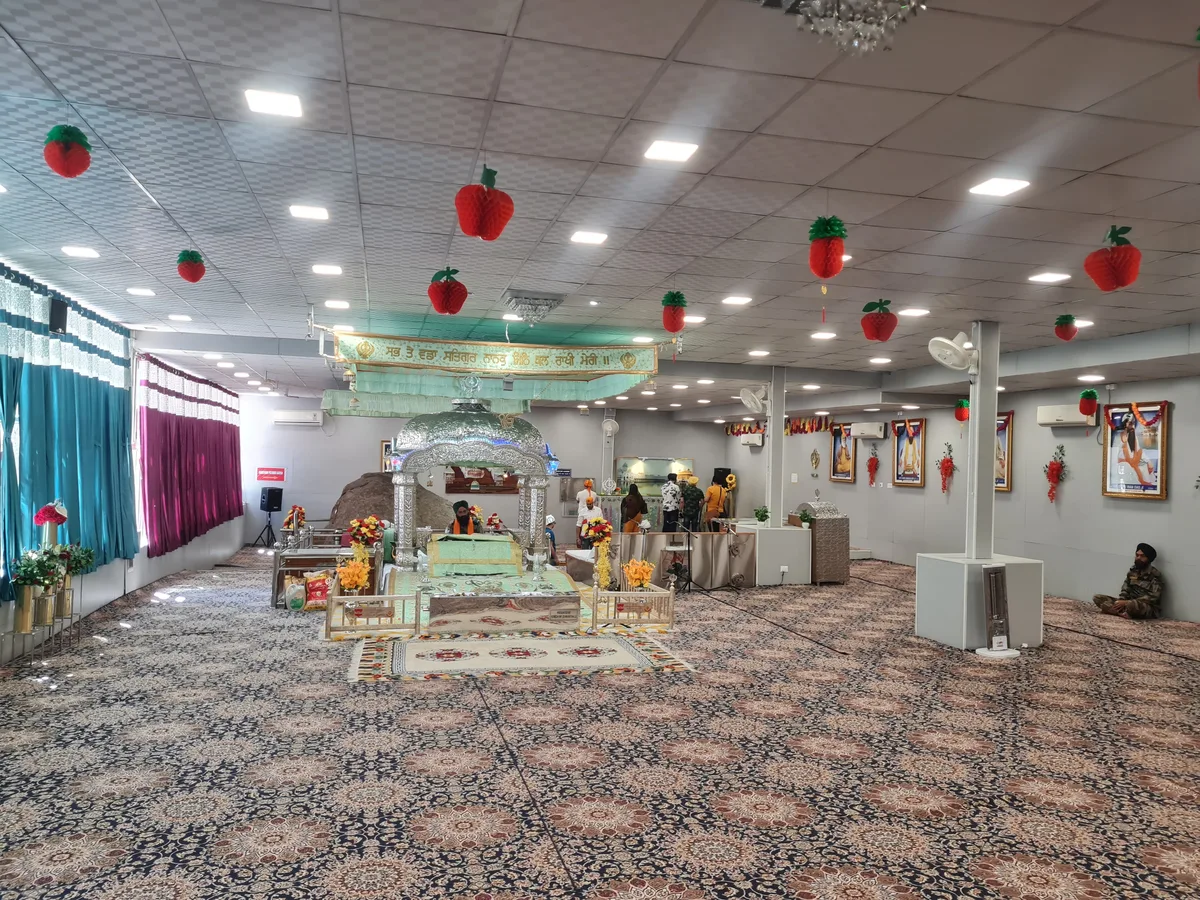
For centuries, local Tibetan Buddhist lamas revered the rock under the name 'Nanak Lama'. The site remained relatively obscure until the late 1970s, when the Border Roads Organisation (BRO) was blasting the mountain slopes to construct the modern Srinagar-Leh highway. When bulldozers proved utterly incapable of dislodging the sacred boulder - even snapping heavy steel cables and breaking tractor teeth - the army operators experienced vivid visions instructing them to leave the sacred stone untouched. The Indian Army subsequently established Gurudwara Pathar Sahib, and to this day, officers and jawans of the Ladakh Scouts maintain the daily prayers and temple administration.
The 24/7 Army Langar: Warm Sustenance, Operational Discipline & Traveler Hospitality
Answer-First Summary: Why stopping for piping hot chai and freshly prepared dal-roti at Pathar Sahib is a sacred tradition for Himalayan riders.
Stepping inside Gurudwara Pathar Sahib after a brisk morning motorcycle ride into the dry mountain wind, travelers are welcomed by an atmosphere of warmth, humility, and military precision. Before entering the sanctum, all visitors must remove their boots and riding gloves at the sheltered footwear racks, thoroughly wash their hands and feet at the clean water stations, and cover their heads with a rumal (head scarf provided free of charge).
The central spiritual experience for traveling riders is the famous Langar (community kitchen). Operated around the clock by dedicated Indian Army personnel, the langar hall serves steaming hot vegetarian meals - typically consisting of spiced yellow lentils (dal), aromatic basmati rice, freshly rolled wheat rotis, and sweet semolina halwa or kheer - accompanied by continuous cups of sweet, cardamom-infused masala chai.
The service operates on strict principles of universal brotherhood: generals, motorcycle tourers, local Ladakhi shepherds, and international backpackers sit side by side on floor carpets, sharing identical meals with zero social hierarchy. There is strictly no charge for the food or tea; voluntary donations (dasvandh) can be placed in the transparent collection boxes inside the prayer hall to support the supply chain.
For adventure riders completing high-mileage highway legs between Srinagar, Kargil, and Leh, this warm pitstop is a crucial physiological checkpoint. The hot liquids and simple carbohydrates replenish core body heat and stabilize blood glucose levels, combating early symptoms of dehydration and mild hypothermia caused by mountain wind chill.
Route Telemetry & Day 1 Acclimatization Logistics: Why Pathar Sahib is the Ideal Shakedown Ride
Answer-First Summary: Covering 25 km of smooth NH1 tarmac at 11,500 ft without crossing taxing mountain passes.
At Ride & Fire Rentals, our senior fleet mechanics always instruct riders arriving in Leh by air to dedicate their first 48 hours strictly to acclimatization. Heading straight into the 17,982-foot switchbacks of Khardung La or the 17,688-foot crest of Chang La on Day 1 is an invitation to severe Acute Mountain Sickness (AMS). Instead, the 25 km cruise from Leh to Gurudwara Pathar Sahib serves as the gold standard mechanical and physiological shakedown run.
Leaving our workshop in Leh (elevation 11,562 ft), you merge onto National Highway 1 heading west. The road surface is immaculate two-lane military asphalt constructed and maintained by BRO Project HIMANK. The elevation remains virtually flat, gently descending from 11,562 ft down to 11,500 ft at Pathar Sahib.
Because this route does not climb over high passes, your pulmonary system is not stressed by severe hypoxemia. The 40-minute ride allows you to test your throttle response, braking feel, and riding ergonomics while your body begins producing extra red blood cells to adapt to the thin Himalayan air.
THE WESTERN DAY-TRIP TRILOGY: Gurudwara Pathar Sahib is naturally paired with two world-famous attractions located just minutes further down the same tarmac. Only 5 km west of the gurudwara lies the mysterious Magnetic Hill gravity anomaly, where vehicles appear to defy gravity and roll uphill on neutral gear. Continuing an additional 4 km west brings you to the dramatic Sangam Indus-Zanskar River Confluence at Nimmu. This entire 70 km round-trip circuit can be completed comfortably between 10:00 AM and 03:00 PM.
Mechanical Maintenance & Riding Dynamics: Throttle Calibration, Tire Pressures & Road Hazards on NH1
Answer-First Summary: Senior Mechanic Stanzin Dorje explains carburetor lean-surge, brake disc temperatures, and crosswinds.
While the road to Pathar Sahib is among the smoothest highways in UT Ladakh, riding a motorcycle at 11,500 feet introduces specific mechanical behaviors that every rider must monitor.
EFI VS CARBURETOR POWER DELIVERY: On modern fuel-injected machines like the Royal Enfield Himalayan 450 or Scram 411, the Manifold Absolute Pressure (MAP) sensor automatically recalculates barometric pressure drops, keeping the air-fuel ratio crisp. However, riders on older carbureted machines (such as the classic Bullet 350 or 500) will experience a soft low-end hesitation and minor power loss of approximately 15% due to atmospheric oxygen scarcity. Do not aggressively rip the throttle wide open from low RPM; roll on smoothly to prevent spark plug carbon fouling.
CROSSWINDS IN THE INDUS CANYON: As you ride past the Leh airport runway and descend toward the Phyang monastery plains, the wide Indus river basin acts as a natural wind funnel. Gusting canyon crosswinds of 40 to 60 km/h frequently batter riders from the south. Keep your elbows relaxed, maintain a light grip on the handlebars, and tuck your knees firmly against the fuel tank to stabilize your chassis line.
PARKING INCLINES & KICKSTAND SAFETY: The parking bay outside Gurudwara Pathar Sahib is located on a paved roadside terrace. Always park your motorcycle in 1st gear with the side stand pointed into the gentle uphill gradient. Never park in neutral on a slope; the vibration of heavy passing military trucks can cause the side stand to fold, resulting in an expensive tip-over that snaps your clutch lever or breaks your rear-view mirror.
Complete Fuel Logistics & Dead Zone Calculations: Leh to Khaltse Highway Corridor
Answer-First Summary: Mapping fuel availability from Leh city center through Nimmu, Basgo, and the 95 km run to Khaltse.
Understanding fuel staging along the Srinagar-Leh highway is essential for preventing unnecessary roadside stranding. The western corridor out of Leh is well-serviced compared to the barren eastern Changthang plateau, but disciplined fuel monitoring remains mandatory.
PETROL PUMPS ON NH1: The last full-service fuel stations leaving Leh heading west are located in the Choglamsar and Spituk outskirts (Indian Oil and HPCL). Once you pass Spituk (km 8 from Leh), there are NO commercial petrol stations until you reach Khaltse - located 95 km from Leh. There are no retail petrol pumps at Gurudwara Pathar Sahib, Magnetic Hill, or Nimmu village.
TANK RANGE CALCULATIONS: If you are doing the standard half-day shakedown loop (Leh → Pathar Sahib → Magnetic Hill → Sangam → Leh), the total round-trip distance is roughly 70 km. A stock Himalayan 450 (17L tank) or Scram 411 (15L tank) consumes less than 2.5 liters for this entire loop. However, if you plan to continue west toward Lamayuru Monastery and Moonland (115 km one-way) or Kargil (216 km one-way), you must depart Leh with a 100% full fuel tank.
JERRY CAN REQUIREMENTS: For day trips along NH1 as far as Lamayuru or Khaltse, external jerry cans are completely unnecessary. The twin fuel pumps at Khaltse operate reliably during daylight hours. Only riders continuing past Kargil into the remote Suru Valley and Zanskar need to strap extra fuel containers to their pannier racks.
Photography Tips, Drone Regulations & Military Security Guidelines at Pathar Sahib
Answer-First Summary: Documenting the shrine respectfully, understanding camera bans in the sanctum, and strict drone prohibitions.
Gurudwara Pathar Sahib provides magnificent photographic opportunities, blending pristine Sikh architecture with soaring Himalayan arid crags. However, because the shrine is managed directly by the Indian Army within a strategic border corridor, strict security protocols apply.
INTERIOR SANCTUM PHOTOGRAPHY BAN: Photography and video recording are strictly prohibited inside the main prayer hall and sanctum sanctorum housing the sacred boulder. Respect this directive completely. You are free to take photographs in the exterior courtyard, the langar hall, and from the highway viewpoint overlooking the river valley.
DRONE BAN: Operating civilian camera drones within 10 km of Gurudwara Pathar Sahib is strictly prohibited by civil aviation and military security directives. The area sits directly within the approach funnel for the strategic Kushok Bakula Rimpochee Airport in Leh and adjacent military bases. Launching a drone will result in immediate confiscation of equipment, police detention, and legal charges under the Indian Aircraft Act.
BEST LIGHTING HOURS: The front facade of the Gurudwara faces south toward the Indus River. The best natural lighting occurs between 09:00 AM and 01:00 PM, when high-altitude sunlight illuminates the golden domed spire and saffron flags against the deep blue Himalayan sky.
Practical Visiting Protocol, Dress Codes & Local Etiquette for Motorcyclists
Answer-First Summary: Essential dos and don'ts when entering the shrine in riding gear.
Visiting Gurudwara Pathar Sahib is effortless if you keep a few straightforward etiquette rules in mind:
HEAD COVERINGS: Covering your head is mandatory for everyone regardless of gender or faith. Bandanas, scarves, and traditional rumals are provided at the entrance bins. Motorcycle helmets and riding caps with visors must be removed.
RIDING BOOTS: Heavy adventure riding boots must be deposited at the guarded shoe stall outside. Woolen socks are recommended during chilly morning visits, as marble floors can be freezing between October and April.
MODEST ATTIRE: Wear full-length riding pants or jeans. Tank tops, sleeveless shirts, and shorts are not permitted inside the gurudwara complex.
TOBACCO & ALCOHOL STRICTLY PROHIBITED: Smoking, carrying cigarettes, e-cigarettes, tobacco pouches, or alcohol anywhere on the gurudwara premises is strictly forbidden. Discard any smoking materials in designated bins well outside the boundary gate.
Itinerary Integration: Combining Pathar Sahib with Magnetic Hill, Sangam & Basgo Citadel
Answer-First Summary: Crafting the ultimate 1-day Western Ladakh motorcycle loop for Day 1 or Day 2 of your expedition.
To maximize your riding day without over-taxing your body, we recommend our classic 'Sham Valley Western Loop' itinerary:
09:30 AM - Depart Ride & Fire Rentals in Leh after a hearty breakfast and morning tire pressure inspection.
10:15 AM - Arrive at Gurudwara Pathar Sahib (km 25). Pay respects at the sacred boulder, listen to the morning kirtan, and enjoy hot masala chai and sweet halwa prasad.
11:15 AM - Ride 5 km further west to Magnetic Hill. Switch your motorcycle into neutral gear inside the painted yellow box and watch the optical illusion unfold.
11:45 AM - Continue 4 km down to the Sangam Confluence viewpoint. Ride the winding paved descent down to the riverbed to watch the jade Indus converge with the muddy glacial Zanskar.
01:00 PM - Enjoy lunch at a traditional riverside restaurant in Nimmu village (apricot juice and hot momos).
02:15 PM - Ride an additional 12 km west to explore the dramatic 15th-century mud-brick ruins of Basgo Fortress and the Chamba Lhakhang temple.
04:30 PM - Smooth, relaxed highway cruise back to Leh along NH1, arriving before the chilly evening mountain winds pick up at dusk.
Route Milestones, Elevation & Road Conditions
| Milestone | Elevation (ft / m) | Distance from Leh | Key Facilities & Highway Telemetry |
|---|---|---|---|
| Leh Main Market / Changspa | 11,562 ft / 3,524 m | 0 km | Ride & Fire Rentals, IOCL fuel pump, hospitals, hotels. |
| Spituk Checkpoint & Monastery | 10,830 ft / 3,301 m | 8 km | Ancient Gompa, airport runway view, last fuel station. |
| Phyang Valley Junction | 11,200 ft / 3,414 m | 16 km | Smooth dual-lane highway, wide plains, crosswinds. |
| Gurudwara Pathar Sahib | 11,500 ft / 3,505 m | 25 km | Historic Sikh shrine, 24/7 hot langar, parking bay, restrooms. |
| Magnetic Hill Box | 11,000 ft / 3,353 m | 30 km | Gravity optical illusion road, cafes, adventure quad biking. |
| Sangam Confluence Viewpoint | 10,400 ft / 3,170 m | 33 km | Indus-Zanskar confluence, rafting camps, viewpoints. |
| Nimmu Village Market | 10,350 ft / 3,155 m | 35 km | Major transit village, tea stalls, local Ladakhi restaurants. |
| Basgo Fort & Gompa Turnoff | 10,800 ft / 3,292 m | 40 km | Mud-brick fortress ruins, 15th-century Maitreya Buddha. |
| Saspol Village & Rock Caves | 10,100 ft / 3,078 m | 62 km | Painted Buddhist caves, lush apricot groves, homestays. |
| Khaltse Market & Fuel | 9,800 ft / 2,987 m | 95 km | Major town, twin IOCL petrol stations, police checkpost. |
| Lamayuru Monastery & Moonland | 11,520 ft / 3,510 m | 115 km | Ancient Yuru Gompa, lunar mud formations, Fotu La base. |
Ready for Your Ladakh Motorcycle Adventure?
Navigating the complex checkpoints and steep elevations of UT Ladakh requires both legal compliance and mechanical reliability. At Ride & Fire Rentals, we offer locally registered motorcycles with the mandatory LA-02 yellow commercial plates, ensuring you clear every military and union checkpoint seamlessly. Our fleet is 100% fuel-injected and thoroughly checked before every handover at our Changspa Road workshop.
For external travel planning references, you can check the official Ladakh Tourism Portal or apply for permits via the LAHDC Leh Permit Portal.
Season Launch Offer
Book your motorcycle direct from our Changspa Road facility. Get a standard 25% direct booking discount, plus enter coupon code LADAKH5 at checkout for an extra 5% off (saving nearly 30% total) on your entire rental! This promotion is active until June 30.
Senior Fleet Mechanic's Pre-Ride Inspection Checklist: Controls, Chains & Fasteners on NH1
Answer-First Summary: Essential 10-minute mechanical shakedown in Leh before riding west toward Pathar Sahib, Magnetic Hill, and Sangam.
At Ride & Fire Rentals, our senior workshop technicians follow a strict 10-minute pre-ride protocol before rolling any machine out of our Changspa facility. Even on a relaxing 70 km western day loop, high-altitude vibration and dry alpine dust test critical motorcycle subsystems.
HANDLEBAR CONTROL & LEVER FREE-PLAY: Begin by checking your clutch lever free-play. High-altitude climbs heat up clutch friction plates, expanding the clutch pack. If your cable has zero slack, the clutch will slip slightly under hard roll-on acceleration, glazing the plates within 50 km. Ensure exactly 2 to 3 mm of free-play at the lever pivot. Similarly, verify that the front brake lever does not feel spongy; a quick pump should yield firm, immediate resistance well before the lever approaches the throttle grip.
FASTENER TORQUE & SUBFRAME VIBRATION: The single-cylinder thumper engines of Royal Enfield Himalayan 450s and Scram 411s produce characteristic harmonic vibrations that loosen un-torqued bolts. Using an 8mm, 10mm, and 12mm wrench, inspect the tightness of your mirror stalks, exhaust shield brackets, crash guard mounting studs, and license plate bolts. A dab of medium-strength blue thread-locker on accessory bolts prevents roadside loss.
DRIVE CHAIN HEALTH IN ARID DUST: The high desert environment of Ladakh is exceptionally dry and silty. Fine granite dust adheres to wet chain lubricants, forming an abrasive grinding paste that rapidly wears out O-rings and sprocket teeth. Spray a dry-film wax lubricant onto the inner rollers while rotating the rear wheel, allowing it to tack up for 15 minutes before rolling onto the highway. Confirm that your chain slack sits between 25 and 30 mm while the bike rests on its side stand.
OPTICAL VISOR PREPARATION: Midday solar radiation on the Srinagar-Leh highway is intense, with UV indices routinely reaching 11+. Wipe down your helmet visor with a microfiber cloth and mild water - never wipe a dusty visor dry with gloves, as granite quartz crystals will permanently scratch optical coatings. Carry a drop-down tinted internal sunshield or quality UV-400 polarized sunglasses to prevent retinal glare fatigue on the bright open plains.
Frequently Asked Questions
What are the daily visiting hours and entry fee for Gurudwara Pathar Sahib? +
Gurudwara Pathar Sahib is open daily from 06:00 AM to 07:00 PM. There is strictly NO entry fee, parking fee, or camera ticket. Visiting the sacred boulder and enjoying the community langar is 100% free of charge for all travelers.
Do I need an Inner Line Permit (ILP) to visit Gurudwara Pathar Sahib? +
No. Gurudwara Pathar Sahib is situated directly on National Highway 1 (the Srinagar-Leh Highway), which is an open public transit highway. Neither Indian domestic citizens nor international foreign travelers require an Inner Line Permit (ILP) or Protected Area Permit (PAP) to visit.
Can I visit Gurudwara Pathar Sahib on Day 1 of arriving in Leh? +
Yes. Because Pathar Sahib is located at 11,500 ft (slightly lower than Leh at 11,562 ft) and requires no high pass crossings, it is the safest and most recommended Day 1 afternoon shakedown ride for travelers acclimatizing in Ladakh.
Where is the nearest petrol pump to Gurudwara Pathar Sahib? +
The nearest petrol pumps are located in Spituk and Leh (20 to 25 km east). Heading west toward Kargil, the next fuel station is located 70 km away at Khaltse. There are no retail petrol pumps directly at Pathar Sahib.
Can I ride an outside rental motorcycle (DL, HR, HP) to Pathar Sahib? +
Yes. Commercial rental motorcycles licensed outside Ladakh (such as DL, HP, or HR plates) are legally permitted to ride along National Highway 1 between Srinagar, Kargil, and Leh. However, to ride into internal border circuits like Nubra, Pangong, or Hanle, you must rent a local LA-02 commercial yellow-plate bike in Leh.
What dress code is required inside Gurudwara Pathar Sahib? +
Visitors must wear full pants or jeans, remove all footwear before entering, and cover their heads with a cloth scarf or bandana (provided free at the entrance). Sleeveless shirts and shorts are not permitted.
How long does it take to ride from Leh to Gurudwara Pathar Sahib? +
The 25 km ride takes approximately 35 to 45 minutes on a motorcycle at relaxed cruising speeds of 50 to 60 km/h along the well-paved, two-lane military asphalt of NH1.