
Quick Summary: How do you visit Phyang Monastery and Museum by motorcycle from Leh?
Quick Answer: Phyang Monastery (11,800 ft / 3,600 m), historically known as Gangon Tashi Chodzong, is located 20 km west of Leh in the tranquil Phyang Valley beneath the shadow of Gang Ngonpo (Blue Mountain). Founded in 1515 CE by Chosje Denma Kunga Drakpa under royal patronage of King Tashi Namgyal, it is one of the primary seats of the Drikung Kagyu lineage in Ladakh. It houses a celebrated museum containing a 900-year-old sacred Mahakala image, ancient Chinese, Mongolian, and Tibetan matchlock muskets, shields, and rare thangkas. By motorcycle, it is reached via National Highway 1 (NH1) past Spituk for 16 km, followed by a 4 km winding paved ascent into the Phyang village oasis. Open daily from 07:00 AM to 07:00 PM with free entry (nominal ₹30 museum maintenance fee). No Inner Line Permit is required.
Fortress of the Blue Mountain: 1515 AD Foundation by Chosje Denma Kunga Drakpa
Answer-First Summary: Nestled at 11,800 ft under Gang Ngonpo, Phyang preserves five centuries of Drikung Kagyu monastic heritage.
Riding west from Leh along the sweeping desert highway of NH1, the broad, gravelly floodplains of the Indus Valley suddenly open into a dramatic side canyon to the right. Clinging to a prominent rocky spur nestled deep beneath the dark, pyramidal peak of Gang Ngonpo ('The Blue Mountain') sits Phyang Monastery - historically named Gang-Ngon Tashi Chodzong ('The Auspicious Citadel of the Blue Mountain'). Resting at an elevation of 11,800 ft (3,600 m), this magnificent white-and-red monastic complex commands a serene, sheltered presence above a lush ribbon of green barley terraces and willow groves.
Historical records date the foundation of Phyang to 1515 CE during the golden age of the Namgyal dynasty. King Tashi Namgyal, seeking to atone for the violence of his military conquests and secure spiritual protection for his realm, invited the renowned Buddhist master Chosje Denma Kunga Drakpa to establish a permanent monastic seat in the valley. Monastic chronicles recount that when Chosje Denma was meditating in the high hills of Phyang, he witnessed a divine vision of Achi Chokyi Drolma (the primary female protector deity of the Drikung Kagyu lineage) riding a blue celestial horse across the mountain crest, pointing her riding crop to sanctify the exact knoll where the monastery was subsequently erected.
King Tashi Namgyal bestowed extensive royal estates, granaries, and village tax endowments upon the monastery, decreeing that Phyang serve as the primary spiritual fortress of the Drikung Kagyu school in Central Ladakh (paired with Lamayuru in Lower Ladakh). Over the ensuing centuries, Phyang expanded into a self-sustaining monastic city housing over one hundred monks, featuring monastic schools, meditation hermitages, and vast archives of Buddhist literature.
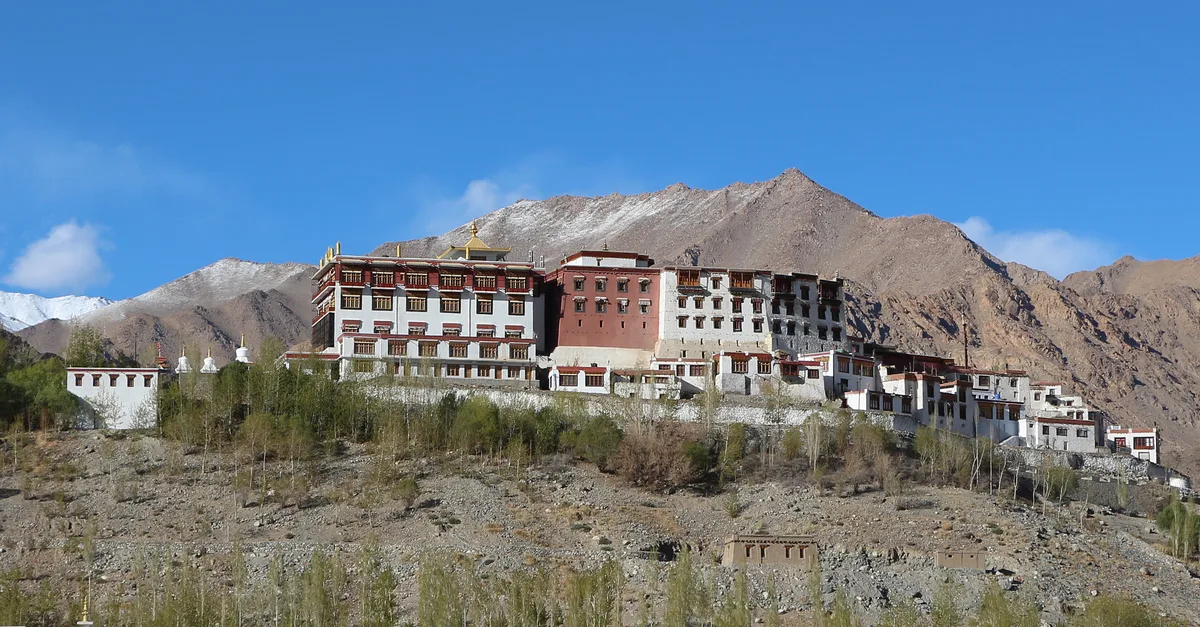
For adventure motorcyclists, Phyang offers a peaceful, authentic cultural stopover situated just off the main western highway. The smooth, winding canyon spur provides an exhilarating short ride, while the monastery's tranquil courtyards and ancient chapels offer deep insight into Tibetan Buddhist contemplative traditions.
The 900-Year Sacred Museum: Ancient Mongolian Armor, Matchlock Guns & Mahakala Relics
Answer-First Summary: Exploring one of the most astonishing private historical weapon and sacred art archives in the Himalayas.
While Phyang's assembly halls are rich in religious beauty, the crowning highlight for history enthusiasts is the monastery's celebrated museum, housed within the ancient thick-walled treasury rooms of the central complex.
THE 900-YEAR MAHAKALA RELIC: The most spiritually potent treasure in the museum is a sacred bronze and stone image of Mahakala (the wrathful manifestation of Avalokiteshvara), believed to date back over 900 years, predating the physical foundation of the monastery itself. Brought to Ladakh by early Kagyu yogis from Tibet, the statue is revered as a miraculous talisman that protected the valley from medieval sieges and plagues.
MEDIEVAL WEAPONS & ARMOR: Unlike most Buddhist monasteries that display exclusively religious artifacts, Phyang preserves an extraordinary collection of medieval military weaponry presented by royal kings and conquering generals over five centuries. Visitors can examine authentic 16th- and 17th-century Mongolian iron scale armor, ornate Tibetan battle helmets inlaid with silver dragons, heavy Chinese matchlock muskets with carved wooden stocks, steel broadswords, and circular rhinoceros-hide shields.
THANGKAS & SACRED STATUARY: The museum also displays a priceless collection of 14th- to 17th-century thangkas painted on hand-woven silk using mineral pigments ground from lapis lazuli, malachite, and cinnabar, alongside antique Kashmiri and Nepalese bronze sculptures of the Kagyu lineage masters, including Milarepa, Marpa, and Gampopa.
The Phyang Tsedup Festival: Sacred Cham Dances & Giant Thangka Unfurling
Answer-First Summary: Every summer, monks perform sacred masked dances and unroll a monumental two-story silk thangka.
Phyang Monastery is famous throughout the Himalayas for its vibrant annual festival: the Phyang Tsedup. Held on the 2nd and 3rd days of the sixth Tibetan lunar month (typically falling in July or early August), this sacred event draws thousands of Ladakhi villagers and international travelers to the monastery courtyard.
THE SACRED CHAM DANCES: Dressed in heavy, flowing silk brocade robes and donning terrifying painted wooden masks representing wrathful protector deities, skeleton spirits (Chitipati), and animal messengers, resident monks perform intricate, synchronized masked dances (cham). The dances are accompanied by the rhythmic, thunderous cadence of giant temple drums, crashing brass cymbals, and deep-toned copper horns (dungchen). According to Buddhist philosophy, these sacred dances are not dramatic theatrical entertainment, but profound visual meditations that purge malevolent spiritual obstacles and bestow merit upon all onlookers.
UNFURLING OF THE GIANT THANGKA: A major highlight of the festival, occurring on a special multi-year cycle, is the solemn unfurling of the monumental two-story-high silk appliqué thangka depicting Skyoba Jigten Sumgon (the founder of the Drikung Kagyu lineage). Suspended from the monastery's upper rooftop battlements across the entire courtyard facade, this colossal sacred masterpiece is exposed to sunlight for only a few hours, during which pilgrims line up to touch their foreheads to the silk hem in prayer.
Motorcycle Route Logistics: Cruising NH1 West & the Winding 4 km Phyang Valley Spur
Answer-First Summary: Navigating from Leh along 16 km of smooth military blacktop, followed by a scenic 4 km valley climb.
The motorcycle ride to Phyang Monastery is a classic half-day western excursion that can be completed easily in 2 to 3 hours, or integrated into a full-day ride along National Highway 1.
HIGHWAY TELEMETRY FROM LEH: Depart Ride & Fire Rentals in Changspa, head west past the Leh main roundabout, and join National Highway 1 (the Srinagar-Leh Highway). The road rolls past the Spituk Military Cantonment (km 8) and borders the perimeter of the Kushok Bakula Rimpochee Airport runway on immaculate two-lane military asphalt.
THE PHANG PLAINS & HIGHWAY TURNOFF: Once past the airport, NH1 traverses the wide, flat, windswept plains of Phyang. The highway blacktop is smooth and wide, allowing for relaxed cruising at 60 to 75 km/h. At km 16, look for a prominent green BRO signboard on the right-hand side of the highway indicating 'Phyang Monastery 4 KM'.
THE 4 KM CANYON SPUR: Turn right off the main highway onto the Phyang access road. The road narrows into a scenic single-to-two-lane paved blacktop that gently winds north through the fertile Phyang village oasis. You cruise beneath arching willow canopies, alongside stone-walled apricot orchards, and past traditional mud-brick farmsteads. The road climbs a gentle 6% to 8% gradient for 4 km, terminating directly at the paved parking courtyard below the monastery entrance.
PARKING & WALKING ACCESS: The parking area offers stable, paved asphalt footing with designated motorcycle parking bays. From the parking lot, an easy 2-minute walk up a gentle stone ramp brings you directly to the monastery courtyard and ticket desk.
Senior Fleet Mechanic Advice: Airbox Dust Cleaning, High-Gear Highway Rolling & Suspension Setup
Answer-First Summary: Senior Fleet Mechanic Stanzin Dorje explains engine maintenance and crosswind stability on the Phyang plains.
While the road to Phyang is 100% paved asphalt, the surrounding geographical environment introduces specific mechanical considerations.
AIRBOX SNORKEL DEFENSE ON HIGHWAY PLAINS: The wide desert plains between Spituk and Phyang are prone to sudden localized dust devils (thermal dust vortices) that sweep fine quartz sand across the highway. On dual-sport motorcycles like the Royal Enfield Himalayan 450 or Scram 411, high-velocity highway riding can pack micro-fine dust into the airbox intake. Periodically inspect your air filter box; wipe away dry dust from the airbox walls with a damp cloth so particles don't bypass the filter seal into your intake manifold.
HIGH-GEAR HIGHWAY ROLLING: The flat, straight tarmac of NH1 encourages riders to cruise in 5th or 6th gear. However, remember that at 11,800 feet, atmospheric oxygen is roughly 35% thinner than at sea level. Avoid lugging the engine at low RPMs (below 3,000 RPM) in top gear under roll-on acceleration; drop down one gear to maintain brisk engine momentum and keep cooling oil circulating rapidly.
SUSPENSION PRELOAD FOR SMOOTH TOURING: Set your rear monoshock preload to standard touring settings (middle click). The smooth tarmac of NH1 requires minimal damping adjustment, but ensure your front fork seals are wiped clean of abrasive highway dust using a clean microfiber cloth.
Fuel Logistics & Roadside Stops: Exploring the Western Corridor out of Leh
Answer-First Summary: Mapping fuel from Leh, Spituk, and the 75 km run to Khaltse.
Fuel planning for Phyang Monastery is simple and stress-free.
ROUND-TRIP DISTANCE MATH: The total round-trip distance from Leh to Phyang and back is exactly 40 km. A standard motorcycle consumes less than 1.5 liters of fuel for this entire ride. You do not need external jerry cans or spare fuel containers.
NEARBY PETROL PUMPS: The last full-service petrol stations leaving Leh heading west are:
1. Spituk IOCL Pump (km 8 from Leh): Full-service filling station with air check and basic puncture services.
2. Leh City Pumps (km 0): Multiple retail pumps along the main exit roads.
If you plan to continue west past Phyang toward Gurudwara Pathar Sahib (km 25), Magnetic Hill (km 30), or Basgo Fort (km 40), be aware that the next official commercial petrol pump heading west is at Khaltse - located 75 km past Phyang. Always depart Leh with a full fuel tank.
VILLAGE CAFES & REFRESHMENTS: Phyang village is renowned for its organic vegetable gardens and quiet homestays. Near the monastery gate, small family-run tea stalls serve hot masala chai, fresh Ladakhi bread (khambir) with apricot jam, and steaming vegetable momos.
Cultural Etiquette, Monastic Respect & Photography Protocols Inside Prayer Halls
Answer-First Summary: Visiting hours, monastic donations, modest attire, and respecting resident lamas.
Phyang is a living monastic community where over one hundred monks reside, study, and meditate. Observing respectful cultural etiquette ensures a warm, authentic visit.
VISITING HOURS & ENTRY: Phyang Monastery is open daily from 07:00 AM to 07:00 PM (with a brief midday monastic lunch interval from 01:00 PM to 01:30 PM). Admission to the main prayer halls is free. Entrance to the specialized ancient museum costs a nominal ₹30 maintenance fee.
FOOTWEAR & ATTIRE: Remove your riding boots, motorcycle gloves, and helmet before stepping onto the wooden floorboards of the Dukhang and museum. Wear full pants and shirts that cover your shoulders; shorts and sleeveless tops are strictly unacceptable in monastic complexes.
PHOTOGRAPHY PROTOCOL: Photography is permitted in the outer courtyard, rooftop viewing terraces, and village grounds. Inside the ancient prayer halls, ask the resident monk for permission before taking photos. Flash photography is strictly forbidden to protect ancient 16th-century mineral frescoes from optical light degradation. Circumambulate all stupas and altars clockwise.
Itinerary Architecture: Combining Phyang with Spituk, Pathar Sahib & Magnetic Hill
Answer-First Summary: The ultimate 1-day Western Ladakh shakedown loop for Day 1 or Day 2 of your expedition.
For motorcyclists who want to explore the scenic western corridor out of Leh, we recommend our classic 'Western Valley Heritage Circuit':
09:30 AM - Depart Ride & Fire Rentals in Changspa along NH1 heading west.
10:00 AM - Stop at Spituk Monastery (km 8) to visit the ancient Kali temple (Mahakal shrine) and enjoy panoramic views over the Leh airport runway and Indus River.
11:15 AM - Turn right onto the Phyang valley spur (km 16) and ride the scenic 4 km climb into Phyang village.
11:45 AM - Explore the historic assembly halls, 900-year-old museum collection, and medieval weapon displays at Phyang Monastery (km 20).
01:15 PM - Savor a traditional Ladakhi lunch of hot thukpa and fresh apricot juice at a village cafe in Phyang.
02:30 PM - Return to NH1 and continue west to visit Gurudwara Pathar Sahib (km 25) for hot army langar and tea.
03:45 PM - Test the gravity optical illusion at Magnetic Hill (km 30) and enjoy views of the Indus-Zanskar confluence at Sangam (km 33).
05:15 PM - Smooth, relaxed highway cruise back to Leh along NH1, arriving comfortably before dusk.
Valley Crosswind Mechanics & Radiant Highway Heat Management in the Lower Indus Basin
Answer-First Summary: Handling canyon gusts, tire temperatures, and aerodynamic wind fatigue along NH1.
The broad western corridor of NH1 between Spituk and Phyang is known for its distinct aerodynamic and thermal characteristics.
CROSSWIND FUNNEL ON PHAYANG PLAINS: As radiant solar heating warms the wide gravel plains, thermal updrafts create fierce crosswinds blowing across NH1 from the south. When cruising at 65 to 75 km/h, sudden gusts can push your front wheel sideways. Maintain a relaxed, flexible upper body, keep your elbows bent, and grip the motorcycle tank firmly with your thighs to allow the chassis to absorb wind buffeting without upsetting your steering trajectory.
RADIANT HIGHWAY HEAT: Unlike the sub-zero high passes of Changthang, the lower western highway corridor experiences radiant asphalt heat between June and August (28°C to 32°C). Stay well-hydrated by drinking water at regular intervals, wear a ventilated mesh or multi-season touring jacket with zippered intake vents open, and carry UV-400 sunglasses to protect your eyes from radiant glare reflected off the bleached granite plains.
Route Milestones, Elevation & Road Conditions
| Milestone | Elevation (ft / m) | Distance from Leh | Key Facilities & Highway Telemetry |
|---|---|---|---|
| Leh Main Market | 11,562 ft / 3,524 m | 0 km | Ride & Fire Rentals, full-service workshop, IOCL pumps, ATMs. |
| Spituk Military Checkpoint | 10,830 ft / 3,301 m | 8 km | Ancient Gompa, airport runway view, last fuel station on NH1. |
| Airport Perimeter Straight | 11,100 ft / 3,383 m | 12 km | Wide dual-lane military asphalt, crosswinds, flat terrain. |
| Phyang Highway Junction | 11,200 ft / 3,414 m | 16 km | Turn right off NH1, green BRO sign: Phyang Monastery 4 KM. |
| Phyang Lower Village | 11,400 ft / 3,475 m | 18 km | Tranquil oasis, stone-walled orchards, willow groves, cafes. |
| Phyang Monastery Gate | 11,800 ft / 3,600 m | 20 km | Paved parking lot, ticket booth, 1515 CE Drikung Kagyu Gompa. |
| Phyang 900-Year Museum | 11,820 ft / 3,603 m | 20.1 km | Ancient Mahakala image, Mongolian armor, matchlock weapons. |
| Upper Hermitage Ridge | 12,100 ft / 3,688 m | 22 km | Meditation caves, panoramic views under Gang Ngonpo. |
Ready for Your Ladakh Motorcycle Adventure?
Navigating the complex checkpoints and steep elevations of UT Ladakh requires both legal compliance and mechanical reliability. At Ride & Fire Rentals, we offer locally registered motorcycles with the mandatory LA-02 yellow commercial plates, ensuring you clear every military and union checkpoint seamlessly. Our fleet is 100% fuel-injected and thoroughly checked before every handover at our Changspa Road workshop.
For external travel planning references, you can check the official Ladakh Tourism Portal or apply for permits via the LAHDC Leh Permit Portal.
Season Launch Offer
Book your motorcycle direct from our Changspa Road facility. Get a standard 25% direct booking discount, plus enter coupon code LADAKH5 at checkout for an extra 5% off (saving nearly 30% total) on your entire rental! This promotion is active until June 30.
Senior Fleet Mechanic's Guide to Crosswind Aero-Stability & Cooling Radiator Care on NH1
Mastering gusting western valley crosswinds, radiator seed protection, and throttle control on the Gang Ngonpo climb.
The 20 km ride from Leh to Phyang Monastery traverses two distinct terrain profiles: the high-speed, military-grade asphalt straights of National Highway 1 across the lower Indus basin, followed by a tight, winding 4 km mountain spur climbing into the high granite amphitheatres beneath Mount Gang Ngonpo.
CROSSWIND AERODYNAMICS ON SPITUK PLAINS: The open, treeless military highway between Spituk airport and the Phyang turnoff is famous for intense, unpredictable crosswinds funneling across the valley from the southern gorges. At cruising speeds of 70 km/h, unexpected lateral gusts can push a loaded adventure motorcycle half a lane sideways. To counter this aerodynamic force, adopt an active riding posture: keep your elbows bent and relaxed, grip the motorcycle fuel tank securely with your inner thighs, and counter-steer gently into the wind by pressing forward on the upwind handlebar grip.
LUGGAGE MASS BALANCE & SURFACE AREA: High-profile soft duffel bags and oversized aluminum panniers act like sails in broadside valley winds. Keep heavy items - such as toolkits, spare tubes, tire inflators, and water reserves - packed as low and close to the motorcycle's center of gravity as possible. Avoid strapping bulky, lightweight items high on top of your rear luggage rack, which raises the bike's roll center and amplifies crosswind instability.
POPLAR SEED FLUFF & RADIATOR HEAT DISSIPATION: The lush, irrigated oasis of Phyang village is lined with dense groves of ancient willow and poplar trees. In June and July, these trees shed dense clouds of white seed fluff that drift across the roadway. The radiator fans on modern liquid-cooled motorcycles suck this cotton-like fluff deep into the cooling fins, forming an insulating felt mat that can cause severe engine overheating on the steep 4 km climb to the monastery. Inspect your radiator face daily; gently blow out trapped debris from the rear side using compressed air or rinse with a gentle stream of water. Never pick at cooling fins with screwdrivers, which bends the delicate aluminum fins and permanently restricts airflow.
SWITCHBACK THROTTLE CONTROL ON MONASTERY RIDGE: The final approach to Phyang Monastery features several tight ascending hairpins cut into the dry scree ridge. When navigating these switchbacks, avoid grabbing the front brake in the middle of a turn, which will stand the bike up and wash out the front wheel on loose surface dust. Shift into 1st gear before entering the turn, maintain steady throttle opening to keep drive tension on the chain, and use a light drag on the rear brake to control your turn radius.
HERMITAGE DIRT TRACK EXPLORATION: For adventurous riders continuing past the monastery along the rough dirt track toward the upper meditation hermitage and the base of Gang Ngonpo (12,100 ft), reduce rear tire pressure slightly to 28 PSI to enhance traction over loose granite rubble. Ensure your engine bash plate is securely bolted; loose rocks thrown up by the front 21-inch tire can otherwise strike and puncture fragile engine crankcases.
Frequently Asked Questions
What are the visiting hours and entry fees for Phyang Monastery and Museum? +
Phyang Monastery is open daily from 07:00 AM to 07:00 PM (with a brief midday break from 01:00 PM to 01:30 PM). Admission to the main prayer halls is free. Entrance to the specialized ancient museum costs a nominal ₹30 maintenance fee. Parking for motorcycles is free.
What makes Phyang Monastery historically significant? +
Founded in 1515 CE by Chosje Denma Kunga Drakpa under royal patronage of King Tashi Namgyal, Phyang is one of the primary seats of the Drikung Kagyu tradition in Ladakh. It is historically renowned for its 900-year-old museum containing ancient Mahakala relics, rare 16th-century Mongolian armor, matchlock guns, and Chinese weapons.
How do you reach Phyang Monastery by motorcycle from Leh? +
Ride west from Leh along National Highway 1 (NH1) past Spituk for 16 km. Turn right at the green Phyang signboard and follow the smooth paved spur road for 4 km up into Phyang village, terminating directly at the monastery parking courtyard (total distance: 20 km).
Do I need an Inner Line Permit (ILP) to visit Phyang Monastery? +
No. Phyang Monastery is located along the open National Highway 1 corridor in the Sham Valley. Neither Indian domestic travelers nor foreign international tourists require an Inner Line Permit (ILP) or Protected Area Permit (PAP) to visit.
When is the Phyang Tsedup Festival held? +
The Phyang Tsedup Festival is celebrated annually on the 2nd and 3rd days of the sixth Tibetan lunar month (usually July or early August). The festival features sacred masked cham dances performed by resident monks and the ceremonial unrolling of a monumental two-story-high silk thangka.
Where is the nearest petrol pump to Phyang Monastery? +
The nearest fuel station is the Indian Oil (IOCL) petrol station in Spituk, located 12 km east along NH1. Heading further west toward Kargil, the next commercial filling station is 75 km away at Khaltse. A full tank from Leh easily covers the entire 40 km round-trip ride.
Can I combine Phyang Monastery with Gurudwara Pathar Sahib and Magnetic Hill? +
Yes. Because Phyang is located at km 20 on NH1, it is easily combined with Spituk Monastery (km 8), Gurudwara Pathar Sahib (km 25), Magnetic Hill (km 30), and the Sangam Confluence (km 33) into an effortless, highly rewarding full-day western acclimatization circuit.