
Quick Summary: How do you visit Lamayuru Monastery and Moonland by motorcycle from Leh?
Quick Answer: Lamayuru Monastery (11,520 ft / 3,510 m) is located 115 km west of Leh along the smooth, paved Srinagar-Leh National Highway 1 (NH1). The ride takes 3 to 3.5 hours one-way, passing through Nimmu and Khaltse. It features the ancient 11th-century Drikung Kagyu monastery founded by Mahasiddha Naropa and the world-famous lunar-like Moonland sedimentary geological formations. No Inner Line Permit is required. The monastery is open 08:00 AM to 05:00 PM with a ₹50 entry fee, while the roadside Moonland viewpoint is accessible 24/7 with zero admission cost.
The Geological Marvel of Moonland: How an Ancient Pleistocene Lake Created Ladakh's Lunar Landscape
Answer-First Summary: Sedimentary lacustrine clay deposits dried out over 35,000 years ago, creating the bleached, cratered badlands known as Moonland.
Riding 115 km west of Leh along the sweeping dual-lane military blacktop of National Highway 1 (NH1), the jagged granite cliffs of the Indus River gorge suddenly yield to a landscape that appears torn from another celestial body. Spreading across the steep canyon basin beneath Lamayuru village is 'Moonland' - a bizarre expanse of pale yellowish-white clay pinnacles, eroded gullies, and cratered mud terraces that starkly contrasts with the ochre and chocolate-brown mountains encircling it.
Geologists trace the origin of Moonland back to the late Pleistocene epoch, approximately 35,000 to 40,000 years ago. Tectonic upheaval along the Indus Suture Zone triggered massive rock avalanches that dammed the ancient valley, forming a vast prehistoric freshwater lake over 15 km long and hundreds of meters deep. Over millennia, fine glacial silt, calcareous marl, and lacustrine clay settled into dense horizontal sedimentary strata on the lakebed.
When natural seismic activity or hydraulic overflow eventually breached the natural earthen dam, the lake drained catastrophically down toward the Indus River. Subsequent millennia of intense wind erosion, sub-zero freeze-thaw thermal weathering, and flash rainfall carved the soft lacustrine sediment into knife-edge ridges, deep labyrinths, and conical pillars resembling the cratered surface of the moon.
The roadside viewing terrace along NH1 offers an exceptional panoramic perspective of this geological formation. At twilight and under the glow of a full moon, the mineral-rich white clay reflects ambient light with an eerie luminescence. Motorcycle riders can pull into the designated paved shoulder directly off the highway to view and photograph the terrain with zero entry tickets or checkpoint restrictions.
The Sacred Heritage of Tharpa Ling: Naropa's Meditation Cave, Lotsawa Rinchen Zangpo & Monastic Treasures
Answer-First Summary: Founded in the 11th century by Mahasiddha Naropa and Rinchen Zangpo, Lamayuru is one of Ladakh's oldest Drikung Kagyu sanctuaries.
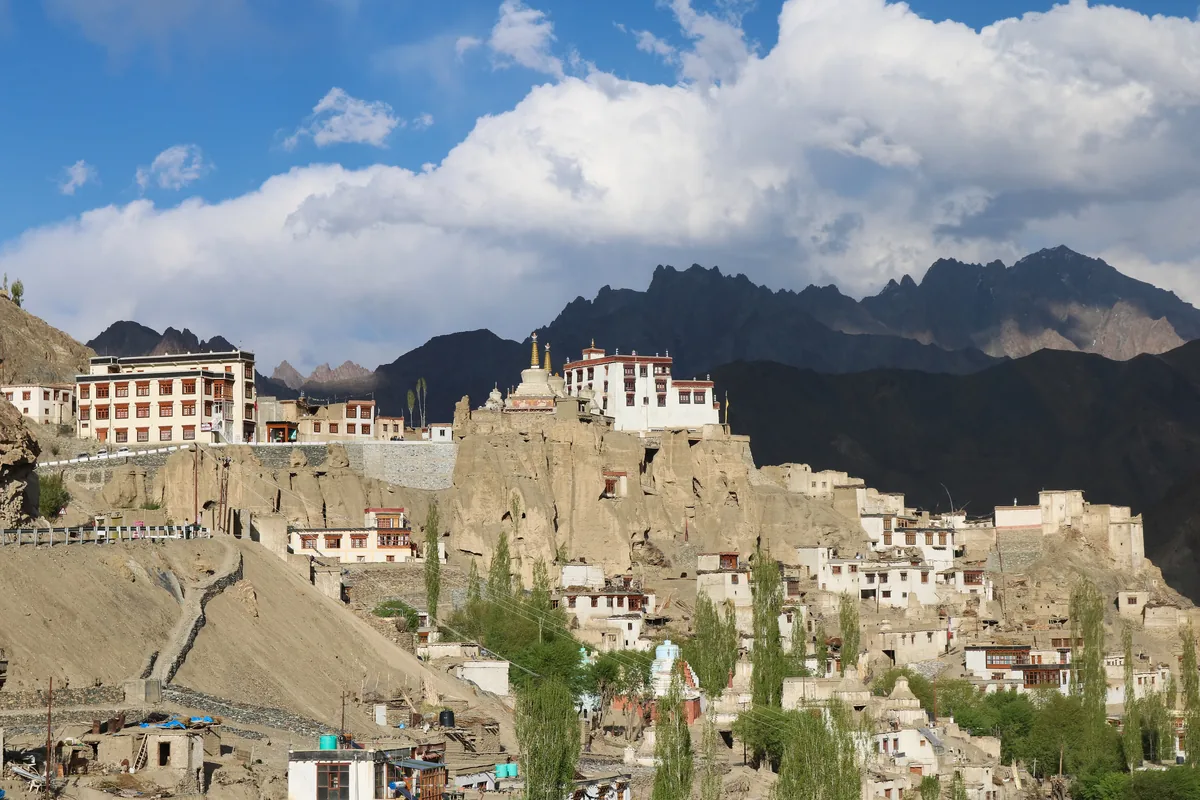
Perched on a towering limestone crag overlooking the Moonland basin sits Lamayuru Monastery, historically known in classical Tibetan as Yung-drung Tharpa Ling ('The Swastika Place of Freedom'). It is revered as one of the oldest, largest, and most spiritually potent monastic citadels in central Ladakh, affiliated with the Drikung Kagyu lineage of Tibetan Buddhism.
Monastic tradition records that in the early 11th century, the celebrated Indian Buddhist tantric master Mahasiddha Naropa walked across the trans-Himalayan passes from Kashmir to meditate in a natural granite cave here. Naropa caused the prehistoric lake to dry up by performing miraculous rituals, allowing the soil to be sanctified for the construction of a temple. The sacred cave where Naropa engaged in years of intense solitary contemplation remains preserved inside the lower assembly hall (Dukhang) of the monastery.
Shortly after Naropa's retreat, the Great Translator Lotsawa Rinchen Zangpo arrived in the valley under the patronage of the King of Guge, erecting the original Singhe Ghang (Lion Temple) at the western base of the crag. Over the centuries, Lamayuru expanded into a massive multi-level complex housing several hundred monks, serving as an inviolable sanctuary where even hunted fugitives could claim spiritual asylum without fear of arrest.
Inside the primary prayer halls, visitors can examine priceless 11th-century frescoes, finely detailed thangkas depicting the Kagyu lineage masters, and a colossal multi-armed image of Avalokiteshvara (the Bodhisattva of Compassion). Every summer, on the 17th and 18th days of the fifth Tibetan lunar month (usually late June or early July), the monastery courtyard erupts in color during the Yuru Kabgyat festival, where red-hat monks perform sacred masked cham dances to purge negative planetary energies.
Motorcycle Route Logistics: Leh to Lamayuru on NH1, the Jalebi Switchbacks & Fotu La Ascent
Answer-First Summary: Navigating 115 km of smooth BRO highway, military corridors, and the famous Jalebi Loops climbing to 11,520 ft.
The motorcycle ride from Leh to Lamayuru is widely regarded by senior touring riders as one of the most rewarding half-day rides in the Himalayas. Leaving our workshop on Changspa Road in Leh, you merge onto NH1 heading west. The first 35 km takes you past the Sangam Indus-Zanskar confluence at Nimmu, Basgo Fort, Gurudwara Pathar Sahib, and Magnetic Hill on flawless multi-lane tarmac.
Beyond Nimmu, NH1 crosses to the northern bank of the Indus, rolling smoothly through Basgo fortress ruins, Saspol, and Nurla. The highway follows the river canyon down to Khaltse (elevation 9,800 ft / 2,987 m), located 95 km from Leh. Khaltse is the major agricultural trade hub of the Sham Valley, filled with sweet apricot orchards, roadside walnut stalls, and a bustling military checkpoint.
At Khaltse, NH1 crosses back over the Indus River on a sturdy steel cantilever bridge and begins a sustained climb into the Wanla-Lamayuru mountain range. Approximately 12 km after Khaltse, riders encounter the renowned 'Jalebi Loops' (Hangro Loops) - a breathtaking series of 18 tightly engineered hairpins carved into the steep shale mountainside by BRO Project VIJAYAK.
The switchbacks offer consistent 8% to 10% climbing gradients with immaculate cambered asphalt. PILOT ADVICE: Take wide lines into blind right-hand ascending hairpins, as heavy military Ashok Leyland 4x4 convoys frequently descend down the center of the tarmac. Accelerating through the top hairpins brings you around a dramatic rocky saddle, suddenly revealing Lamayuru village and the Moonland basin spread out below.
If continuing west toward Kargil, NH1 climbs another 15 km past Lamayuru to summit Fotu La Pass (13,479 ft / 4,108 m). Fotu La is the highest geographic elevation on the entire 434 km Srinagar-Leh Highway, featuring crisp alpine air, a high-altitude Prasar Bharati television tower, and expansive vistas stretching toward the Nun-Kun glaciated massifs.
Fuel Strategy, Mechanic Advice & Downhill Engine Braking on the Khaltse Descents
Answer-First Summary: Senior fleet mechanic Stanzin Dorje explains carburetor/EFI fueling, brake-fade prevention, and fuel stops along NH1.
At Ride & Fire Rentals, we inspect hundreds of motorcycles returning from the western highway circuits. While the road surface from Leh to Lamayuru is 98% pristine asphalt, the sustained elevation changes demand disciplined riding technique and strict mechanical awareness.
FUEL LOGISTICS: The round trip from Leh to Lamayuru and back is 230 km. If you ride an adventure motorcycle like the Royal Enfield Himalayan 450 (17-liter fuel tank, ~25-28 km/L) or Scram 411 (~30 km/L), a single full tank in Leh easily covers the entire journey with ample reserve. However, for smaller tank capacities or riders continuing toward Kargil, the crucial fuel stop is Khaltse. Khaltse features two authorized Indian Oil petrol pumps operating 07:00 AM to 08:00 PM. Always top up your tank at Khaltse before ascending into the pass sectors.
BRAKE-FADE PREVENTION ON DESCENTS: When riding back down the Jalebi Loops toward Khaltse, inexperienced riders often drag their rear brake pedal continuously to manage speed. On heavy loaded touring bikes carrying panniers and a pillion, constant brake drag superheats the DOT 4 brake fluid above 230°C within 8 to 10 hairpins. The fluid boils, creating compressible vapor bubbles in the hydraulic brake line that result in sudden, catastrophic lever sponge and complete loss of rear braking power.
MECHANIC RULE: Always practice active engine braking. Drop your transmission into 2nd gear before entering steep downhill curves, letting high-compression engine vacuum control your descent speed. Apply firm, pulsed front-brake pressure for 2 to 3 seconds to shed velocity before the corner, then release the lever completely to allow airflow to cool the brake discs and calipers.
TIRE PRESSURES ON HOT ASPHALT: Unlike the freezing 17,500-foot passes of Eastern Ladakh, the lower Sham Valley (Khaltse to Nimmu) experiences blazing midday summer heat with tarmac temperatures exceeding 45°C. Check your cold tire pressures in Leh before departure: 22 PSI front and 32 PSI rear (solo) or 36 PSI rear (with pillion/luggage). Over-inflating tires causes the contact patch to harden over hot asphalt, reducing cornering traction on the high-speed sweeping bends along the Indus.
The Wanla Fort Detour: Exploring the Ancient 14th-Century Citadel & Choskor Temple
Answer-First Summary: Branching off the highway through the Wanla Monastery & 11-Headed Avalokiteshvara temple reveals King Lhachen Gyalbu's ancient citadel and the Padum bypass.
For motorcyclists seeking adventure beyond the main highway tarmac, taking the historic detour into the Wanla valley just 12 km south of Lamayuru is highly recommended. Wanla was the ancient ancestral capital of the Kingdom of Ladakh before the royal court moved down to Shey and Leh. The road branches off from Khaltse or Lamayuru through a dramatic, narrow canyon flanked by towering purple shale cliffs.
Perched on an isolated, knife-edge rocky pinnacle rising 300 feet above the village stream stand the dramatic ruins of Wanla Fortress (Khar). Built in the early 14th century by King Lhachen Gyalbu, the mud-brick battlements commanded strategic oversight of ancient caravan tracks leading over the passes into Zanskar. At the base of the fortress sits the Wanla Choskor (Sumtsek temple) - one of the most architecturally significant three-story wooden temple structures surviving in the Western Himalayas.
Inside the dimly lit sanctuary, preserved by local villagers, stands an extraordinary 11-headed stucco sculpture of Avalokiteshvara rising through two floor levels, surrounded by vibrant 14th-century murals illustrating tantric mandalas and royal donor portraits. The artistic style bridges the ancient Kashmiri art of Alchi with early Western Tibetan painting schools, making it an essential pilgrimage for culture and history enthusiasts.
ROUTING TO ZANSKAR: The road through Wanla, Fanila (Phanjila), and Hanupatta forms the northern segment of the new Nimmu-Padum-Darcha (NPD) strategic highway corridor. Adventure riders equipped with robust dual-sport machines can push south past Hanupatta past the fairytale amphitheater of Photoksar Village (via Sirsi La) and over Singge La Pass (16,590 ft) directly into the heart of Zanskar, bypassing Kargil entirely. However, this remote mountain route features loose gravel, river fords, and unpaved shelf roads requiring high riding skill.
Night Photography over Moonland: Stargazing, Milky Way Tracking & Full Moon Physics
Answer-First Summary: Capturing Bortle Class 1 night skies over the pale clay badlands and managing camera batteries in sub-zero air.
While thousands of daytime tourists witness Moonland from tour buses, relatively few travelers experience the location after dark. Lamayuru offers some of the most spectacular, light-pollution-free night skies in the entire Western Himalayas, rated as a Bortle Class 1 dark sky reserve by astrophotographers.
Once the village diesel generators power down at 11:00 PM, the valley plunges into absolute, ink-black silence. The galactic core of the Milky Way arches directly over the eroded spires of Moonland, creating an astonishing celestial contrast between millions of twinkling stars and the pale, prehistoric sedimentary lakebed.
CAMERA SETTINGS & ASTROPHOTOGRAPHY: To photograph the Milky Way over the clay formations, mount your camera on a sturdy tripod weighted down with your motorcycle helmet or a stone against canyon crosswinds. Use a wide-angle lens (14mm to 24mm) with an aperture of f/2.8 or wider. Set manual focus on infinity, select ISO 3200 to 6400, and expose for 20 to 25 seconds. The soft ambient starlight naturally illuminates the pale clay, producing images of surreal, otherworldly beauty.
FULL MOON NIGHTS: If your expedition dates coincide with a full moon, the visual phenomenon changes completely. Under direct lunar illumination, the white lacustrine sediment acts like a giant natural reflector, casting sharp, deep shadows across the gullies and creating the unmistakable illusion of standing on the surface of the moon itself. THERMAL PRESERVATION TIP: Lithium-ion camera and smartphone batteries lose up to 50% of their charge within 30 minutes in cold mountain air. Always keep spare batteries in an inner jacket pocket close to your chest heat until ready to shoot.
Itinerary Planning: Lamayuru as a Day Trip from Leh vs Overnight Halt on the Srinagar-Kargil Circuit
Answer-First Summary: Structuring your riding timetable whether you return to Leh or continue west into Kargil and Zanskar.
Motorcycle travelers typically integrate Lamayuru into their Ladakh expeditions using one of two well-tested tactical itineraries. Deciding between a day excursion and an overnight staging depends on your overall route architecture.
OPTION 1: THE DAY 2 SHAM VALLEY DAY TRIP (230 km round trip). For riders who arrived in Leh by flight and are completing their mandatory 48-hour Leh acclimatization protocol, a full-day ride to Lamayuru is the ultimate conditioning run. Departing Leh at 08:30 AM, you reach Khaltse by 11:00 AM for fresh apricot juice, summit the Jalebi Loops to explore Lamayuru Gompa and Moonland from 11:45 AM to 02:00 PM, have a hearty Ladakhi lunch at a local village dhaba, and cruise back to Leh before sunset at 06:00 PM. Because the maximum elevation reached is only 11,520 ft, it poses zero altitude sickness risk while providing 6 hours of high-quality saddle time.
OPTION 2: THE TRANS-HIMALAYAN TRANSIT OVERNIGHT (Leh to Kargil, 215 km). For riders riding the full Srinagar-Leh highway or connecting south into Zanskar via the new Padum highway, Lamayuru is the ideal midday staging point. Departing Leh early, you tour Lamayuru, cross Fotu La (13,479 ft), descend past the historic 30-ft Mulbekh Chamba rock carving, and reach Kargil by late afternoon for an overnight hotel stay.
For riders who choose to sleep in Lamayuru village, the reward is extraordinary tranquility after daytime tour buses depart. Multiple clean family-run homestays and monastic guest houses offer private rooms (₹800 to ₹1,800/night) with direct balcony views over the illuminated Moonland canyon.
Cultural Etiquette, Photography Regulations & Local Homestay Hospitality
Answer-First Summary: Visiting hours, monastic donations, drone restrictions, and respectful conduct inside sacred prayer halls.
Lamayuru Monastery is a functioning monastic university and active spiritual residence for over 60 lamas and novice monks. To ensure a harmonious and culturally respectful visit, riders should observe established monastic etiquette.
TIMINGS & ENTRY TICKETS: The monastery is open to visitors daily from 08:00 AM to 05:00 PM. An entry ticket of ₹50 per person is collected at the ticket counter near the main vehicle gate, with all proceeds funding monastery maintenance and novice monk schooling. The roadside Moonland viewpoints along NH1 have no gates, timings, or entry charges.
SHOES & CLOTHING: Always remove your riding boots and gloves before crossing the threshold of any prayer hall (Dukhang). Wear modest riding apparel; remove helmets, sunglasses, and bandanas. Always walk around monastic chortens, mani stone walls, and inner sanctums in a clockwise direction (kora).
PHOTOGRAPHY & DRONES: Photography is generally permitted in the courtyards and exterior terraces. However, photography inside the inner prayer chapels is strictly prohibited to protect the delicate vegetable and mineral pigments of the ancient 11th-century frescoes. The use of commercial aerial drones is strictly banned by district administration across the entire Lamayuru sector due to sensitive defense flight paths and proximity to military installations along NH1.
Route Milestones, Elevation & Road Conditions
| Milestone | Elevation (ft / m) | Distance from Leh | Road Condition & Key Facilities |
|---|---|---|---|
| Leh Main Market | 11,562 ft / 3,524 m | 0 km | Commercial hub, rental workshops, hospitals, fuel pumps. |
| Spituk Checkpoint | 10,800 ft / 3,292 m | 8 km | Dual-lane blacktop, airport junction, HPCL fuel station. |
| Nimmu (Sangam) | 10,300 ft / 3,139 m | 35 km | Indus-Zanskar confluence, rafting camps, cafes, smooth tarmac. |
| Basgo Fortress | 10,850 ft / 3,307 m | 42 km | Ancient mud-brick royal ruins, historic temples, broad shoulders. |
| Saspol Village | 10,200 ft / 3,109 m | 62 km | Apricot orchards, caves with ancient murals, roadside tea stalls. |
| Khaltse Market | 9,800 ft / 2,987 m | 95 km | Major transit town, police checkpoint, 2 IOCL fuel pumps, dhabas. |
| Khaltse Cantilever Bridge | 9,750 ft / 2,972 m | 98 km | Crossing Indus River, start of Wanla mountain canyon climb. |
| Jalebi (Hangro) Loops | 10,600 ft / 3,231 m | 108 km | 18 steep asphalt hairpin switchbacks, military convoy route. |
| Moonland Viewpoint | 11,350 ft / 3,459 m | 113 km | Paved roadside viewing platform, cratered yellow clay badlands. |
| Lamayuru Village & Gompa | 11,520 ft / 3,510 m | 115 km | 11th-century monastery, Naropa cave, homestays, restaurants. |
| Fotu La Pass Summit | 13,479 ft / 4,108 m | 130 km | Highest pass on NH1 Srinagar-Leh, TV tower, panoramic views. |
Ready for Your Ladakh Motorcycle Adventure?
Navigating the complex checkpoints and steep elevations of UT Ladakh requires both legal compliance and mechanical reliability. At Ride & Fire Rentals, we offer locally registered motorcycles with the mandatory LA-02 yellow commercial plates, ensuring you clear every military and union checkpoint seamlessly. Our fleet is 100% fuel-injected and thoroughly checked before every handover at our Changspa Road workshop.
For external travel planning references, you can check the official Ladakh Tourism Portal or apply for permits via the LAHDC Leh Permit Portal.
Season Launch Offer
Book your motorcycle direct from our Changspa Road facility. Get a standard 25% direct booking discount, plus enter coupon code LADAKH5 at checkout for an extra 5% off (saving nearly 30% total) on your entire rental! This promotion is active until June 30.
Frequently Asked Questions
Do you need an Inner Line Permit (ILP) to visit Lamayuru and Moonland? +
No. Lamayuru Monastery and the Moonland viewpoints are situated directly along National Highway 1 (Srinagar-Leh Highway), which is an open national transit corridor. Neither Indian citizens nor foreign nationals require an Inner Line Permit (ILP) or Protected Area Permit (PAP) to visit this sector.
What are the entry ticket fees and visiting hours for Lamayuru Monastery? +
Lamayuru Monastery is open daily from 08:00 AM to 05:00 PM. The entry fee is ₹50 per person, which supports monastery preservation and novice monk education. Viewing Moonland from the highway overlooks is free and accessible 24 hours a day.
Can I ride an outside rental bike (DL, HR, HP, PB plates) to Lamayuru? +
Yes. Because Lamayuru lies directly on National Highway 1, commercial rental motorcycles licensed from outside Ladakh (such as Delhi or Chandigarh) are legally permitted to transit along NH1. However, if you plan to divert onto internal circuits like Nubra, Pangong, or Hanle, local Ladakh Motorcycle Renters Association (LMBRA) union rules require a locally registered LA-02 commercial yellow-plate bike.
Where is the last petrol pump before Lamayuru? +
The last reliable fuel stop before Lamayuru is at Khaltse, located 20 km before the monastery (95 km west of Leh). Khaltse has two authorized Indian Oil petrol stations with reliable fuel supply. Beyond Khaltse, the next petrol pump heading west is at Kargil, 120 km away.
What is the best time of year and day to photograph Moonland? +
The best season is from May through October when the Srinagar-Leh highway is fully open and free of snow. The most dramatic lighting occurs in the late afternoon (04:00 PM to 06:00 PM) when low-angle sunlight casts sharp shadows across the eroded clay gullies, or during a full moon night when the pale soil reflects eerie lunar radiance.
How long does it take to ride a motorcycle from Leh to Lamayuru? +
The 115 km journey along NH1 takes approximately 3 to 3.5 hours of steady riding. The road is impeccably paved military asphalt maintained by BRO Project VIJAYAK, allowing smooth cruising speeds between 50 and 70 km/h, with winding hairpins on the Jalebi Loops.
Can you stay overnight in Lamayuru? +
Yes. Lamayuru village features dozens of comfortable family-run homestays, guesthouses, and hotel options ranging from ₹800 to ₹2,500 per night. Staying overnight offers incredible stargazing over the Moonland canyon and an opportunity to witness early morning monastic prayer assemblies at 06:30 AM.