
Quick Summary: What is the historical and religious significance of Datun Sahib in Leh?
Quick Answer: Datun Sahib is a venerated 500-year-old sacred tree located in the historic Old Town of Leh, situated just behind the Jama Masjid below Leh Palace. According to trans-Himalayan historical tradition, during his Third Udasi (spiritual journey) across Tibet and Ladakh in 1517 CE, Guru Nanak Dev Ji planted a herbal tooth-stick (datun) into the arid desert ground, which miraculously blossomed into a colossal mesquite tree. Revere by Sikhs, Buddhists (who honor Guru Nanak as Guru Gompache), and Muslims alike, it stands as a living symbol of communal harmony and spiritual refuge.
The Miracle in the Cold Desert: Introducing Datun Sahib
Answer-First Summary: How a herbal tooth-stick planted by Guru Nanak in 1517 CE blossomed into Leh's oldest living botanical relic.
In the arid, rain-shadow expanse of Ladakh - where trees struggle to survive above 11,500 feet and require deliberate glacial meltwater irrigation - the survival of a colossal, centuries-old deciduous tree in the heart of Leh's rocky Old Town is widely regarded as a spiritual wonder. Tucked within the labyrinthine pedestrian alleys just behind the grand Jama Masjid, beneath the towering shadow of Leh Palace, stands Datun Sahib.
Datun Sahib is an ancient mesquite tree (Salvadora or Pilu species) whose sprawling boughs, gnarled roots, and dense green canopy have sheltered travelers, pilgrims, and local traders for more than five centuries. According to historical tradition preserved across Ladakh, Punjab, and Tibet, the tree was born in 1517 CE during the historic Third Udasi (travel) of Guru Nanak Dev Ji - the founder of Sikhism - as he returned from his spiritual journeys through Sumer Parbat, Mount Kailash, Mansarovar, and Western Tibet.
For adventure motorcyclists preparing their machines with Ride & Fire Rentals, a pilgrimage to Datun Sahib offers an extraordinary glimpse into the pluralistic spiritual fabric of Ladakh. It connects the high-altitude trails of your upcoming journey with the sacred footprints of the saintly travelers who crossed these very same mountain passes on foot five hundred years ago.
Standing beneath the expansive shade of Datun Sahib, one feels the immediate drop in temperature and the soothing rustle of leaves against the ancient mud-brick walls of Old Town. The tree's survival in an alpine desert where winter temperatures frequently plunge below -25°C stands as an enduring testament to the trans-Himalayan spiritual lore that defines this mountain kingdom.
Guru Nanak's Third Udasi: The Himalayan Sojourn of Guru Gompache
Answer-First Summary: Tracing the Guru's 1517 CE journey across Tibet, Leh, and the boulder legend of Pathar Sahib.
Between 1514 and 1518 CE, Guru Nanak Dev Ji undertook his legendary Third Udasi (travel), traversing the high Himalayas through Nepal, Sikkim, Tibet, Ladakh, and Kashmir, spreading his message of universal brotherhood, divine unity (Ik Onkar), and selfless compassion.
THE BUDDHIST REVERENCE FOR GURU GOMPACHE: In Tibetan Buddhist folklore and Ladakhi chronicles, Guru Nanak was welcomed not as a foreign traveler, but as an enlightened saint of the highest spiritual order. Monks across Ladakh referred to him as 'Guru Gompache' (The Saintly Monk) or 'Nanak Lama', venerating him as an incarnation of Guru Padmasambhava (Guru Rinpoche). Ancient thangka paintings and monastic oral traditions in Hemis, Basgo, and Alchi recount his spiritual debates with local lamas and hermits.
THE JOURNEY FROM PATHAR SAHIB TO LEH: Prior to entering Leh, Guru Nanak meditated along the banks of the Indus River near Nimu, where he defeated a demonic force that hurled a colossal boulder at him - the legendary event commemorated today at Gurudwara Pathar Sahib on NH1. From Nimu, the Guru marched up the Indus Valley into Leh, camping near the foot of the royal palace hill.
THE PLANTING OF THE TOOTH-STICK: One morning after his dawn ablutions and meditation, Guru Nanak took his natural herbal tooth-stick (datun) - traditionally carved from a healing neem, babool, or pilu branch - and stuck it into the dry, stony ground. He blessed the spot, proclaiming that a great tree would grow there to provide shade, medicine, and spiritual solace to all weary travelers regardless of caste, creed, or nationality. Against all botanical probability in the rain-shadow desert, the twig took root, sprouted branches, and grew into the majestic tree that stands today.
THE EXPEDITION TO KASHMIR VIA KARGIL: From Leh, Guru Nanak continued his westward march across Ladakh, crossing Namika La and Fotu La into the Suru Valley and Kargil before negotiating the snowy defiles of Zoji La into the Kashmir Valley. His teachings during this trans-Himalayan journey left an indelible mark on the mountain communities, planting the seeds of mutual tolerance that define Ladakhi social culture to this day.
Interfaith Harmony at the Core of Leh: Buddhists, Sikhs & Muslims
Answer-First Summary: How a single sacred site has united three major world religions for half a millennium.
What makes Datun Sahib uniquely magnificent is that it belongs exclusively to no single religion; rather, it is lovingly protected and venerated by every community in Ladakh.
THE THREE-FAITH NEXUS: Datun Sahib is physically nestled between the historic Grand Jama Masjid of Leh (built in 1667 CE) and the ancient Buddhist residential quarter of Old Town Leh. For centuries, Ladakhi Buddhist families have tied saffron and yellow prayer ribbons to its outer branches to pray for fertility, health, and safe travels across the passes. Sikh soldiers and pilgrims from across the globe visit the site to pay homage with Ardas prayers, while local Muslim shopkeepers and elders gather under its branches to rest, converse, and maintain the surrounding flagstones.
SYMBOL OF LADAKHI HARMONY: In a region where cultural coexistence has survived through harsh geopolitical changes, Datun Sahib stands as an unshakeable monument to interfaith peace. When communal tensions occasionally flared elsewhere in northern India, Leh's elders gathered beneath this tree to reaffirm their shared identity as children of the same mountain valleys.
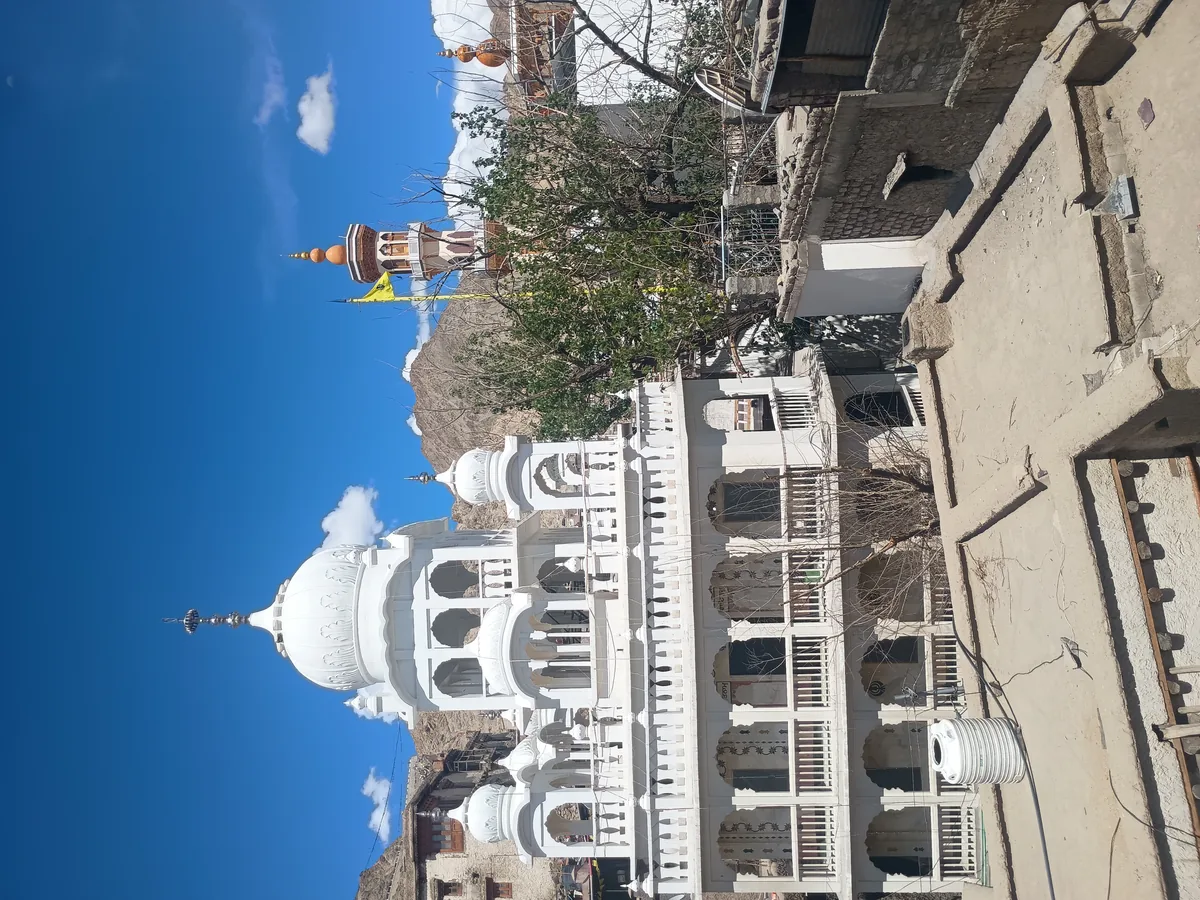
THE MEMORIAL GURUDWARA SHRINE: Directly adjacent to the tree trunk, a small, dignified shrine room has been established, housing the Sri Guru Granth Sahib under the care of local volunteers and the Indian Army's Sikh regiments, where visitors can sit on clean carpets for silent meditation.
Botanical Anomaly: Survival in Ladakh's Extreme Sub-Zero Desert
Answer-First Summary: Analyzing how a warm-climate mesquite tree survives at 11,520 feet in -25°C winters.
From a botanical perspective, the existence of Datun Sahib at 11,520 feet (3,511 meters) above sea level is an extraordinary mystery that has fascinated visiting horticulturists and naturalists for decades.
THE NATURAL RANGE OF MESQUITE: Trees of the Salvadora or Prosopis (mesquite/pilu) families are native to the warm, arid subtropical plains of Punjab, Rajasthan, and Sindh. They thrive in hot, low-altitude desert environments with high temperatures and deep sandy soil. They are not naturally equipped to survive alpine permafrost, heavy winter snowfalls, extreme atmospheric ultraviolet radiation, and months of continuous sub-zero freezes.
THE MICROCLIMATE OF OLD TOWN: Botanists speculate that the unique microclimate of Old Town Leh has contributed to its longevity. The thick mud-brick walls of surrounding ancient residences radiate absorbed daytime solar heat throughout the night, protecting the root zone from deep frost penetration. Furthermore, subterranean seepage from the natural hillside springs descending from Namgyal Tsemo ridge keeps the tree's taproot hydrated throughout the dry winter months.
CANOPY PRESERVATION & CARE: The tree's sprawling trunk measures several feet in diameter, with massive horizontal limbs supported by wooden crutches and steel bracing frames installed by the Ladakh Autonomous Hill Development Council (LAHDC) to prevent heavy winter snowpacks from fracturing the historic branches.
ANATOMICAL RESILIENCE TO ULTRAVIOLET EXPOSURE: At 11,500 feet, ultraviolet solar radiation is roughly 30% more intense than at sea level. The leaves of Datun Sahib have adapted with a thick waxy cuticle layer that prevents cellular moisture desiccation while reflecting excess infrared wavelengths. This remarkable biological fortitude allows the sacred tree to continue producing vibrant green foliage year after year, offering a welcoming emerald contrast against the stark ochre cliffs of the Leh ridge.
Senior Fleet Mechanic Advice: Town Maneuvering, Kickstand Stability & Chain Slack
Answer-First Summary: Stanzin Dorje explains secure parking on Leh's slopes, sidestand footings, and tire wear in town.
Before you park your motorcycle and head into Old Town on foot, observe several critical mechanics' rules for urban parking in Leh.
SECURE PARKING ON INCLINED SURFACES: Leh is built on an alluvial fan; almost every side street features a subtle incline. Never park your motorcycle facing downhill on its sidestand; the machine will easily roll forward off the stand and crash onto its side, snapping the clutch or front brake lever. Always park facing uphill, leave the transmission engaged in 1st gear, and pull the bike firmly back against the gear engagement before deploying the sidestand.
SIDESTAND FOOTPAD ON GRAVEL OR SOFT BITUMEN: In peak summer, Leh's asphalt parking lots soften under intense solar radiation. A narrow motorcycle sidestand foot can sink into hot bitumen or loose gravel, causing your machine to topple. PILOT TIP: Carry a compact aluminum sidestand enlarger plate or a flat crushed tin can under your seat to place beneath your kickstand foot.
INSPECTING TIRES FOR DEBRIS: Town riding exposes tires to sharp construction gravel, nails, and discarded iron wire. While your motorcycle rests at the parking lot, take two minutes to inspect the front and rear tread grooves for embedded foreign objects before they cause a slow puncture on the open highway.
Day 1 Acclimatization Walk: Zero Strain at Baseline Altitude
Answer-First Summary: Why a visit to Datun Sahib is medically ideal during your first 24 to 48 hours in Leh.
When landing in Leh, proper acclimatization requires active rest - avoiding bed-ridden lethargy while strictly shunning strenuous vertical climbs, as detailed in our Leh Acclimatization Guide.
PERFECT HORIZONTAL WALKING PROFILE: The walk to Datun Sahib from the town parking lots involves a very gentle, short stroll of roughly 250 meters with less than 15 meters of elevation gain. This allows newly arrived travelers to keep their heart rates below 90 beats per minute while gently mobilizing their leg muscles and promoting venous blood return.
SHADED RECOVERY OASIS: The microclimate beneath Datun Sahib's canopy is remarkably cool and oxygen-rich compared to the sun-baked concrete streets of the market. Resting on the stone benches beneath the leaves offers a tranquil environment to practice relaxed diaphragmatic breathing, helping reduce baseline altitude anxiety and headache symptoms.
SAFETY PROXIMITY: Should you experience sudden altitude symptoms (such as dizziness or acute shortness of breath), you are located directly in the center of Leh, within a 3-minute taxi ride of SNM District Hospital and its specialized hyperbaric oxygen chambers.
Senior Fleet Mechanic's 5-Point Town Checklist for Old Town Excursions
Answer-First Summary: Stanzin Dorje's quick pre-flight routine for urban exploring in Leh.
Before heading out from your hotel or rental shop to explore Old Town Leh, take three minutes to perform this basic mechanical check:
1. FRONT BRAKE LEVER TRAVEL: Ensure the front brake lever does not feel spongy. Urban riding requires instant brake response to avoid pedestrians emerging from blind alleyways.
2. COOLANT LEVEL CHECK: For liquid-cooled motorcycles (Himalayan 450, KTM 390 Adventure), verify that the coolant reservoir level is between MIN and MAX. Town stop-and-go riding causes cooling systems to cycle frequently.
3. TIRE PRESSURE INTEGRITY: Confirm cold tire pressures: 22 PSI front, 32 PSI rear. Low pressure increases steering heaviness dramatically at low speeds.
4. REARVIEW MIRROR TIGHTNESS: Leh's alleys have tight corners where mirrors can be knocked out of alignment. Tighten the locknuts so they stay fixed at your optimal viewing angle.
5. HORN RELIABILITY: A clear, working horn is essential for politely warning pedestrians and stray dogs around blind corners in Old Town.
Combining Datun Sahib with Old Town Heritage Attractions
Answer-First Summary: Creating a rewarding 2-hour walking circuit: Jama Masjid, Central Asian Museum, and Leh Palace.
Datun Sahib forms the spiritual centerpiece of a captivating cultural walking loop through historic Leh.
THE 2-HOUR OLD TOWN HERITAGE CIRCUIT: Begin at 10:00 AM at the Balkhang Chowk parking area. Walk into the Central Asian Museum to explore four floors of Silk Route caravan artifacts and enjoy the quiet garden courtyard.
PAYING RESPECTS AT DATUN SAHIB: At 11:15 AM, stroll 150 meters north to Datun Sahib. Spend 30 minutes sitting beneath the sacred canopy, visiting the small memorial shrine room, and soaking in the peaceful interfaith atmosphere.
OPTIONAL PALACE VIEW: If you are on Day 2 of acclimatization and feeling strong, continue walking up the paved heritage stairway toward Leh Palace. If you are still on Day 1, conclude your stroll with a refreshing seabuckthorn tea at Lala's Art Cafe before returning to your motorcycle.
Visiting Etiquette, Timings & Sacred Protocols
Answer-First Summary: Respecting the shrine, visiting hours, zero entrance fees, and shoe removal rules.
Visiting Datun Sahib is an open, welcoming experience for travelers of all backgrounds when approached with reverence.
VISITING HOURS & ACCESSIBILITY: The sacred tree and outer courtyard are accessible daily from 06:00 AM to 08:00 PM. The adjacent small memorial gurudwara shrine room is typically open from 07:00 AM to 07:00 PM. There are no midday closures.
ZERO ENTRANCE FEE: Admission to Datun Sahib is completely free. There are no commercial ticket counters. Voluntary donations to support the upkeep of the shrine can be placed in the Golak (donation box) inside the prayer room.
HEAD COVERING & SHOE REMOVAL: When entering the enclosed platform directly around the sacred tree trunk and inside the shrine room, visitors are required to remove their shoes and cover their heads with a scarf, bandana, or rumaal (head coverings are provided free at the shrine entrance). Avoid smoking, chewing tobacco, or consuming alcohol anywhere near the sacred perimeter.
PHOTOGRAPHY RULES: Photography of the magnificent tree, outer courtyard, and historic plaques is permitted. However, avoid taking flash photographs inside the small prayer room while worshippers are seated in silent prayer.
Route Milestones, Elevation & Road Conditions
| Milestone / Location | Elevation (ft / m) | Distance from Leh Market | Key Facilities & Spiritual Telemetry |
|---|---|---|---|
| Ride & Fire Rentals (Changspa) | 11,562 ft / 3,524 m | 0 km | Fleet basecamp, workshop, protective gear fittings. |
| Polo Ground Parking Apron | 11,500 ft / 3,505 m | 1.2 km | Secure municipal motorcycle parking (₹20 fee). |
| Balkhang Chowk Gate | 11,505 ft / 3,507 m | 1.4 km | Old Town entrance, pedestrian zone begins, fruit stalls. |
| Grand Jama Masjid Leh | 11,510 ft / 3,508 m | 1.5 km | Historic 1667 CE Mughal-Ladakhi mosque, carved timber. |
| Central Asian Museum | 11,500 ft / 3,505 m | 1.6 km | 4-story Tibetan Lhasa tower, caravan trading artifacts. |
| Datun Sahib Sacred Tree | 11,520 ft / 3,511 m | 1.8 km | 500-year-old mesquite tree planted by Guru Nanak in 1517 CE. |
| Memorial Gurudwara Shrine | 11,525 ft / 3,513 m | 1.8 km | Small meditation room, Sri Guru Granth Sahib, head coverings. |
| Leh Palace Lower Gate | 11,680 ft / 3,560 m | 2.1 km | Ancient royal citadel, Namgyal heritage exhibition. |
Ready for Your Ladakh Motorcycle Adventure?
Navigating the complex checkpoints and steep elevations of UT Ladakh requires both legal compliance and mechanical reliability. At Ride & Fire Rentals, we offer locally registered motorcycles with the mandatory LA-02 yellow commercial plates, ensuring you clear every military and union checkpoint seamlessly. Our fleet is 100% fuel-injected and thoroughly checked before every handover at our Changspa Road workshop.
For external travel planning references, you can check the official Ladakh Tourism Portal or apply for permits via the LAHDC Leh Permit Portal.
Season Launch Offer
Book your motorcycle direct from our Changspa Road facility. Get a standard 25% direct booking discount, plus enter coupon code LADAKH5 at checkout for an extra 5% off (saving nearly 30% total) on your entire rental! This promotion is active until June 30.
Frequently Asked Questions
What is Datun Sahib in Leh and who planted it? +
Datun Sahib is a 500-year-old sacred mesquite tree located in Old Town Leh. It was planted in 1517 CE by Guru Nanak Dev Ji - the founder of Sikhism - during his Third Udasi across Tibet and Ladakh. According to tradition, the Guru planted his herbal tooth-stick (datun) in the arid soil, which miraculously took root and grew into a massive tree.
Where is Datun Sahib located and can I ride my bike there? +
Datun Sahib is located in Old Town Leh, directly behind the Jama Masjid below Leh Palace. You cannot ride your motorcycle directly to the tree because the Old Town alleys are narrow, paved pedestrian lanes. You should park your motorcycle at the Polo Ground or Balkhang Chowk parking lots and take an easy 3-minute walk.
Do I need a permit to visit Datun Sahib? +
No. Datun Sahib is located within the central municipal area of Leh city. Neither Indian domestic travelers nor international tourists require an Inner Line Permit (ILP) or Protected Area Permit (PAP) to visit.
Is there an entry fee for Datun Sahib? +
No, visiting Datun Sahib is completely free of charge. Visitors may offer voluntary donations in the shrine room donation box to support the maintenance of the site.
What are the visiting hours for Datun Sahib? +
The tree courtyard is open daily from 06:00 AM to 08:00 PM. The adjacent memorial prayer room is typically open from 07:00 AM to 07:00 PM.
What rules must I follow when visiting Datun Sahib? +
Visitors must remove their shoes and cover their heads before stepping onto the sacred platform around the tree and entering the shrine room. Clean headscarves are provided free at the entrance. Smoking, tobacco, and alcohol are strictly prohibited.
Why is Datun Sahib revered by both Buddhists and Sikhs? +
In Ladakhi Buddhist tradition, Guru Nanak is revered as 'Guru Gompache' (The Saintly Monk) or 'Nanak Lama', regarded as an enlightened manifestation of high spiritual stature. Both Buddhist and Sikh communities revere the site as a sacred landmark of divine blessing and interfaith harmony.