Quick Summary: How do you ride a motorcycle to Korzok Village and Tso Moriri Lake?
Quick Answer: Korzok Village (15,075 ft / 4,595 m) and Tso Moriri Lake (14,836 ft / 4,522 m) are situated in the high southeastern Changthang plateau, 220 km from Leh via the Indus Valley, Chumathang, Mahe Bridge, and Namashang La pass (16,200 ft). As one of the world's highest permanent human settlements, Korzok features the 300-year-old Drukpa Korzok Gompa and traditional Changpa pastoralist communities. Because sleeping at 15,000 ft carries severe Acute Mountain Sickness (AMS) risks, spending at least 3 to 4 nights acclimatizing at lower elevations in Leh or Nubra is mandatory before sleeping here. Shoreline camping is strictly illegal to protect the delicate Ramsar wetland ecosystem. Indian travelers need an online Inner Line Permit (ILP); foreign tourists require a Protected Area Permit (PAP) arranged via an authorized Leh agency.
The Enchanted Realm of Mountain Lake: Geography, Ramsar Wetland Status & Wildlife Sanctuaries
Answer-First Summary: Tso Moriri spans 29 km of endorheic alpine blue at 14,836 ft, sheltered under the towering Mentok Kangri massifs.
Cresting the windswept pass of Namashang La (16,200 ft) and descending past the turquoise waters of Kyagar Tso Lake, the arid Changthang wilderness suddenly unfolds to reveal one of the most breathtaking sights in the trans-Himalaya: Tso Moriri (Mountain Lake). Situated at a staggering elevation of 14,836 ft (4,522 m), this pristine endorheic body of water stretches 29 km in length and up to 8 km in width, bordered by soaring glaciated peaks exceeding 20,000 feet, including Mentok Kangri (6,250 m) and Chamser Kangri (6,622 m).
Unlike Pangong Tso, which is partially saline and heavily commercialized with roadside movie prop installations, Tso Moriri is an oligotrophic, highly protected alpine ecosystem. In 2002, the Indian government and international conservation bodies designated Tso Moriri as a Wetland of International Importance under the Ramsar Convention.
Fed by sub-surface glacial springs and glacial meltwater streams, the wetland supports fragile marsh sedge meadows (Carex and Kobresia) that provide vital summer breeding and nesting habitats for some of the rarest avifauna on the planet. Travelers regularly observe the majestic Black-Necked Crane (Grus nigricollis) - the state bird of Ladakh - foraging along the shallow northern shoreline alongside large flocks of Bar-Headed Geese, Brahminy Ducks (Ruddy Shelduck), and Great Crested Grebes.
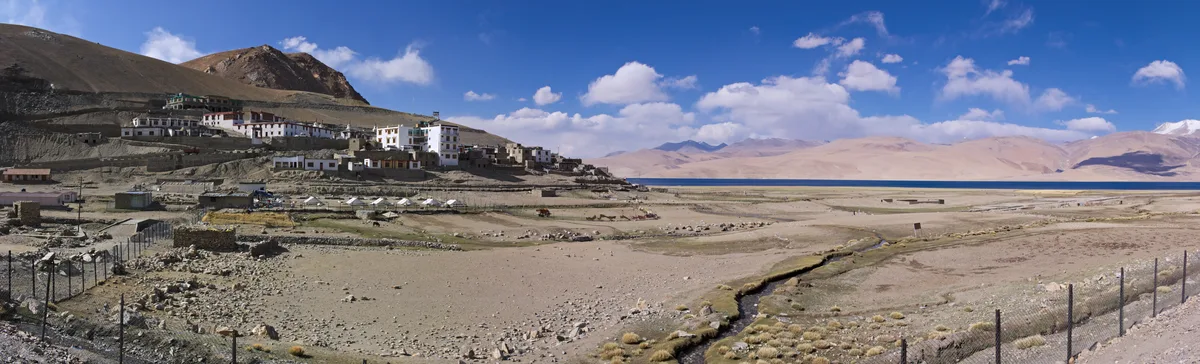
Flanking the lake's northwestern shoreline on a steep alluvial fan sits Korzok village (15,075 ft / 4,595 m) - recognized by geographers as one of the highest permanently inhabited agricultural and pastoral settlements on the planet. Here, hardy Ladakhi families cultivate the world's highest fields of naked barley and herd the prized Changra goats that produce exquisite cashmere pashmina wool.
The Sacred Sanctuary of Korzok Gompa: 300 Years of Drukpa Lineage & Ancient Relics
Answer-First Summary: Perched above the village, this 17th-century monastery serves as the spiritual compass of the Changpa nomads.
Rising like a fortress above the whitewashed stone houses of the village stands Korzok Monastery, founded around 1700 AD by the revered lama Kunga Lodro under the patronage of the local rulers of Rupshu. Affiliated with the Drukpa Kagyu lineage of Tibetan Buddhism, Korzok Gompa has served for over three centuries as the undisputed spiritual, cultural, and judicial epicenter for the nomadic Changpa tribes traversing the high plateaus.
The monastery's main prayer hall (Dukhang) houses a magnificent gilded statue of Shakyamuni Buddha flanked by ancient images of Padmasambhava, Avalokiteshvara, and the Drukpa lineage masters. The walls are adorned with smoke-blackened 18th-century frescoes depicting fierce tantric protector deities (Dharmapalas) and intricate cosmological mandalas executed with pigments ground from local mineral ores.
KORZOK GUSTOR FESTIVAL: If your motorcycle expedition arrives in mid-summer (usually July or early August), the monastery courtyard comes alive during the two-day Korzok Gustor festival. Nomadic Changpa families travel hundreds of kilometers on horseback and motorcycles from their remote valley pastures, dressed in their finest maroon woolen robes (gonchas), fur hats, and turquoise-encrusted jewelry. Resident monks perform sacred masked cham dances to traditional cymbals, long horns (dungchen), and drums, re-enacting the victory of Buddhist dharma over demonic forces and blessing the herds for the harsh winter ahead.
The Changpa Nomads of Rupshu: Cashmere Pashmina, Yak-Hair Rebo Tents & Summer Pastures
Answer-First Summary: Encountering one of the world's most resilient pastoralist cultures in the high valleys of Korzok Phu.
To visit Korzok is to step into the ancient pastoral world of the Changpas - a semi-nomadic indigenous people who have roamed the freezing Changthang grasslands for over a millennium. These resilient pastoralists maintain an intimate symbiosis with their livestock: the Tibetan sheep, hardy domestic yaks, and above all, the Capra hircus (Changthangi or Pashmina goat).
The freezing winter temperatures of Tso Moriri, which routinely drop to -35°C, stimulate the Changra goats to grow an ultra-fine undercoat of soft down beneath their shaggy outer hair. This delicate fiber - measuring less than 15 microns in diameter - is combed out by hand each spring to yield authentic Pashmina, the most valuable cashmere wool on earth and the primary economic engine of the Changpa economy.
A short 6 km ride north of Korzok village leads into Korzok Phu, the high summer grazing valley where nomadic encampments pitch their traditional Rebo tents. Woven by hand from coarse, durable black yak hair, Rebos are aerodynamic marvels: their porous weave breathes freely during sunny daytime hours while shedding rain and snow, naturally tightening in freezing night winds to trap the warmth of indoor dung stoves. If invited into a Rebo tent, accept the offered cup of steaming gur-gur cha (salty butter tea) with two hands - a universal gesture of respect and goodwill among mountain nomads.
Severe High-Altitude Sleeping Hazards: Managing Hypoxemia at 15,075 Feet
Answer-First Summary: Why sleeping at Korzok carries extreme AMS risks and how to manage pulmonary and cerebral safety.
At Ride & Fire Rentals, our highest safety priority is ensuring our riders survive high-altitude night halts without medical emergencies. While riding across an 18,000-foot pass during the day is exhilarating, sleeping at 15,075 feet (4,595 m) in Korzok places extraordinary prolonged physiological stress on the human cardiovascular system.
THE NOCTURNAL HYPOXEMIA DANGER: When you fall asleep, your autonomic nervous system naturally reduces your respiratory rate. At 15,000 feet, where the ambient barometric pressure is only 430 mmHg (compared to 760 mmHg at sea level), this drop triggers severe arterial oxygen desaturation, known as nocturnal hypoxemia. Riders who are improperly acclimatized awaken gasping for air, suffering from crushing frontal headaches, nausea, dizziness, and intense insomnia (Cheyne-Stokes breathing).
MANDATORY ACCLIMATIZATION PROTOCOL: NEVER ride to Tso Moriri directly from Leh on your first or second night. We mandate that riders spend at least 48 to 72 hours in Leh (11,562 ft) followed by an intermediate night in Nubra (10,000 ft) or Pangong (14,270 ft) before attempting an overnight stay in Korzok. If you feel dizzy, nauseous, or have a severe throbbing headache upon reaching Korzok, DO NOT sleep there. Descend immediately 60 km down to the Indus Valley at Chumathang (13,000 ft) or Upshi (11,480 ft), where the increased oxygen will rapidly reverse symptoms.
MEDICATION & HYDRATION: Drink 4 to 5 liters of water daily, as mountain air rapidly leaches moisture from your lungs. Avoid alcohol and sedatives completely; they depress the respiratory drive and drastically increase the risk of High Altitude Pulmonary Edema (HAPE). Carry Diamox (Acetazolamide) and consult a physician regarding its preventive use.
Complete Fuel Logistics & Dead Zone Calculations: The 220 km Run from Leh to Korzok
Answer-First Summary: Mapping fuel stops at Karu, the 75 km detour to Nyoma, and mandatory jerry can capacity.
Fuel planning for Tso Moriri requires strict discipline, as the high desert basin offers zero commercial petrol filling stations.
NO PETROL PUMP IN KORZOK: There is NO commercial petrol pump in Korzok village, Sumdo, or along the shores of Tso Moriri. The nearest official retail fuel pumps are located at:
1. Nyoma (75 km northeast via Mahe Bridge): An official IOCL station.
2. Karu (185 km northwest): A 24/7 IOCL multi-lane station.
ROUND-TRIP DISTANCE MATH: The standard round trip from Leh to Korzok and back via the classic Indus route is 440 km. If you plan to continue from Korzok across Polo Kongka La pass (16,200 ft) to Tso Kar (White Lake) and reconnect with the Manali-Leh Highway at Debring/More Plains, you will cover over 320 km of remote, high-altitude terrain with zero fuel infrastructure.
RECOMMENDED FUEL LOAD: For a machine like the Royal Enfield Himalayan 450 (17L tank) or Scram 411 (15L tank), a single tank is NOT sufficient to cover the Tso Moriri circuit plus high pass climbs. Every rider must carry at least 7 to 10 liters of spare petrol in sturdy, leak-proof metal jerry cans strapped to the motorcycle pannier frames. Top up 100% at Karu, and if your route permits, take the 35 km detour from Mahe Bridge to Nyoma to brim all tanks and cans before turning south into the Sumdo gorge.
Road Conditions & Motorcycle Mechanics: Tarmac, Corrugated Dirt & Sandy Shelf Tracks
Answer-First Summary: Senior Mechanic Stanzin Dorje explains suspension damping, radiator stone guards, and tire pressures.
The 220 km journey from Leh to Korzok presents two contrasting road surfaces that test both the rider's stamina and the motorcycle's chassis engineering.
LEH TO MAHE BRIDGE (165 km): This entire stretch follows the scenic Indus River canyon along National Highway 1D. Built by BRO Project HIMANK, the road consists of smooth, sweeping, high-speed asphalt with gentle gradients and broad corners. Riding speeds of 60 to 75 km/h are easily sustained.
MAHE TO SUMDO & NAMASHANG LA (25 km): The road narrows as it branches south into the barren Rupshu mountains, climbing gently past Puga geothermal valley to summit Namashang La pass (16,200 ft). The ascent features older asphalt with occasional patches of loose gravel and frost-heave cracks.
THE FINAL CORRUGATED SECTOR (SUMDO TO KORZOK, 30 km): Once you descend Namashang La and pass Kyagar Tso, the paved blacktop ends abruptly. The final 30 km along the lake's western edge consists of unpaved, deeply corrugated dirt washboards, loose gravel shelves, and fine sand tracks. Riding over continuous washboard ridges creates violent high-frequency vibrations that loosen license plate bolts, headlight brackets, and luggage straps.
MECHANIC SETUP: Before hitting the washboards, soften your rear monoshock preload by 1 to 2 clicks to allow the suspension to absorb the chatter rather than transferring shocks into your spine. Lower your tire pressures slightly (to 20 PSI front, 28 PSI rear) to expand the tire contact patch over loose gravel. Maintain a steady standing posture on your footpegs with bent knees, keeping your weight centered and letting the motorcycle track freely beneath you.
Strict Eco-Regulations & Ramsar Wetland Conservation Rules: What is Illegal at Tso Moriri
Answer-First Summary: Why shoreline tent camping and off-road riding result in heavy fines and police impoundment.
Because Tso Moriri is an internationally recognized Ramsar wetland and a fragile wildlife sanctuary, the Ladakh Autonomous Hill Development Council (LAHDC) and Department of Wildlife Protection enforce zero-tolerance environmental laws.
SHORELINE CAMPING IS STRICTLY ILLEGAL: Pitching personal tents, setting up commercial camps, or parking vehicles within 500 meters of the lake shoreline is strictly banned by Supreme Court and UT Ladakh directives. The wetlands and soft sandy banks are critical nesting grounds for endangered migratory birds. Violators face minimum fines of ₹5,000 to ₹25,000, and vehicles driven onto the marshlands will be impounded by police checkposts.
NO OFF-ROAD DRIVING: Stay strictly on the established vehicular tracks. Joyriding across the fragile desert steppe destroys thousands of years of cryptobiotic soil crusts and crushes bird eggs buried in shallow shoreline nests.
PLASTIC & LITTER BAN: UT Ladakh enforces a strict single-use plastic ban. Carry reusable insulated water bottles, avoid buying disposable plastic water bottles in the village, and pack out 100% of your non-biodegradable waste (granola wrappers, chain lube cans, used wet wipes) back to Leh.
Accommodation Realities, Homestay Etiquette & Recommended Itineraries
Answer-First Summary: Where to sleep in Korzok, booking basic family homestays, and integrating the Tso Moriri-Tso Kar loop.
Understanding lodging realities in Korzok prevents disappointment and ensures a comfortable stay.
HOMESTAY & GUESTHOUSE REALITIES: There are no five-star luxury resorts in Korzok. Lodging is limited to established seasonal guesthouses (such as Tsomoriri Hotel Lake View, Mentok Guesthouse) and traditional family-run Ladakhi homestays. Rooms are clean but basic, featuring thick traditional quilts, solar-heated water buckets, and limited electricity from 07:00 PM to 10:30 PM. Room rates range from ₹1,200 to ₹3,500/night including home-cooked dinner and breakfast.
THE MASTER CIRCUIT ITINERARY: To experience Tso Moriri at its finest, we recommend the 'Changthang Twin Lakes Circuit':
DAY 1: Leh to Tso Moriri via Karu, Chumathang, and Mahe Bridge (220 km, 6-7 hours). Evening sunset walk through Korzok village and prayer flag terraces overlooking the turquoise lake.
DAY 2: Morning visit to the 300-year-old Korzok Gompa and a gentle ride into Korzok Phu nomadic pastures. Depart Korzok at 11:00 AM, cross Polo Kongka La pass (16,200 ft), and descend into the vast hyper-saline salt pans of Tso Kar (White Lake). Explore the Puga geothermal steam vents and join the Manali-Leh highway at Debring over the mighty Tanglang La pass (17,480 ft) back to Leh.
Route Milestones, Elevation & Road Conditions
| Milestone | Elevation (ft / m) | Distance from Leh | Key Facilities & Highway Telemetry |
|---|---|---|---|
| Leh Main Market | 11,562 ft / 3,524 m | 0 km | Ride & Fire Rentals, full-service mechanics, IOCL pumps, ATMs. |
| Karu Junction & Fuel | 11,300 ft / 3,444 m | 35 km | Major military base, 24/7 petrol pump, ATM, cafes. |
| Upshi Police Checkpost | 11,480 ft / 3,500 m | 48 km | Checkpost registration, highway split (Manali vs Changthang). |
| Chumathang Hot Springs | 13,000 ft / 3,962 m | 140 km | Natural boiling sulfur springs, dhabas, basic homestays. |
| Mahe Bridge Checkpoint | 13,600 ft / 4,145 m | 165 km | Mandatory permit checkpoint, concrete bridge across Indus River. |
| Sumdo Village Junction | 14,100 ft / 4,297 m | 180 km | Valley junction: branch east to Hanle vs south to Tso Moriri. |
| Puga Geothermal Valley | 14,500 ft / 4,420 m | 185 km | Steaming sulfur geysers, pilot geothermal energy wells, mud pools. |
| Namashang La Pass Summit | 16,200 ft / 4,937 m | 195 km | Scenic mountain pass, prayer flags, broad gravel hairpins. |
| Kyagar Tso (Small Lake) | 15,300 ft / 4,663 m | 202 km | Turquoise saline lake, Changpa nomads, wild kiangs grazing. |
| Korzok Viewpoint (Tarmac Ends) | 14,900 ft / 4,541 m | 210 km | Pavement terminates, unpaved corrugated washboards begin. |
| Korzok Village & Gompa | 15,075 ft / 4,595 m | 220 km | World's highest permanent village, 300-yr monastery, homestays. |
| Tso Moriri Lake Shoreline | 14,836 ft / 4,522 m | 222 km | Ramsar wetland, black-necked cranes, camping strictly illegal. |
Ready for Your Ladakh Motorcycle Adventure?
Navigating the complex checkpoints and steep elevations of UT Ladakh requires both legal compliance and mechanical reliability. At Ride & Fire Rentals, we offer locally registered motorcycles with the mandatory LA-02 yellow commercial plates, ensuring you clear every military and union checkpoint seamlessly. Our fleet is 100% fuel-injected and thoroughly checked before every handover at our Changspa Road workshop.
For external travel planning references, you can check the official Ladakh Tourism Portal or apply for permits via the LAHDC Leh Permit Portal.
Season Launch Offer
Book your motorcycle direct from our Changspa Road facility. Get a standard 25% direct booking discount, plus enter coupon code LADAKH5 at checkout for an extra 5% off (saving nearly 30% total) on your entire rental! This promotion is active until June 30.
Riding the 30 km Washboard Corrugations: Chassis Vibration Isolation & Spoke Care
Answer-First Summary: Mastering the brutal unpaved corrugated washboards between Kyagar Tso and Korzok village without damaging your bike.
While the ride along the Indus to Mahe Bridge is silky smooth, the final 30 km stretch skirting Kyagar Tso toward Korzok village presents some of the most punishing corrugated dirt washboards in the Western Himalayas.
WASHBOARD RESONANCE PHYSICS: Heavy 4x4 tourist transport vehicles carve rhythmic, closely spaced lateral ridges into the dry silt. Riding over these corrugations at low speeds (15 to 20 km/h) sends violent harmonic shockwaves through the motorcycle chassis, rattling handlebars, jarring tooth enamel, and fatiguing forearms. Counterintuitively, slightly increasing your velocity to 35-45 km/h allows the tires to skim across the crests of the ridges rather than falling into every trough, dramatically smoothing the chassis ride.
BODY POSITION & BIOMECHANICS: Stand fully upright on your footpegs with the balls of your feet centered over the pegs. Clamp your inner knees lightly against the fuel tank side grips and keep your arms loose with elbows flared out wide. Let your legs act as natural secondary shock absorbers, absorbing vertical chatter while keeping your head and torso level.
LUGGAGE SECUREMENT & ROC STRAP CHECKS: Elastic rubber bungee cords are dangerous on corrugated tracks - the continuous bouncing causes bungees to stretch and snap, launching heavy duffel bags into your rear wheel and locking up the drivetrain. Use heavy-duty nylon webbing straps with quick-release cam buckles (such as Roc Straps). Stop after the first 5 km of washboard riding to cinch down all luggage straps, as vibrations naturally compress soft duffels.
SPOKE NIPPLE & RIM DEFENSE: Inspect your wire-spoke wheels upon arriving in Korzok. If any spoke sounds loose or wobbly when tapped, gently tighten the nipple with a spoke wrench just until it matches the pitch of neighboring spokes. Do not overtighten, as uneven tension can pull the aluminum rim out of round.
Route Telemetry: How to Reach This Destination
Before heading out, check our detailed real-time distance and road telemetry guides for exact mileage, checkpoint rules, fuel stops, and mountain pass clearances:
215 km route through Chumathang hot springs and Namshang La (16,000 ft).
Remote Trans-Himalayan route along Tsaga La, Loma, and Nyoma.
Recommended Rental Vehicles from Ride & Fire:
Conquer this route with our expedition-spec Toyota Hilux 4x4 (700mm wading depth & heavy payload) or the unyielding Mahindra Bolero Camper 4x4. For solo two-wheeler riders, the Royal Enfield Himalayan 450 provides the best ground clearance (230 mm) for water crossings. We also facilitate guaranteed on-request bookings for Thar 4x4 and Jimny 4x4 with 100% legal UT Ladakh commercial yellow plates.
Reserve Vehicle on WhatsApp →Frequently Asked Questions
Is shoreline camping permitted at Tso Moriri Lake in Ladakh? +
No. Shoreline camping, pitching personal tents, or driving vehicles within 500 meters of Tso Moriri is strictly illegal under Supreme Court directives and Ladakh Wildlife Department regulations. Tso Moriri is a protected Ramsar Wetland and a critical breeding site for endangered Black-Necked Cranes. Violators face minimum fines of ₹5,000 to ₹25,000, and vehicles will be impounded.
Do I need an Inner Line Permit (ILP) to visit Tso Moriri and Korzok? +
Yes. Tso Moriri is located within a restricted border zone. Indian domestic citizens must obtain an online Inner Line Permit (ILP) through lahdclehpermit.in, explicitly selecting 'Tso Moriri / Korzok'. Foreign nationals require a Protected Area Permit (PAP) issued via a registered travel agency in Leh in groups of at least two persons.
How dangerous is altitude sickness (AMS) when sleeping at Korzok village? +
Very dangerous if improperly acclimatized. Korzok sits at 15,075 ft (4,595 m), where atmospheric oxygen is only ~58% of sea level. Sleeping here triggers severe nocturnal hypoxemia if you have not spent at least 3 to 4 prior nights acclimatizing in Leh or Nubra. If you develop a severe headache, nausea, or shortness of breath, descend immediately to Chumathang or Upshi.
Where is the nearest petrol pump to Tso Moriri? +
There are no fuel pumps in Korzok village. The nearest official filling stations are at Nyoma (75 km northeast via Mahe Bridge) and Karu (185 km northwest). Riders must top up completely before heading to the lake and carry 7 to 10 liters of extra fuel in jerry cans.
What are the road conditions between Leh and Korzok (Tso Moriri)? +
The first 165 km from Leh to Mahe Bridge is smooth, well-paved two-lane highway asphalt. The stretch from Mahe to Namashang La pass (16,200 ft) is older asphalt with occasional frost heaves. The final 30 km along the lake from Kyagar Tso to Korzok consists of rough, unpaved, deeply corrugated washboard dirt and gravel.
Are there luxury hotels and mobile network coverage in Korzok? +
No. Accommodation in Korzok is limited to basic family-run Ladakhi homestays and rustic seasonal guesthouses. Electricity is available via solar power for 3 to 4 hours in the evening. There is no commercial Wi-Fi, and cellular mobile networks (outside postpaid SIMs) generally do not work.
How long does it take to ride from Leh to Tso Moriri by motorcycle? +
The 220 km motorcycle ride takes approximately 6 to 7 hours of active riding time, allowing for checkpost document registrations, fuel top-ups, and scenic photo stops along the Indus River and Kyagar Tso.