
Quick Summary: How do you visit Stakna Monastery (Tiger's Nose) by motorcycle from Leh?
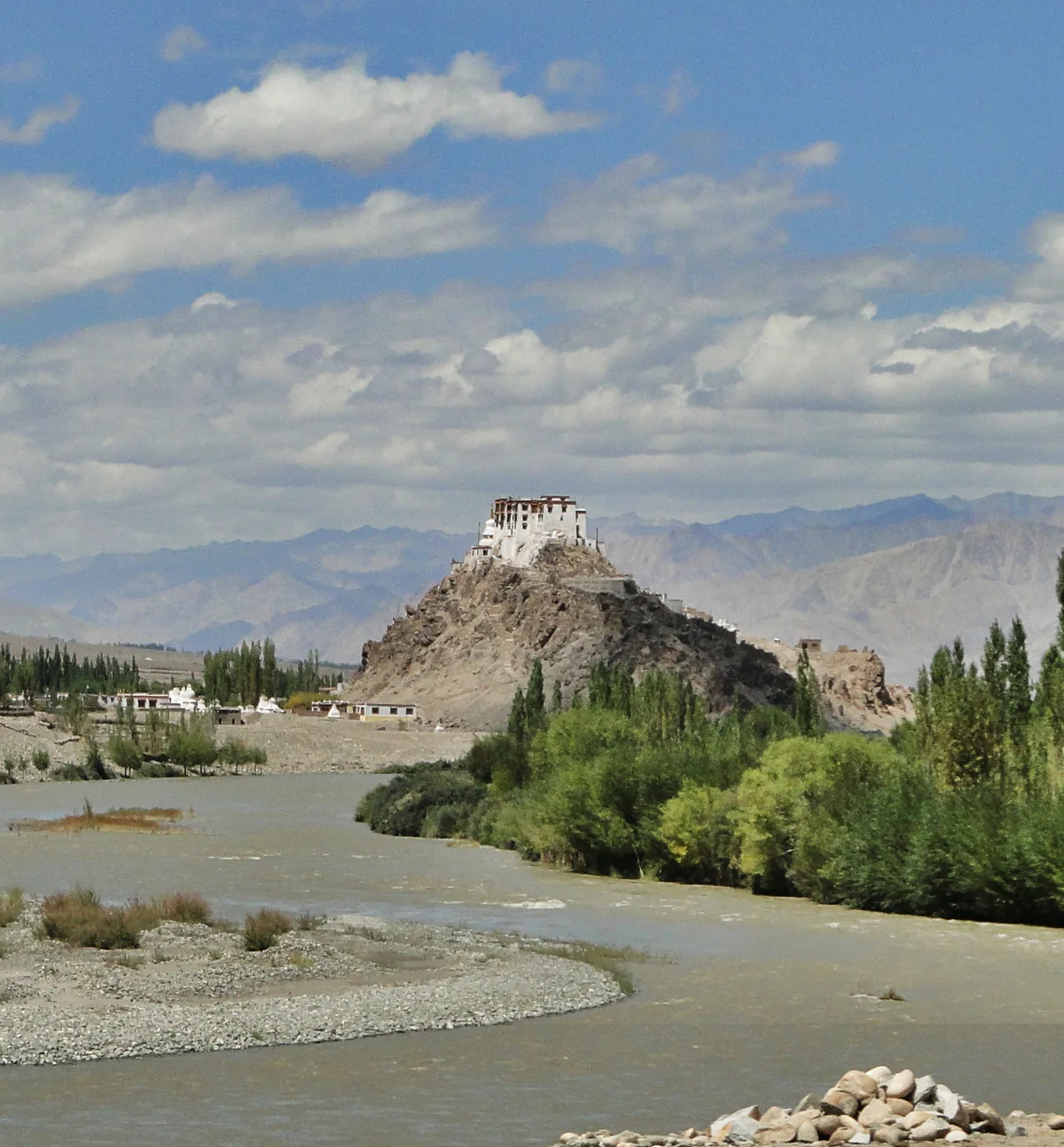
Quick Answer: Stakna Monastery (11,800 ft / 3,600 m) is situated 25 km southeast of Leh, perched atop an isolated rocky hillock rising dramatically from the bed of the Indus River. The hill resembles a leaping tiger's nose, giving the monastery its name ('Stak-na'). Founded circa 1580 AD by the Bhutanese saint Chosje Jamyang Palkar, it is the sole Bhutanese Drukpa Kagyu monastery in Ladakh. By motorcycle, it is accessed via the smooth Leh-Manali Highway (NH3), crossing a historic wooden suspension bridge over the turquoise Indus River before ascending a short paved spiral track to the monastery courtyard. Open daily from 06:00 AM to 06:00 PM with free admission. It offers an intimate, crowd-free alternative to Thiksey and Hemis.
The Tiger's Nose of the Indus: Dramatic Topography, River Islets & Bhutanese Drukpa Kagyu Origins
Answer-First Summary: Rising sheer from the alluvial riverbed at 11,800 ft, Stakna stands as Ladakh's sole Bhutanese spiritual citadel.
Riding southeast from Leh along the sweeping blacktop of National Highway 3 (the Leh-Manali Highway), the wide braided floodplains of the Indus River present a succession of whitewashed monasteries clinging to mountain crags. But at km 25, an extraordinary geographic anomaly commands attention: an isolated, rocky hillock rises 200 feet directly out of the center of the riverbed, crowned by a fortress-like monastery complex surrounded by fluttering prayer flags.
Locals have called this rocky outcrop 'Stakna' (classical Tibetan: Tag-na, meaning 'Tiger's Nose') for centuries, as the elongated shape of the limestone knoll when viewed from the north uncannily resembles the snout of a leaping royal Bengal tiger poised above the turquoise waters of the river.
Stakna holds a singular place in Himalayan ecclesiastical history: it is the only monastery in UT Ladakh affiliated with the Southern Drukpa Kagyu school originating in Bhutan, spiritually linked to the Je Khenpo (supreme religious head of Bhutan). The monastery was founded around 1580 AD by the revered Bhutanese scholar and master saint Chosje Jamyang Palkar, who traveled across the trans-Himalaya upon the invitation of the Ladakhi king, Jamyang Namgyal. Recognizing the saint's supreme spiritual accomplishments, the king gifted him the dramatic river rock, royal land endowments, and spiritual authority across numerous estate villages.
Unlike mass-tourism destinations like Thiksey or Hemis, which frequently host dozens of tour buses, Stakna remains remarkably serene, contemplative, and authentic. Home to approximately 30 resident monks, the monastery echoes with the soft sounds of flowing river water, canyon winds, and morning gong chimes, providing motorcyclists with an intimate immersion into living Himalayan Buddhist tradition.
Sacred Relics of Saint Jamyang Palkar: The Kamrup Arya Avalokiteshvara & Silver Chorten
Answer-First Summary: Inside the assembly halls, priceless statues and sacred relics survive from centuries of trans-Himalayan pilgrimages.
Climbing the stone staircase into the central assembly hall (Dukhang), visitors step into an opulent sanctuary preserved with remarkable devotion. The interior walls feature vibrant 18th-century frescoes illustrating the Eighty-Four Mahasiddhas of India, Shakyamuni Buddha, and lineage masters of the Drukpa Kagyu school.
THE SACRED KAMRUP ARYA AVALOKITESHVARA: The primary religious treasure of Stakna is a small, exquisitely sculpted statue of Arya Avalokiteshvara (the Bodhisattva of Universal Compassion). Monastic chronicles record that this sacred image was brought to Ladakh in the 16th century all the way from Kamrup in Assam by Chosje Jamyang Palkar. Revered as a 'talking statue' endowed with miraculous spiritual power, it is housed within a gilded glass reliquary draped in fine silk scarves.
THE SEVEN-FOOT SILVER CHORTEN: On the upper floor chapel stands a magnificent seven-foot-tall silver-gilded reliquary stupa (chorten), commissioned by the King of Ladakh to enshrine the sacred mortal remains of Chosje Jamyang Palkar. The stupa is encrusted with turquoise, coral, lapis lazuli, and amber gems gifted by royal caravans returning from Tibet and Central Asia. Next to the chorten are precious silver statues of Padmasambhava, Shabdrung Ngawang Namgyal (the unifier of Bhutan), and Bodhisattva Maitreya, making Stakna a treasure-house of Himalayan art.
Motorcycle Route Logistics: Cruising NH3, the Indus Wooden Suspension Bridge & Hillock Ascent
Answer-First Summary: Navigating 25 km of smooth highway blacktop, timber plank bridges, and the winding spiral climb.
The motorcycle ride from Leh to Stakna is an effortless, deeply relaxing half-day trip that highlights the visual grandeur of the Central Indus Valley.
HIGHWAY TELEMETRY ON NH3: Leaving Ride & Fire Rentals in Changspa, head south past Choglamsar and merge onto NH3. The road is immaculate, wide, dual-lane military asphalt maintained by BRO Project HIMANK. You cruise past Sindhu Ghat (km 9), Shey Palace (km 15), and the towering terrace of Thiksey Monastery (km 19). At km 24, a prominent signboard directs riders to turn right toward 'Stakna Monastery / Bridge'.
CROSSING THE INDUS TIMBER BRIDGE: The access road branches off the highway tarmac onto a picturesque single-lane suspension bridge crossing the rushing Indus River. The bridge deck is constructed of heavy, weathered wooden planks secured to a steel truss framework. PILOT ADVICE: Reduce your speed to 10-15 km/h before rolling onto the timber decking. Loose or uneven wooden planks can produce unexpected tire deflection, especially on narrow front dual-sport tires. Maintain a straight handlebar line and steady throttle across the river.
SPIRAL HILLOCK ASCENT: Once across the river, the road turns left and immediately begins a gentle, winding paved climb snaking around the southern contours of the rocky hillock. The 800-meter climb features three broad, sweeping hairpins with smooth asphalt and protective stone parapets, terminating directly at the level paved terrace outside the monastery entrance gates.
Mechanical Telemetry & Bridge Physics: Crossing Timber Planks on Loaded Adventure Bikes
Answer-First Summary: Senior Mechanic Stanzin Dorje explains tire deflection, suspension compression, and kickstand safety on river terraces.
At Ride & Fire Rentals, we frequently guide riders across the historic bridges of the Indus. Crossing wooden-plank suspension structures requires specific riding awareness.
TIMBER PLANK TRACTIVE COEFFICIENT: Weathered timber planks have a substantially lower friction coefficient than asphalt, particularly in the morning when dew or river spray dampens the wood grain. Never apply aggressive front brake pressure while tires are rolling across wooden bridge planks, as the front wheel can lock and wash out instantly. Rely on gentle, balanced rear-brake dragging to modulate your speed across the bridge spans.
SUSPENSION ACTION OVER EXPANSION JOINTS: Steel suspension bridges feature raised transition expansion joints where the abutment meets the approach ramp. As your front 21-inch wheel rolls over the steel lip, ease off the brake lever to allow the front fork to stroke freely through its travel, preventing harsh rim strikes on loaded machines carrying full side panniers.
PARKING TERRACE INCLINES: The parking terrace outside Stakna Monastery sits on an exposed, windswept rock saddle overlooking the river. Always park your motorcycle in 1st gear, pointed facing into the gentle slope with the side stand deployed firmly on level bedrock. Never leave the transmission in neutral on a slope; afternoon river gusts can rock the bike forward, collapsing the side stand and sending the machine crashing onto the stone flagstones.
Senior Fleet Mechanic Advice: Engine Cooling, Chain Lubrication & Dusty Valley Winds
Answer-First Summary: Managing thermal loads, radiator cleaning, and dry-film wax lube in the Central Indus basin.
While the ride to Stakna involves minimal elevation climb compared to Khardung La, the lower Indus basin introduces distinct mechanical factors that every rider should manage.
RADIATOR INSECT & SEED DEFENSE: During mid-summer (July and August), the lush irrigated barley fields surrounding Shey, Thiksey, and Stakna produce dense swarms of insects and floating poplar seed fluff. These particles get drawn into the delicate aluminum cooling fins of liquid-cooled machines like the Royal Enfield Himalayan 450 or KTM 390 Adventure, restricting airflow. Inspect your radiator face daily; gently rinse trapped debris from behind the core with low-pressure water. Never use high-pressure car washers, which bend cooling fins and ruin heat-exchange efficiency.
CHAIN LUBRICATION IN RIVERBED SAND: The river corridor around Stakna is prone to afternoon sand drifts whipped up by riverbed winds. Wet, sticky chain lubes attract fine river silt, grinding down O-rings and sprocket teeth. Spray dry-film chain wax every 300 km, allowing it to dry thoroughly before riding.
TIRE PRESSURES FOR STREET TOURING: Maintain standard street touring tire pressures: 22 PSI front and 32 PSI rear (solo) or 36 PSI rear (with pillion/luggage). The smooth NH3 tarmac allows for stable, high-speed tracking at 65 to 75 km/h.
Fuel Logistics & Resupply: Staging from Leh & Karu Junction
Answer-First Summary: Mapping fuel stations between Leh city center, Choglamsar, and the major Karu junction pump.
Fuel planning for the Stakna circuit is straightforward, as the central highway is well-served with commercial infrastructure.
ROUND-TRIP DISTANCE MATH: The round-trip distance from Leh to Stakna is 50 km. A modern single-cylinder touring bike consumes less than 2 liters of petrol for this entire ride. You do not need external fuel cans or spare jerry containers.
PETROL STATIONS: The primary retail pumps along this corridor are:
1. Choglamsar (km 6 from Leh): High-capacity Indian Oil (IOCL) station.
2. Karu Junction (km 35 from Leh, 10 km past Stakna): A massive 24/7 multi-bay IOCL station equipped with clean restrooms, air pumps, and digital payments.
If your day's itinerary includes continuing past Stakna to visit Hemis Monastery (45 km from Leh) or ascending into the Changthang plateau via Chang La pass, stop at Karu to top your main fuel tank to 100% capacity.
Monastic Silence, Photography Etiquette & Resident Monk Hospitality
Answer-First Summary: Experiencing the tranquil courtyard, butter tea invitations, and respecting prayer hours.
Because Stakna receives only a fraction of the commercial foot traffic of neighbouring monasteries, the resident monks are exceptionally warm, welcoming, and hospitable toward respectful travelers.
VISITING HOURS & ENTRY: Stakna Monastery is open daily from 06:00 AM to 06:00 PM. Admission is 100% free of charge. There are no mandatory entry ticket counters or camera fees, though placing a voluntary donation of ₹20 to ₹50 into the monastery collection box is customary and helps maintain the ancient complex.
BUTTER TEA & MONASTIC HOSPITALITY: Visitors climbing to the upper rooftop terrace are frequently invited into the monastic kitchen (sol-thab) by resident lamas for a warm cup of gur-gur cha (salty Ladakhi butter tea) and dry roasted barley flour (tsampa). Accept the cup with two hands, take a small sip, and enjoy the tranquil conversation. If offered tea, leaving a small cash donation on the kitchen table before departing is considered polite.
ROOFTOP 360-DEGREE VIEWPOINT: Don't miss climbing the narrow wooden stairs to the monastery's flat roof terrace. From this elevated platform atop the Tiger's Nose, you enjoy an uninterrupted, 360-degree panorama over the turquoise braids of the Indus River flowing east to west, flanked by the lush green fields of Stakna village on one side and the dramatic white tiered towers of Thiksey Monastery rising 6 km away across the valley.
Itinerary Architecture: The Central Indus Gompa Loop (Shey, Thiksey, Stakna & Hemis)
Answer-First Summary: Structuring the definitive full-day cultural loop along the eastern Indus corridor.
Stakna Monastery is best experienced as an integral component of the 'Central Indus Monastic Loop' - the quintessential Day 2 acclimatization itinerary for Ladakh riders:
09:00 AM - Depart Ride & Fire Rentals in Leh along NH3.
09:30 AM - Stop at Sindhu Ghat (km 9) for a peaceful morning stroll along the sacred riverbanks.
10:15 AM - Explore the ancient summer palace and giant copper-gilt Shakyamuni Buddha at Shey Palace (km 15).
11:30 AM - Marvel at the 12-story architectural splendor of Thiksey Monastery and its 49-foot Maitreya Buddha (km 19).
01:00 PM - Savor an organic Ladakhi garden lunch at a local cafe near Thiksey.
02:15 PM - Cross the Indus suspension bridge to explore the peaceful Bhutanese sanctuary of Stakna Monastery (km 25). Spend 1.5 hours wandering the quiet courtyards and enjoying panoramic views from the Tiger's Nose.
04:00 PM - Continue 15 km further southeast along the gorge to visit the royal treasure-house of Hemis Monastery (km 45).
05:30 PM - Smooth, relaxed highway cruise back to Leh along NH3, arriving comfortably before dusk.
Riverbed Crosswind Dynamics & Sand Drift Management along the Southern Indus Bank
Answer-First Summary: Handling sudden lateral crosswinds and loose sand patches on the Stakna approach road.
As the afternoon heats up, the broad Indus river valley acts as a thermal wind tunnel. Strong katabatic winds channel down from the high glaciated ridges of the Zanskar Range, generating sustained crosswinds of 40 to 60 km/h across the Stakna bridge and river approach.
RIDING TECHNIQUE IN CROSSWINDS: When crossing the open riverbed terrace toward Stakna, keep your body relaxed and flexible. Never lock your elbows or death-grip the handlebars; tense muscles cause sudden, jerky steering over-corrections when a wind gust strikes your front wheel. Lean the motorcycle slightly into the direction of the wind while keeping your upper torso centered over the chassis line, and tuck your knees securely against the rubber tank pads.
MANAGING SAND DRIFTS: Where the paved approach road skirts the riverbed gravel, dry wind frequently deposits thin drifts of fine alluvial sand across the asphalt surface. These sand patches look harmless from a distance but act like ball bearings under street tires. Approach sandy patches with a straight handlebar, avoid sudden brake inputs, and maintain steady, smooth throttle to let the front tire track smoothly through the loose silt.
Route Milestones, Elevation & Road Conditions
| Milestone | Elevation (ft / m) | Distance from Leh | Key Facilities & Highway Telemetry |
|---|---|---|---|
| Leh Main Market | 11,562 ft / 3,524 m | 0 km | Ride & Fire Rentals, full-service workshop, IOCL pumps, ATMs. |
| Choglamsar Transit Hub | 11,300 ft / 3,444 m | 6 km | Bustling market, IOCL petrol pump, Tibetan handicraft center. |
| Sindhu Ghat Promenade | 10,500 ft / 3,200 m | 9 km | Sacred riverbank walkway, amphitheater, parking bay. |
| Shey Palace & Monastery | 11,200 ft / 3,414 m | 15 km | Royal summer capital, copper-gilt Shakyamuni Buddha, parking. |
| Thiksey Gompa Terrace | 11,800 ft / 3,600 m | 19 km | 12-story mini-Potala, 49-ft Maitreya Buddha, restaurants. |
| Stakna Turnoff (NH3) | 11,400 ft / 3,475 m | 24 km | Highway junction, signpost: Stakna Monastery / Bridge. |
| Indus Timber Bridge | 11,350 ft / 3,459 m | 24.5 km | Single-lane wooden suspension bridge across Indus River. |
| Stakna Monastery Gate | 11,800 ft / 3,600 m | 25.3 km | Tiger's Nose hillock, parking terrace, Kamrup Avalokiteshvara. |
| Karu Junction & Fuel | 11,300 ft / 3,444 m | 35 km | Major military hub, 24/7 petrol station, ATMs, Chang La gateway. |
| Hemis Monastery Gate | 12,000 ft / 3,658 m | 45 km | Drukpa Kagyu headquarters, Naropa museum, Hemis festival. |
Ready for Your Ladakh Motorcycle Adventure?
Navigating the complex checkpoints and steep elevations of UT Ladakh requires both legal compliance and mechanical reliability. At Ride & Fire Rentals, we offer locally registered motorcycles with the mandatory LA-02 yellow commercial plates, ensuring you clear every military and union checkpoint seamlessly. Our fleet is 100% fuel-injected and thoroughly checked before every handover at our Changspa Road workshop.
For external travel planning references, you can check the official Ladakh Tourism Portal or apply for permits via the LAHDC Leh Permit Portal.
Season Launch Offer
Book your motorcycle direct from our Changspa Road facility. Get a standard 25% direct booking discount, plus enter coupon code LADAKH5 at checkout for an extra 5% off (saving nearly 30% total) on your entire rental! This promotion is active until June 30.
Senior Fleet Mechanic's Suspension Setup & Tire Deflection Guide for Indus River Terraces
Dialing in preload, rebound damping, and tire contact patches for timber bridge transitions and gravel tracks.
At Ride & Fire Rentals, our senior workshop technicians tune motorcycle chassis specifically for the mixed terrain of the Central Indus Valley. Even on a gentle 50 km loop to Stakna, crossing wooden suspension bridges and undulating river gravel terraces tests your suspension geometry and tire grip dynamics.
SUSPENSION PRELOAD & COMPRESSION DAMPING: Before setting out along the Indus, adjust your rear shock preload to match your payload. On the Royal Enfield Himalayan 450 with its 43mm Showa upside-down front forks and linkage-type rear monoshock, add 2 clicks of preload if you are carrying hard aluminum panniers or a pillion rider. This prevents the rear end from squatting excessively, preserving the correct steering rake angle (26.5 degrees) and preventing front-wheel vagueness when carving through the sweeping turns of NH3.
TIRE DEFLECTION & CONTACT PATCH DYNAMICS: Maintain 22 PSI in your front tire and 32 to 34 PSI in your rear tire (cold reading in Leh). Lowering tire pressures too much on paved roads increases rolling resistance and generates excessive internal tire carcass heat, leading to premature center-tread wear. At these pressures, dual-sport tires like the CEAT Gripp-XL or Metzeler Karoo Street provide an optimal contact patch over the timber planks of the Stakna suspension bridge while remaining stiff enough to resist rim damage when striking sharp expansion joints.
STEERING DYNAMICS & HAIRPIN TECHNIQUE: The short 800-meter climb winding up the rocky Stakna bluff features three sharp 180-degree uphill hairpins. When negotiating these tight corners on an adventure motorcycle with a 21-inch front wheel, keep your elbows elevated, look through the exit of the turn toward the monastery portal, and maintain light, steady throttle in 1st gear. Dragging the rear foot brake lightly stabilizes the chassis, smoothing out drive-chain lash and preventing the bike from falling inward into the apex.
KICKSTAND SAFETY & PARKING TERRACE STABILITY: The parking terrace outside Stakna Monastery sits on an exposed, windswept rock saddle overlooking the Indus River. Afternoon thermal wind funnels down the valley with surprising force. Always park your motorcycle in 1st gear with the front wheel pointed slightly uphill, deploying the side stand on flat, solid bedrock. If parking on loose gravel, place a flat river stone or a kickstand enlarger footplate beneath the side stand puck to prevent the motorcycle from sinking and toppling onto its fairings.
POST-RIDE RADIATOR & AIR FILTER CHECK: Upon returning to Leh after riding along the fertile farm terraces of Shey, Thiksey, and Stakna, inspect your radiator core. During July and August, blooming poplar trees and irrigated agricultural fields release clouds of airborne seeds that lodge between radiator cooling fins. A quick rinse with low-pressure water keeps your cooling system operating at peak thermal efficiency for the high-altitude passes ahead.
Frequently Asked Questions
What does the name 'Stakna' mean, and why is it called the Tiger's Nose? +
In classical Tibetan, 'Stak' means tiger and 'Na' means nose ('Tag-na'). The monastery is named after the isolated rocky hillock upon which it is built, which, when viewed from the northern highway approach, closely resembles the facial profile and snout of a leaping tiger above the Indus River.
What are the visiting hours and entry fee for Stakna Monastery? +
Stakna Monastery is open daily from 06:00 AM to 06:00 PM. Admission is 100% free of charge for all visitors. There is no entry ticket, parking fee, or camera charge, though voluntary donations into the monastery collection box are appreciated to support the resident lamas.
What makes Stakna Monastery unique among Ladakh's Buddhist monasteries? +
Stakna is the ONLY monastery in Ladakh affiliated with the Bhutanese Drukpa Kagyu tradition, spiritually connected to the Je Khenpo of Bhutan. It was founded in 1580 AD by Bhutanese saint Chosje Jamyang Palkar and houses a sacred 16th-century statue of Arya Avalokiteshvara brought from Kamrup, Assam.
How do you reach Stakna Monastery by motorcycle from Leh? +
Take the smooth Leh-Manali Highway (NH3) southeast from Leh for 24 km. Turn right at the Stakna signboard, cross the picturesque single-lane wooden-plank suspension bridge over the Indus River, and ride the 800-meter paved spiral road up the hillock to the monastery entrance.
Do I need an Inner Line Permit (ILP) to visit Stakna Monastery? +
No. Stakna is located along the open National Highway 3 corridor in the Central Indus Valley. Neither Indian domestic travelers nor foreign tourists require an Inner Line Permit (ILP) or Protected Area Permit (PAP) to visit.
Where is the nearest petrol pump to Stakna Monastery? +
The nearest fuel stations are located in Choglamsar (19 km northwest toward Leh) and at Karu Junction (10 km southeast along NH3). A full tank from Leh easily covers the entire 50 km round-trip ride.
Can I cross the Stakna Indus wooden bridge on a heavy motorcycle? +
Yes. The wooden suspension bridge regularly accommodates passenger cars, small utility trucks, and loaded adventure motorcycles. Ride across at a slow, steady speed (10 to 15 km/h) without sudden braking to ensure smooth traction on the timber planks.