
Quick Summary: How do you ride a motorcycle to Namgyal Tsemo Gompa and Fortress in Leh?
Quick Answer: Namgyal Tsemo Gompa (12,140 ft / 3,700 m) is perched on the rugged rocky ridge towering directly above Leh Palace and the Old Town of Leh. Built in 1430 AD by King Tashi Namgyal, it houses a sacred three-story-high golden Maitreya Buddha and the Gonkhang protector chapel. By motorcycle, it is accessed via a 3 km paved route looping north around the Leh Polo Ground and through Sankar village, followed by a 600-meter paved spur climbing steep 12% hairpins to the upper ridge parking lot. Visiting hours are daily from 07:00 AM to 01:00 PM and 02:00 PM to 07:00 PM with a nominal ₹20 entry fee. It offers the premier 360-degree sunset panorama over the Indus Valley and Stok Kangri massif.
The 1430 AD Fortified Ridge: King Tashi Namgyal, Ancient Citadels & Mongolian Defensive Bastions
Answer-First Summary: Perched 12,140 ft above sea level, Tsemo stood as the supreme military fortress defending the ancient kingdom of Ladakh.
Looking up from the bustling stone courtyards of the Leh Main Market, the skyline is dominated not just by the nine-story Leh Palace, but by the stark, precipitous rocky pinnacle towering 500 feet directly above it. Crowned by red-painted temple roofs and weathered stone battlements fluttering with thousands of multi-colored prayer flags (lungta), Namgyal Tsemo Gompa stands at an elevation of 12,140 ft (3,700 m) - a brooding medieval guardian carved into the living granite.
Historical chronicles record that Namgyal Tsemo was established in 1430 AD by King Tashi Namgyal, the visionary warrior-monarch who unified the divided principalities of Upper and Lower Ladakh under the Namgyal dynasty. Unlike later monastic retreats built purely for contemplative isolation, Tsemo was conceived as an impregnable military citadel and state sanctuary.
King Tashi Namgyal constructed the fortress atop the sheerest promontory of the ridge to secure complete strategic surveillance over ancient Silk Road caravan corridors converging on the Indus basin. Beneath the fortress walls, the king erected a Gonkhang (chapel of guardian deities) to entomb the severed heads and war trophies of defeated Central Asian and Mongol invaders, sanctifying the ground and placing the kingdom under the supernatural protection of fierce tantric deities.
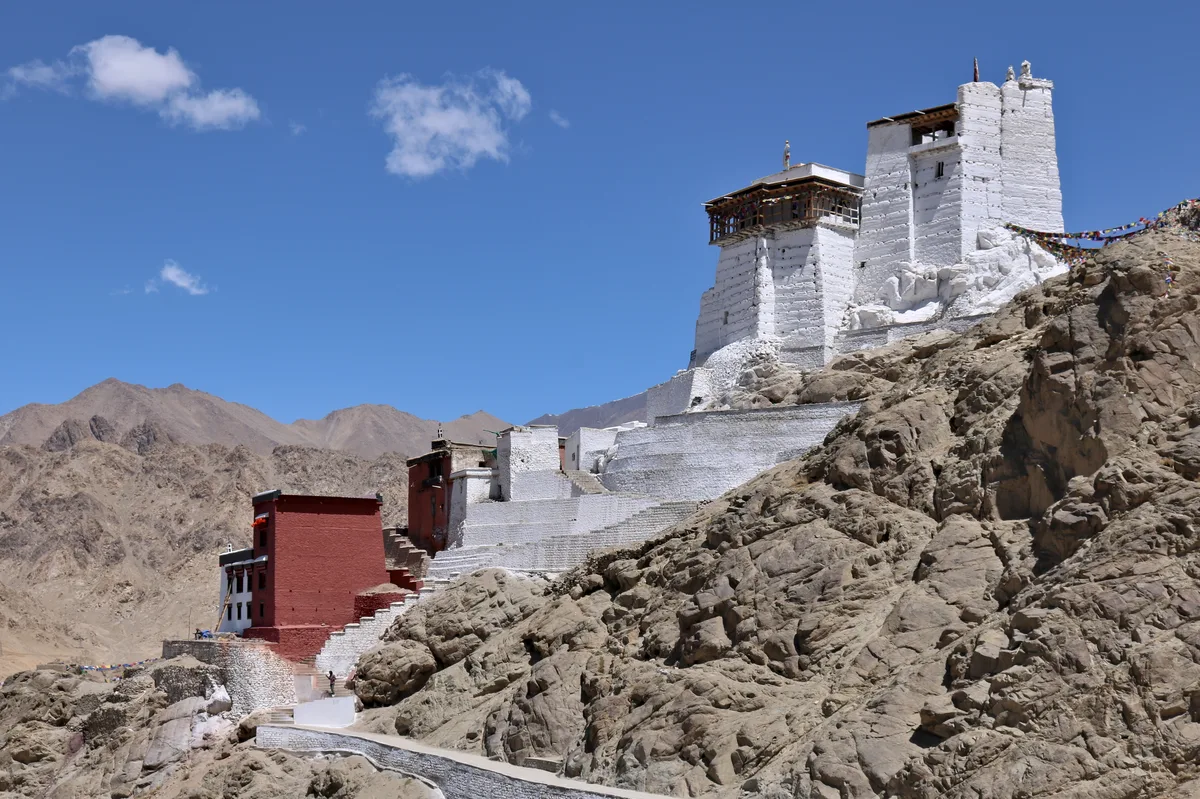
Today, the crumbling outer stone ramparts and watchtowers evoke the turbulent military history of Ladakh, while the interior shrines remain intensely active spiritual sanctuaries maintained by monks from the nearby Spituk Monastery. For motorcyclists, the winding climb to Tsemo is the ultimate local shakedown run, offering unmatched panoramic views over the mud-brick rooftops of Old Town, the green poplar oasis of Choglamsar, and the glaciated 20,000-foot peaks of the Zanskar Range.
The Three-Story Gilded Maitreya Buddha: Chamba Lhakhang & Gonkhang Protector Deities
Answer-First Summary: Inside the sacred sanctum, a colossal 15th-century Future Buddha rises through multiple floor levels.
Passing beneath the low wooden lintel into the dimly lit, butter-lamp-perfumed interior of the Chamba Lhakhang, visitors stand in the presence of one of Ladakh's oldest and most sacred colossi: a colossal three-story-high statue of Maitreya Buddha (the Future Buddha), consecrated by King Tashi Namgyal himself in the early 15th century.
Fashioned from sacred clay, molded copper, and pure gold leaf over an internal juniper wood framework, the statue depicts Maitreya seated with serene, downcast eyes, blessing pilgrims who ascend the narrow wooden monastic ladders to view the deity's face at eye level on the upper mezzanine. Flanking Maitreya are ancient statues of Avalokiteshvara (the Bodhisattva of Compassion) and Manjushri (the Bodhisattva of Transcendent Wisdom), flanked by ancient Buddhist manuscripts handwritten in gold and silver ink on indigo-dyed paper.
THE GONKHANG (RED PROTECTOR CHAPEL): Perched on the highest, most dizzying ledge of the rocky spur is the blood-red Gonkhang, dedicated to Mahakala (the Great Black One), Palden Lhamo, and Vaishravana. Because this sanctuary houses the fierce wrathful protectors of Ladakh, the atmosphere inside is dense with spiritual gravity. Ancient iron swords, matchlock muskets, shields, and animal horns presented by ancient warriors hang from the ceiling beams, veiled in ceremonial silk scarves (khatas). Resident monks perform daily butter-lamp offerings and horn prayers to maintain peace and balance across the frontier.
Motorcycle Climbing Logistics: Polo Ground Hairpins, Sankar Spur & Ridge Parking Safety
Answer-First Summary: Navigating narrow village lanes, 12% climbing gradients, and tight switchbacks up the northern ridge.
While adventurous backpackers hike up a grueling, loose-gravel foot trail from Leh Palace (a steep 20-minute cardio climb that can trigger severe breathlessness during your first 48 hours in Leh), motorcycle riders can pilot their machines directly to the ridge parking terrace via the scenic northern bypass road.
ROUTING DIRECTIONS FROM LEH CENTER: Depart the Main Market heading northeast past the Leh Polo Ground onto Fort Road. Continue past the State Bank of India building and turn left toward Sankar Gompa along a tranquil residential road lined with traditional stone walls, ancient chortens, and willow groves. Passing the entrance of Sankar Monastery, the road curves sharply right and merges onto the Namgyal Tsemo access road.
THE SWITCHBACK CLIMB: The final 1.5 km features a well-paved, single-to-two-lane asphalt spur engineered by the public works department. The road snakes up the northern face of the ridge through 7 tight, climbing hairpins with average gradients of 10% to 12%. PILOT ADVICE: Maintain 2nd gear on modern machines like the Royal Enfield Himalayan 450 or Scram 411. When approaching blind switchbacks, sound your horn firmly - local Leh taxi vans frequently descend briskly around corners without warning.
PARKING TERRACE DYNAMICS: The paved road terminates at a gravel parking terrace situated directly beneath the fortress ridge. Always park your motorcycle with the front wheel pointed slightly uphill, engage 1st gear, and deploy the side stand firmly on a solid stone slab. The gravel surface is loose; a side stand resting on uncompacted silt can sink under the weight of an adventure motorcycle, leading to a costly tip-over. From the parking lot, an easy 3-minute walk up flagstone steps brings you to the temple gates.
Sunset Physics & High-Altitude Acclimatization: Managing 12,140 Ft Views Over the Indus Valley
Answer-First Summary: Why visiting Namgyal Tsemo between 05:00 PM and 06:45 PM delivers Ladakh's most dramatic light spectacle.
At 12,140 feet (3,700 m), Namgyal Tsemo is nearly 600 feet higher than the Leh market basin. This elevated vantage point provides one of the most sublime sunset spectacles in the entire Himalayan mountain system.
THE GOLDEN HOUR SPECTACLE: The optimal window to summit the ridge is between 05:15 PM and 06:30 PM (June through September). As the sun dips behind the jagged peaks of the Ladakh Range to the northwest, warm golden and amber rays strike the sheer face of the 20,187-foot Stok Kangri peak directly across the Indus River valley. The whitewashed facades of Leh Palace and Old Town below are bathed in warm terracotta hues, while the snowy ridges of the Zanskar Range turn brilliant violet and magenta in the alpine afterglow.
WIND CHILL & RAPID COOLING: The moment the solar disc disappears behind the western peaks, the ambient air temperature on the exposed ridge plummets by 8°C to 12°C within fifteen minutes. Fierce evening winds funnel through the mountain notch, creating severe wind-chill factors. Always carry a windproof riding jacket, thermal neck gaiter, and insulated gloves - even if the Leh market was warm and balmy when you departed in the afternoon.
ACCLIMATIZATION VALUE: For riders spending their mandatory 48-hour acclimatization window in Leh, an evening motorcycle excursion to Namgyal Tsemo serves as an ideal mild hypoxic stimulus. You briefly expose your pulmonary system to 12,140 ft without physical exhaustion, prompting your bone marrow to ramp up erythropoietin (EPO) production before you sleep at lower elevation in the town below.
Senior Fleet Mechanic Advice: Low-Gear Climbing, Clutch Heat & Downhill Engine Braking
Answer-First Summary: Senior Mechanic Stanzin Dorje explains clutch friction management on steep Leh inclines and brake maintenance.
At Ride & Fire Rentals, we often see travelers abuse motorcycle clutches on the steep inclines leading to Tsemo and Leh Palace. Steep low-speed climbing at high altitude demands strict mechanical awareness.
AVOIDING CLUTCH SLIPPAGE ON INCLINES: Inexperienced riders often slip their clutch lever continuously in 2nd gear while creeping behind slow-moving tourist taxis up the switchbacks. At 12,000 feet, where atmospheric air is thin and engine cooling airflow is low, riding the friction zone superheats the clutch plates above 200°C within minutes. The engine oil breaks down thermally, and the clutch friction material glazes, resulting in power loss and a burning organic stench. MECHANIC RULE: Drop your gearbox into 1st gear, release the clutch lever completely, and manage your ascent speed purely using smooth throttle control.
DOWNHILL ENGINE BRAKING ON DESCENT: When descending the 12% switchbacks back into Leh, never coast in neutral or hold the clutch lever in while dragging the rear brake pedal. Constant rear-brake drag boils standard DOT 4 brake fluid in heavy loaded bikes, causing sudden brake pedal collapse. Instead, leave the transmission in 1st or 2nd gear, allowing engine compression vacuum to control your descent speed, applying the front brake in short, firm, pulsed squeezes to scrub excess momentum before turn-in.
TIRE PRESSURES ON COLD ASPHALT: Check your tire pressures before heading up: 22 PSI front and 32 PSI rear (solo). Maintain clean front brake discs free of chain oil mist, as sharp downhill braking on hairpins requires 100% friction consistency.
Fuel Planning, Short Trips & City Center Logistics: Exploring Central Leh on Two Wheels
Answer-First Summary: Fuel consumption on short urban climbs, navigating narrow Old Town alleys, and local traffic norms.
Exploring Namgyal Tsemo, Leh Palace, and the surrounding hill shrines involves short, high-gradient riding that burns fuel at surprisingly high rates.
FUEL CONSUMPTION MATH: A 10 km round trip from Changspa up to Namgyal Tsemo and back to Leh consumes approximately 0.5 to 0.7 liters of petrol, as the engine spends considerable time idling and grinding uphill in 1st gear. Ensure your fuel tank has at least 3 liters of fuel before heading up the ridge; if your fuel level is low and you stall on a 12% gradient with the fuel tank tipped backward, the fuel pump pickup in modern EFI tanks may suck air, causing the engine to sputter and stall.
PETROL STATIONS: The closest petrol pumps are the Indian Oil stations located along the Leh-Manali road in Choglamsar (5 km south) or near the airport in Spituk (7 km southwest). There are no fuel stations inside the Old Town or on the Tsemo ridge.
NAVIGATING LEH OLD TOWN: Avoid riding through the tight, cobblestone lanes of the historical Old Town directly beneath the Palace during peak afternoon hours. These ancient passages are narrow (often single-vehicle width with open stone drainage gutters), heavily populated by walking monks and school children, and feature sharp 90-degree corners where oncoming SUVs cannot pass. Always take the broad northern bypass route via Sankar village for a smooth, stress-free motorcycle ascent.
Cultural Etiquette, Temple Donations & Photography Manners Inside Ancient Shrines
Answer-First Summary: Respecting Buddhist monastic sanctums, prayer flag traditions, and photography permissions.
Namgyal Tsemo is an active, deeply venerated Buddhist sanctuary where sacred rituals have been performed unbroken since 1430 AD. Approaching the site with cultural sensitivity ensures a welcoming reception from resident monks.
FOOTWEAR & HAT PROTOCOL: Remove your riding boots and motorcycle gloves at the shoe rack outside the Chamba Lhakhang and Gonkhang. Remove riding bandanas, baseball caps, and helmets before entering. Woolen socks are recommended, as the ancient wooden and stone floorboards can be cold.
CIRCUMAMBULATION DIRECTION: Always walk around Buddhist shrines, stupas, and the central Maitreya Buddha statue in a clockwise (sun-wise) direction. Never turn your back disrespectfully to the main altar or point the soles of your feet toward Buddha images when seated on monastic meditation cushions.
PHOTOGRAPHY RULES & MONASTERY DONATIONS: Photography is permitted in the outer courtyards and viewing terraces. Inside the Chamba Lhakhang, ask the resident monk for permission before taking photographs; flash photography is strictly prohibited, as bright light pulses degrade ancient mineral pigment frescoes over time. A nominal entry fee of ₹20 is collected at the door, and leaving a voluntary offering of ₹20 to ₹50 on the altar is considered an auspicious gesture of respect.
PRAYER FLAGS: The ridge of Tsemo is heavily strung with thousands of prayer flags (lungta). Never step over fallen prayer flags lying on the ground, as they bear sacred Tibetan mantras. If you wish to hang prayer flags, purchase authentic cotton flags in Leh market and ask a resident monk to bless them before tying them securely to the existing flag lines.
Combining Namgyal Tsemo with Leh Palace, Sankar Gompa & Shanti Stupa
Answer-First Summary: The ultimate half-day local Leh acclimatization loop for Day 1 or Day 2 of your adventure.
To experience the cultural and architectural essence of Leh without straining your body on high passes, we recommend our classic 'Leh Citadel Circuit' itinerary:
02:30 PM - Depart Ride & Fire Rentals in Changspa. Ride a relaxed 2 km up to the nine-story Leh Palace (Lachen Palkhar). Spend 1 hour exploring the royal chambers, museum gallery, and historical timber balconies overlooking Old Town.
03:45 PM - Cruise down through the peaceful village of Sankar. Stop at Sankar Gompa (daughter monastery of Spituk) to admire the serene residential gardens and the intricate 1,000-armed Avalokiteshvara statue.
04:45 PM - Ascend the winding switchbacks through the northern valley to arrive at Namgyal Tsemo parking terrace (km 3.5).
05:00 PM - Enter the Chamba Lhakhang to receive blessings from the three-story golden Maitreya Buddha and explore the historic 1430 AD fortress ruins.
05:45 PM to 06:30 PM - Take position on the western fortress terrace to witness the legendary sunset over the Indus Valley and the snowfields of Stok Kangri.
07:00 PM - Gentle descent down the hill into Changspa Road, parking your motorcycle for an evening meal of hot Ladakhi thukpa and butter tea in town.
Senior Mechanic's Pre-Ride Inspection Checklist: Controls, Chains & Fasteners on NH1 / City Incline
Answer-First Summary: Essential 10-minute mechanical shakedown in Leh before tackling steep valley switchbacks.
At Ride & Fire Rentals, our senior workshop technicians follow a strict 10-minute pre-ride protocol before rolling any machine out of our Changspa facility. Even on a short 10 km urban climb up to Tsemo, high-altitude vibration and steep gradients test critical motorcycle subsystems.
HANDLEBAR CONTROL & LEVER FREE-PLAY: Begin by checking your clutch lever free-play. Steep low-speed hill climbing heats up clutch friction plates, expanding the clutch pack. If your cable has zero slack, the clutch will slip slightly under hard roll-on acceleration, glazing the plates within a single afternoon. Ensure exactly 2 to 3 mm of free-play at the lever pivot. Similarly, verify that the front brake lever does not feel spongy; a quick pump should yield firm, immediate resistance well before the lever approaches the throttle grip.
FASTENER TORQUE & SUBFRAME VIBRATION: The single-cylinder thumper engines of Royal Enfield Himalayan 450s and Scram 411s produce characteristic harmonic vibrations that loosen un-torqued bolts. Using an 8mm, 10mm, and 12mm wrench, inspect the tightness of your mirror stalks, exhaust shield brackets, crash guard mounting studs, and license plate bolts. A dab of medium-strength blue thread-locker on accessory bolts prevents roadside loss.
DRIVE CHAIN HEALTH IN ARID DUST: The high desert environment of Ladakh is exceptionally dry and silty. Fine granite dust adheres to wet chain lubricants, forming an abrasive grinding paste that rapidly wears out O-rings and sprocket teeth. Spray a dry-film wax lubricant onto the inner rollers while rotating the rear wheel, allowing it to tack up for 15 minutes before rolling onto the highway. Confirm that your chain slack sits between 25 and 30 mm while the bike rests on its side stand.
OPTICAL VISOR PREPARATION: Midday and late-afternoon solar radiation over the Leh valley is intense, with UV indices routinely reaching 11+. Wipe down your helmet visor with a microfiber cloth and mild water - never wipe a dusty visor dry with gloves, as granite quartz crystals will permanently scratch optical coatings. Carry a drop-down tinted internal sunshield or quality UV-400 polarized sunglasses to prevent retinal glare fatigue on the bright open ridge.
Route Milestones, Elevation & Road Conditions
| Milestone | Elevation (ft / m) | Distance from Leh | Key Facilities & Highway Telemetry |
|---|---|---|---|
| Leh Main Market / Changspa | 11,562 ft / 3,524 m | 0 km | Ride & Fire Rentals, IOCL fuel pump, hotels, hospitals. |
| Leh Polo Ground | 11,580 ft / 3,529 m | 0.8 km | Broad paved road, cafes, taxi stand, sports pavilion. |
| Sankar Gompa Turnoff | 11,650 ft / 3,550 m | 1.5 km | Narrow village road, stone walls, poplar groves, guesthouses. |
| Tsemo Spur Road Entry | 11,750 ft / 3,581 m | 2.1 km | Single-lane paved ascent begins, 10% gradient hairpins. |
| Upper Ridge Hairpin 4 | 11,950 ft / 3,642 m | 2.6 km | Steep switchback, stone retaining walls, valley views. |
| Namgyal Tsemo Parking Lot | 12,100 ft / 3,688 m | 3.1 km | Gravel terrace parking, stone steps entrance, prayer flags. |
| Chamba Lhakhang Temple | 12,140 ft / 3,700 m | 3.2 km | 3-story golden Maitreya Buddha, 1430 AD murals, ticket desk. |
| Fortress Crest & Gonkhang | 12,200 ft / 3,718 m | 3.3 km | Red protector chapel, ancient fort ruins, 360° sunset views. |
Ready for Your Ladakh Motorcycle Adventure?
Navigating the complex checkpoints and steep elevations of UT Ladakh requires both legal compliance and mechanical reliability. At Ride & Fire Rentals, we offer locally registered motorcycles with the mandatory LA-02 yellow commercial plates, ensuring you clear every military and union checkpoint seamlessly. Our fleet is 100% fuel-injected and thoroughly checked before every handover at our Changspa Road workshop.
For external travel planning references, you can check the official Ladakh Tourism Portal or apply for permits via the LAHDC Leh Permit Portal.
Season Launch Offer
Book your motorcycle direct from our Changspa Road facility. Get a standard 25% direct booking discount, plus enter coupon code LADAKH5 at checkout for an extra 5% off (saving nearly 30% total) on your entire rental! This promotion is active until June 30.
Frequently Asked Questions
What are the visiting hours and entry fee for Namgyal Tsemo Gompa in Leh? +
Namgyal Tsemo Gompa is open daily from 07:00 AM to 01:00 PM in the morning, and from 02:00 PM to 07:00 PM in the afternoon/evening. A nominal entry fee of ₹20 per person is collected at the entrance of the Chamba Lhakhang to support temple maintenance. Motorcycle parking at the upper terrace is free of charge.
Can you reach Namgyal Tsemo Monastery by motorcycle or car? +
Yes. While hikers can take the steep walking trail from Leh Palace (15 to 20 minutes), motor vehicles can reach the monastery via a well-paved 3 km road looping north around the Leh Polo Ground and through Sankar village, terminating at the upper ridge parking lot just below the temple gates.
Do I need an Inner Line Permit (ILP) to visit Namgyal Tsemo? +
No. Namgyal Tsemo Gompa is situated directly within Leh town limits. Neither Indian domestic travelers nor foreign international tourists require an Inner Line Permit (ILP) or Protected Area Permit (PAP) to visit.
When is the best time of day to visit Namgyal Tsemo? +
The best time to visit is during the late afternoon from 05:00 PM to 06:45 PM. The sunset views over the Indus Valley, Old Town Leh, and the glaciated peak of Stok Kangri are world-famous. Early mornings (07:00 AM to 09:00 AM) are also tranquil for morning Buddhist prayers.
How does the altitude of Namgyal Tsemo affect acclimatization? +
At 12,140 ft (3,700 m), Namgyal Tsemo is approximately 600 feet higher than Leh market (11,562 ft). Visiting by motorcycle provides a gentle, short-duration high-altitude exposure that stimulates red blood cell production without physical exhaustion, making it an excellent Day 1 or Day 2 acclimatization excursion.
Where is the nearest petrol pump to Namgyal Tsemo? +
The nearest fuel stations are located along the Manali Highway in Choglamsar (5 km south) and near the airport in Spituk (7 km southwest). Ensure you have at least 3 liters of fuel in your tank before climbing the steep ridge switchbacks.
Is photography permitted inside Namgyal Tsemo Gompa? +
Photography without flash is permitted inside the Chamba Lhakhang for a small donation, but flash photography is strictly banned to preserve the 15th-century tempera wall murals. Photography in the exterior fortress courtyards and viewing terraces is unrestricted.