
Quick Summary: How do you visit Matho Monastery by motorcycle from Leh?
Quick Answer: Matho Monastery (12,000 ft / 3,658 m) is situated 26 km southeast of Leh, perched dramatically on an elevated desert alluvial terrace on the south bank of the Indus River, directly opposite Thiksey Monastery. Founded in 1410 AD by Lama Dugpa Dorje, it is revered as the sole monastery of the Sakyapa sect of Tibetan Buddhism in Ladakh. Famous for the annual Matho Nagrang festival (February/March) where two monk oracles (Rongtsan) enter a divine trance to perform blindfolded feats and predict the year's fortunes, it also houses a world-class conservation museum displaying 600-year-old silk and mineral thangkas. By motorcycle, it is reached via NH3, crossing the Indus at Thiksey/Choglamsar onto a smooth rural link road climbing the desert alluvial fan. Open daily from 08:00 AM to 05:00 PM with a nominal ₹30 to ₹50 entry fee. No Inner Line Permit is required.
The Sole Sakyapa Bastion in Ladakh: 1410 AD Foundation by Lama Dugpa Dorje & Sacred Hermitage
Answer-First Summary: Perched at 12,000 ft on a barren alluvial fan, Matho preserves the ancient scholarly traditions of the Sakya school.
Gazing southward across the wide, green floodplains of the Indus River from the terraces of Thiksey Monastery, a solitary, whitewashed monastic citadel stands high against the chocolate-brown scree slopes of the Zanskar Range. Perched at an altitude of 12,000 ft (3,658 m) at the mouth of a deeply incised mountain gorge, Matho Monastery (historically Mangtro Gompa) commands an imposing, windswept presence.
While nearly all of Ladakh's famous monasteries belong to either the Gelugpa (Yellow Hat) or Drukpa/Drikung Kagyu (Red Hat) lineages, Matho holds a unique and prestigious distinction: it is the solitary monastery in UT Ladakh representing the Sakyapa tradition of Tibetan Buddhism. The Sakya school, which ruled Tibet during the 13th and 14th centuries under the patronage of the Mongol emperors, is renowned for its profound scholastic philosophy, precise tantric rituals, and exquisite artistic iconography.
Matho was founded in 1410 AD by the great Tibetan scholar and meditator Lama Dugpa Dorje. After completing years of solitary cave meditation in the high ravines above the Indus, the master attracted royal patronage from the King of Ladakh, who granted land rights for the construction of a permanent monastery. The name 'Mang-tro' translates poetically as 'Many Auspicious Omens', referring to the miraculous signs that accompanied the consecration of the temple ground.
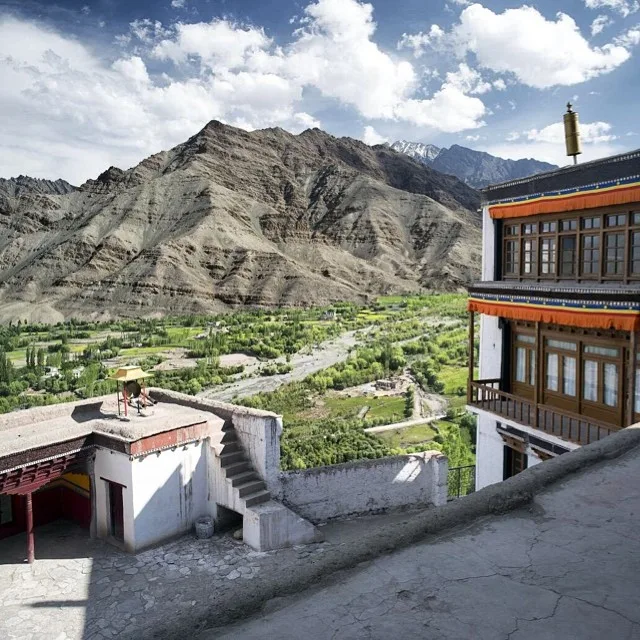
For adventure motorcyclists, riding up to Matho provides a completely distinct visual and spiritual experience from the busy highway tourist circuit. The remote desert terrace offers deep silence, authentic monastic encounters, and a front-row panoramic view stretching across the entire width of the Indus Valley toward the snow-capped Ladakh Range.
The Matho Nagrang Oracle Phenomenon: The Trance of the Two Rongtsan Protectors
Answer-First Summary: Every winter, two chosen monks enter an astonishing spiritual trance, performing blindfolded feats and prophesying.
Matho Monastery is world-renowned among anthropologists, spiritual seekers, and travelers for its extraordinary annual festival: the Matho Nagrang. Held on the 14th and 15th days of the first Tibetan lunar month (usually falling in February or March), this sacred ceremony centers around the manifestation of two divine oracles known as the Rongtsan.
The selection and preparation of the oracles is an ordeal of supreme spiritual discipline. Every four years, two monks from the monastery are chosen through divination. In the months leading up to the festival, these monks enter complete solitary retreat in dark mountain hermitage cells, engaging in rigorous fasting, continuous mantra recitation, and purification rituals to empty their consciousness.
During the festival, as the temple courtyard vibrates to the deep, resonant drone of copper long-horns (dungchen) and the rhythmic clash of cymbals, the two monks emerge possessed by the fierce protector deities. In this deep trance state, their eyes are tied shut with heavy silk cloths. Running blindfolded along the narrow stone parapets and dizzying rooftops of the high monastery walls with superhuman agility, they plunge sharp swords into their own torsos without shedding a drop of blood, bend heavy iron blades with their bare hands, and deliver prophecies predicting harvests, weather patterns, and regional events for the coming year.
For the local Ladakhi community, these prophecies are treated with absolute reverence. Even in the bitter sub-zero cold of February, thousands of villagers gather in the courtyard to receive personal blessings and guidance from the blindfolded deities.
The 600-Year Sacred Museum: Masterpiece Silk Thangkas & International Restoration
Answer-First Summary: Exploring the museum housing priceless 15th-century thangkas restored by international conservationists.
Beyond its oracle traditions, Matho Monastery houses one of the most culturally significant and historically valuable collections of Tibetan Buddhist art in the world. The Matho Museum Project, initiated in 2010 through a partnership between the monastery, local community artisans, and international art restorers (including master conservator Nelly Rieuf), transformed an ancient palace wing into a state-of-the-art conservation sanctuary.
The museum exhibits an astonishing array of 15th- and 16th-century silk appliqué and mineral-paint thangkas, many dating back to the foundation of the monastery in 1410 AD. The paintings depict Shakyamuni Buddha, the Sakya lineage patriarchs (the Five Sakya Forefathers), and intricate tantric mandalas executed with crushed lapis lazuli, malachite, cinnabar, and gold leaf.
Visitors can also examine ceremonial masks worn during ancient sacred dances, antique bronze sculptures brought from Nepal and Tibet, and ancient weapons presented to the monastery by royal patrons. The museum operates on strict conservation standards, utilizing climate-controlled display cases and low-lux fiber-optic lighting to preserve these fragile centuries-old artifacts from ultraviolet degradation.
Motorcycle Route Logistics: Crossing the Indus from Thiksey to the South Bank Alluvial Terrace
Answer-First Summary: Navigating the rural link roads, village bridges, and the scenic gravel climb to 12,000 ft.
The motorcycle ride to Matho is an engaging, scenic journey that takes riders off the main highway corridor onto peaceful rural valley blacktop.
DEPARTING LEH ON NH3: Ride southeast from Leh along the smooth, paved dual lanes of the Leh-Manali Highway (NH3) for 19 km, passing Shey and approaching Thiksey. Just past the base of Thiksey hill, watch for the prominent green junction signboard indicating 'Matho / Stakna South Bank'.
CROSSING TO THE SOUTH BANK: Turn right off the main highway, following a paved single-lane bridge crossing the braided channels of the Indus River. Once on the southern bank, the road winds through the tranquil agricultural village of Matho, passing whitewashed Ladakhi farmsteads, babbling irrigation canals, and ancient apricot orchards.
THE ALLUVIAL FAN ASCENT: Leaving the village green belt, the road begins a steady 4 km climb across a vast, barren alluvial scree fan. The tarmac is smooth and well-banked, featuring long straightaways terminating in sweeping, wide-radius corners with a sustained 6% to 8% incline. PILOT ADVICE: The road climbs from 10,800 ft at the river to 12,000 ft at the gompa gate. Maintain 3rd gear on your motorcycle, allowing the engine to pull smoothly without lugging the transmission.
PARKING TERRACE: The road terminates at a broad, paved parking courtyard directly outside the lower monastery entrance. The parking area offers ample space for motorcycles and support vehicles, with stable bedrock footing that easily supports side stands.
High Desert Incline Mechanics: Riding the Desert Fan to 12,000 Ft & Throttle Management
Answer-First Summary: Senior Mechanic Stanzin Dorje explains power delivery on open alluvial fans and throttle response.
Riding across the wide alluvial fan leading to Matho provides an excellent opportunity to understand high-altitude engine performance under sustained uphill loads.
THROTTLE ROLL-ON ON GRADIENTS: As you climb from the river up the desert plain to 12,000 feet, atmospheric oxygen drops by approximately 35% compared to sea level. On modern fuel-injected motorcycles like the Royal Enfield Himalayan 450 or Scram 411, the ECU automatically reduces fuel injection volume to match the thinner air. While the engine runs cleanly without sputtering, you will notice a mild 12% to 15% reduction in top-end roll-on acceleration. Shift down to 2nd or 3rd gear when overtaking slow farm tractors on the uphill grade rather than trying to power through in high gear.
AVOIDING ENGINE OVERHEATING IN TAILWINDS: On warm summer afternoons, thermal updrafts blowing up the alluvial fan can match your travel speed, creating a zero-relative-wind situation where very little cooling air flows through your engine's radiator or cylinder fins. Keep an eye on your coolant temperature gauge; if riding in a group, maintain a staggered formation to ensure clean, undisturbed airflow reaches every machine's cooling system.
BRAKE CONTROL ON DESCENT: The 4 km descent from Matho back down to the Indus is fast and sweeping. Resist the temptation to carry excessive speed into blind corners where windblown sand drifts frequently collect on the apex. Scrub speed smoothly using progressive front-brake pressure while sitting upright on the chassis.
Senior Fleet Mechanic Advice: Air Filter Defense Against Silt Dust & Brake Fluid Boiling
Answer-First Summary: Managing the fine abrasive quartz silt of the southern Indus slopes.
The southern bank of the Indus River near Matho is significantly drier and windier than the sheltered northern bank.
AIR FILTER INSPECTION: Fine alluvial quartz dust is constantly kicked up by desert canyon winds. This micro-fine silt can coat paper air filter elements, choking combustion airflow and causing the engine to run overly rich. After returning from a day of riding along the south bank, remove your motorcycle seat and inspect the airbox snorkel. If you ride an off-road dual-sport machine fitted with a foam filter, clean and re-oil the element with tacky foam air filter oil.
BRAKE FLUID MOISTURE CONTAMINATION: High-altitude mountain riding generates high brake rotor temperatures. Standard DOT 4 brake fluid is hygroscopic - it naturally absorbs atmospheric moisture over time, which drastically lowers its boiling point from 230°C down to 155°C. At Ride & Fire Rentals, our fleet mechanics flush and replace brake fluid before the start of every touring season to guarantee zero vapor-lock fade on steep downhill hairpins.
Fuel Planning & Rural Transit: Linking Matho with Stakna, Stok & Leh
Answer-First Summary: Mapping the complete southern bank route with zero commercial petrol pumps.
Understanding fuel logistics for the southern bank of the Indus ensures you never find yourself stranded in rural Ladakh.
NO FUEL STATIONS ON THE SOUTH BANK: There are NO commercial retail petrol pumps along the rural south bank link road between Choglamsar, Stok, Matho, and Stakna. The entire 40 km southern loop is rural village terrain.
PETROL PUMP STAGING: The nearest official filling stations are:
1. Choglamsar (14 km northwest): Full-service IOCL station.
2. Karu Junction (16 km east across Stakna bridge): 24/7 IOCL multi-bay station.
TOTAL ROUTE CONSUMPTION: The complete southern loop (Leh → Choglamsar → Stok Palace → Matho Gompa → Stakna → Leh) covers approximately 65 km. A standard motorcycle consumes less than 2.5 liters of fuel for this entire circuit. Simply top up your tank in Leh or Choglamsar before departing.
ATM CASH RESUPPLY: Carry cash from Leh (minimum ₹1,000 to ₹2,000). There are no ATMs in Matho village, and the monastery museum ticket counter and local tea shops operate strictly on cash.
Cultural Etiquette, Photography Permissions & Monastic Donations
Answer-First Summary: Museum visitor guidelines, dress codes, and respectful conduct inside Sakyapa shrines.
Visiting Matho Monastery offers a rare glimpse into the dignified traditions of the Sakyapa order, demanding proper decorum from international and domestic riders alike.
MUSEUM ADMISSION & GUIDELINES: The Matho Museum is open daily from 08:30 AM to 05:00 PM. A nominal admission fee of ₹30 for Indian nationals and ₹50 for foreign tourists is charged to support ongoing art conservation efforts. Flash photography, video recording, and touching display glass are strictly prohibited inside the museum galleries.
MONASTERY VISITING HOURS: The main prayer halls of the monastery are open from 08:00 AM to 05:00 PM. Entry to the prayer halls is free, though voluntary donations into the altar donation boxes are welcomed.
FOOTWEAR & ATTIRE: Remove your motorcycle riding boots and gloves before entering the prayer halls and museum. Wear full-length riding pants or jeans; sleeveless tops and shorts are considered deeply disrespectful. Maintain a hushed, respectful voice within the courtyards, as monks may be engaged in formal philosophical debates or meditation.
High-Altitude Spring Thermal Changes & Alluvial Gravel Riding Techniques
Answer-First Summary: Mastering loose gravel transitions, tire grip, and handling cold morning shadows on the south bank.
The southern bank of the Indus sits in the deep topographic shadow of the high Zanskar Range, experiencing distinct microclimatic conditions that affect road surfaces.
TEMPERATURE INVERSIONS: During morning hours (08:00 AM to 10:00 AM), the south bank remains shaded and freezing long after the northern bank (Thiksey) has warmed in bright sunshine. Pavement temperatures can be 10°C colder, which means tire rubber takes longer to reach optimal operating grip. Avoid aggressive lean angles on cold morning asphalt; ride smoothly and let your tires warm up gradually.
LOOSE ALLUVIAL GRAVEL CORNERS: Where the approach road crosses natural dry wash channels (arroyos) descending from the mountains, torrential flash rains frequently wash loose pea gravel and sharp shale fragments across the tarmac. When cornering on gravel-strewn asphalt, keep your motorcycle as upright as possible, look far ahead through the turn, and avoid sudden braking inputs that could tuck the front tire.
Route Milestones, Elevation & Road Conditions
| Milestone | Elevation (ft / m) | Distance from Leh | Key Facilities & Highway Telemetry |
|---|---|---|---|
| Leh Main Market | 11,562 ft / 3,524 m | 0 km | Ride & Fire Rentals, full-service workshop, IOCL pumps, ATMs. |
| Choglamsar Bridge | 11,300 ft / 3,444 m | 6 km | Bustling town, IOCL petrol pump, turnoff for southern bank. |
| Shey Viewpoint (NH3) | 11,200 ft / 3,414 m | 15 km | Smooth highway blacktop, views of royal palace across river. |
| Thiksey Indus Bridge Turnoff | 11,350 ft / 3,459 m | 19 km | Turn right off NH3, cross paved concrete river bridge. |
| Matho Village Center | 11,450 ft / 3,490 m | 22 km | Traditional farming village, apricot orchards, tea stalls. |
| Alluvial Fan Ascent Base | 11,600 ft / 3,535 m | 23.5 km | Paved desert road climbs steady 7% incline, wide curves. |
| Matho Monastery Gate | 12,000 ft / 3,658 m | 26 km | Paved parking terrace, ticket desk, Sakyapa prayer halls. |
| Matho Conservation Museum | 12,020 ft / 3,664 m | 26.1 km | 600-year restored thangkas, antique armor, art gallery. |
| Upper Hermitage Ridge | 12,250 ft / 3,733 m | 27.5 km | Solitary meditation caves, dramatic canyon gorge views. |
Ready for Your Ladakh Motorcycle Adventure?
Navigating the complex checkpoints and steep elevations of UT Ladakh requires both legal compliance and mechanical reliability. At Ride & Fire Rentals, we offer locally registered motorcycles with the mandatory LA-02 yellow commercial plates, ensuring you clear every military and union checkpoint seamlessly. Our fleet is 100% fuel-injected and thoroughly checked before every handover at our Changspa Road workshop.
For external travel planning references, you can check the official Ladakh Tourism Portal or apply for permits via the LAHDC Leh Permit Portal.
Season Launch Offer
Book your motorcycle direct from our Changspa Road facility. Get a standard 25% direct booking discount, plus enter coupon code LADAKH5 at checkout for an extra 5% off (saving nearly 30% total) on your entire rental! This promotion is active until June 30.
Senior Fleet Mechanic's Guide to Alluvial Fan Gravel Riding & High-Altitude Cooling Management
Tackling desert wash gravel channels, loose scree ascents, and electric cooling fan duty cycles on the Matho spur.
The 26 km journey from Leh to Matho Monastery diverges from standard highway tarmac, leading riders across the wide, rugged alluvial wash of the Stok Mountain range. Navigating this desolate southern desert plateau requires specific mechanical awareness and off-tarmac riding technique.
RIDING ALLUVIAL GRAVEL WASHES: The 6 km link road branching from the southern Indus riverbank toward Matho cuts across dry alluvial flood channels layered with deep, uncompacted granite gravel and loose scree. When transitioning from highway asphalt to this loose surface, stand tall on your footpegs with your knees hugging the fuel tank. Keep your handlebar grip light and relaxed; allow the front 21-inch wheel of your adventure bike to track naturally through the loose stones without fighting the steering.
THROTTLE COMMITMENT & GEAR SELECTION: Maintain momentum by keeping your motorcycle in 2nd gear with a steady, positive throttle opening. Chopping the throttle or braking aggressively with the front brake on loose gravel immediately loads the front fork, causing the front tire to plow and tuck into the stones. If the rear wheel steps out on loose washboard, maintain smooth, progressive throttle to drive the chassis forward and realign your trajectory.
COOLING FAN CYCLES & RADIATOR CARE AT 12,000 FEET: As you ascend the steep 600-foot spur toward Matho Gompa in 1st and 2nd gear, your engine works under high mechanical load with reduced airflow speed. In the rarefied air of 12,000 feet (where atmospheric density is approximately 35% lower than at sea level), heat dissipation through aluminum radiator fins is significantly slower. The electric radiator fan on modern liquid-cooled motorcycles like the Himalayan 450 or KTM 390 Adventure will cycle on frequently. NEVER shut down the engine immediately after pulling into the monastery parking lot while the fan is roaring; allow the motor to idle in neutral for 60 to 90 seconds so circulating coolant can normalize engine cylinder temperatures before turning off the ignition.
BRAKE FLUID HEAT MANAGEMENT ON STEEP DESCENT: When riding back down the steep, twisty spur from Matho toward the Indus Valley, resist the temptation to drag your rear brake continuously. Continuous rear brake dragging rapidly overheats the small single-piston rear caliper and boils standard DOT 4 brake fluid, causing total rear brake pedal fade. Instead, rely on engine braking by selecting 2nd gear, using intermittent, firm pulses of both front and rear brakes to scrub off speed before entering switchback corners.
WINTER FESTIVAL MECHANICAL PREPARATION: For hardy motorcyclists riding to Matho during the legendary Matho Nagrang Oracle Festival in February or March, ambient temperatures hover between -5°C and -18°C. Cold-soaked engine oil thickens dramatically, placing extreme strain on the starter motor. Park your motorcycle where the morning sun can strike the crankcase, carry a portable lithium-ion jump starter, and allow the engine to idle for 5 full minutes until the coolant temperature reaches at least 60°C before engaging 1st gear.
Frequently Asked Questions
What is Matho Monastery famous for in Ladakh? +
Matho Monastery is world-famous for two distinct highlights: it is the ONLY monastery in Ladakh representing the Sakyapa school of Tibetan Buddhism, and it hosts the annual Matho Nagrang festival (February/March) where two monk oracles (Rongtsan) enter a divine trance to perform blindfolded feats and predict the year's events. It also houses a world-class conservation museum with 600-year-old restored silk thangkas.
What are the visiting hours and entry fees for Matho Monastery and Museum? +
The main monastery prayer halls are open daily from 08:00 AM to 05:00 PM with free entry (voluntary donations welcome). The specialized Matho Museum is open from 08:30 AM to 05:00 PM with an entry fee of ₹30 for Indian citizens and ₹50 for foreign tourists to support ongoing art conservation.
How do you reach Matho Monastery by motorcycle from Leh? +
Take the Leh-Manali Highway (NH3) southeast for 19 km to Thiksey. Turn right at the Matho signboard, cross the concrete bridge over the Indus River, and follow the paved rural road through Matho village and up the 4 km desert alluvial fan directly to the monastery parking terrace (total distance: 26 km).
Do I need an Inner Line Permit (ILP) to visit Matho Monastery? +
No. Matho Monastery is situated within the open Central Indus Valley circuit. Neither Indian domestic travelers nor foreign tourists require an Inner Line Permit (ILP) or Protected Area Permit (PAP) to visit.
Where is the nearest petrol pump to Matho Monastery? +
There are no fuel pumps on the rural south bank of the Indus. The nearest official filling stations are at Choglamsar (14 km northwest) and Karu Junction (16 km east via Stakna bridge). A full tank from Leh easily covers the entire 55-65 km round-trip ride.
Is the road to Matho Monastery paved and suitable for all motorcycles? +
Yes. The entire 26 km route from Leh to Matho Monastery is 100% paved asphalt with clear signboards, gentle gradients, and stable parking. It is easily navigable on all machines, including Royal Enfields, adventure dual-sports, and automatic scooters.
Can tourists attend the Matho Nagrang Oracle Festival? +
Yes. Travelers are welcome to attend the Matho Nagrang festival, which takes place on the 14th and 15th days of the first Tibetan lunar month (usually February or March). Because it occurs in deep winter with sub-zero temperatures (-10°C to -15°C), visitors must dress in heavy arctic-grade winter clothing.