
Quick Summary: How do you visit the Hanle Dark Sky Reserve and Indian Astronomical Observatory by motorcycle?
Quick Answer: The Hanle Dark Sky Reserve (HDSR) and Indian Astronomical Observatory (IAO) are situated in the Eastern Changthang plateau at an elevation of 14,760 to 15,000 ft (4,500 to 4,572 m), located 255 km southeast of Leh. Designated as India's first International Dark Sky Reserve in 2022, Hanle offers pristine Bortle Class 1 night skies with virtually zero artificial light pollution. The IAO telescope facility on Mount Saraswati is open for public daytime visits only from 09:30 AM to 10:30 AM and 03:30 PM to 05:30 PM; night access to the observatory dome is strictly prohibited. Stargazing is hosted at village homestays via trained local 'Astro-Ambassadors' using 8-inch Dobsonian telescopes. Indian citizens require an online Inner Line Permit (ILP); foreign nationals require a Protected Area Permit (PAP). Proper acclimatization in Leh (minimum 48-72 hours) and warm winter riding layers are mandatory.
India's First Dark Sky Sanctuary: Why Hanle's Atmospheric Physics Deliver Bortle Class 1 Skies
Answer-First Summary: At 15,000 ft with under 100 mm annual precipitation, Hanle offers astronomical clarity unmatched in South Asia.
Rising out of the vast golden gravel basins of the Eastern Changthang plateau, Hanle is a realm where the boundary between earth and the cosmos appears paper-thin. In December 2022, the Union Territory administration formally notified 1,073 square kilometers around Hanle as India's first International Dark Sky Reserve (HDSR), establishing a protected sanctuary dedicated to astronomical science, astro-tourism, and night-sky preservation.
Astronomers and astrophysicists selected Hanle after decades of rigorous meteorological surveying across the subcontinent. The reasons lie in its extraordinary physical geography: perched at an elevation of 4,500 meters (14,760 ft), Hanle sits in the rain-shadow of the Greater Himalayas, receiving less than 70 mm of annual precipitation. The cold desert atmosphere contains exceptionally low precipitable water vapor (PWV), virtually eliminating atmospheric haze and humidity turbulence that blur ground-based telescope observations.
With cloud-free conditions prevailing over 260 nights per year, zero industrial air pollution, and human settlements clustered in small, off-grid hamlets, Hanle registers as a pristine Bortle Class 1 night sky - the darkest classification on the international astronomical scale. On moonless nights, the cosmic band of the Milky Way arches across the heavens with such brilliant intensity that it casts distinct personal shadows on the desert gravel.
For adventure motorcyclists, reaching this remote Changthang frontier is an unforgettable spiritual milestone. However, operating a motorcycle and surviving overnight at 15,000 feet demands absolute respect for altitude physiology, strict adherence to dark-sky lighting codes, and meticulous cold-weather mechanical preparation.
The Indian Astronomical Observatory (IAO): Mount Saraswati, the Himalayan Chandra Telescope & MACE
Answer-First Summary: Discovering Asia's premier high-altitude optical, infrared, and gamma-ray scientific research installations.
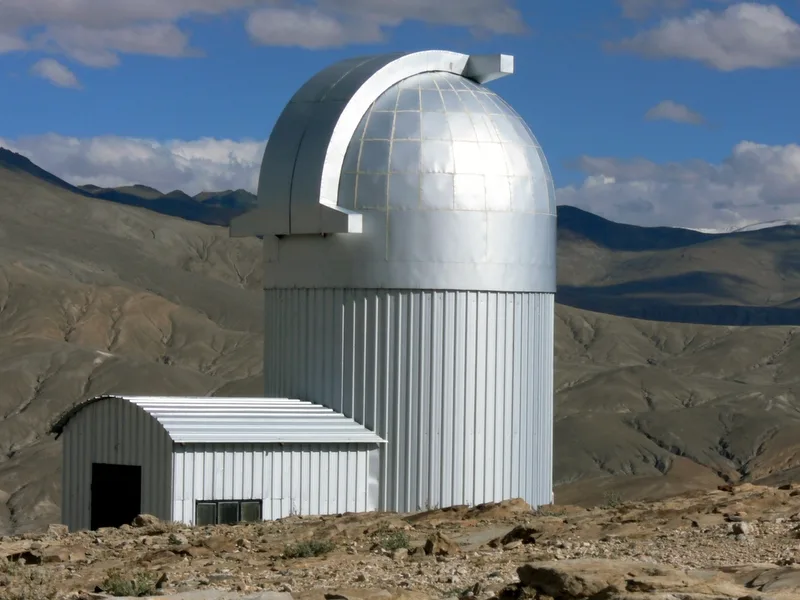
Commanding the northern skyline of the Hanle valley is Digpa-Ratsa Ri (Mount Saraswati), a stark 15,000-foot granite peak crowned by the gleaming metallic domes of the Indian Astronomical Observatory (IAO). Established in 2001 and operated by the prestigious Indian Institute of Astrophysics (IIA) in Bangalore, this facility is one of the highest optical telescope installations in the world.
The observatory's primary scientific instrument is the 2.01-meter optical-infrared Himalayan Chandra Telescope (HCT). Named in honor of Nobel laureate Subrahmanyan Chandrasekhar, this reflecting telescope is controlled remotely via a dedicated satellite link by scientists seated 2,000 km away in Hosakote near Bangalore. The telescope operates seven nights a week, tracking supernovas, exoplanets, gamma-ray bursts, and active galactic nuclei.
Nearby stands the colossal 21-meter dish of the Major Atmospheric Cherenkov Experiment (MACE) telescope - the highest gamma-ray telescope in the world and the second largest on earth. Its giant array of diamond-turned aluminum mirrors captures flashes of Cherenkov radiation triggered when high-energy cosmic rays collide with the upper stratosphere.
VISITING REGULATIONS & TIMINGS: The IAO is an active, ultra-sensitive scientific research station, not a commercial amusement park. Public access to the mountaintop dome is strictly permitted during daylight hours only: daily from 09:30 AM to 10:30 AM in the morning, and 03:30 PM to 05:30 PM in the afternoon. Night access is strictly forbidden to prevent vehicle headlight beams from blinding telescope sensors. Visitors are guided through an educational gallery detailing the observatory's cosmic discoveries; there is no provision for the general public to look through the research telescope eyepieces.
Night Sky Protocols & Astro-Ambassadors: How Stargazing Works in Hanle Village
Answer-First Summary: Understanding the local community telescope network, red-light headlamps, and strict light-discipline rules.
Because tourists cannot enter the IAO facility after dark, the Union Territory administration and IIA conceived an ingenious community-driven model: the Hanle Astro-Ambassador Network.
Over 25 local youth and homestay operators from Hanle, Punguk, and Shado hamlets have undergone rigorous astronomical training by IIA scientists. The administration equipped these homestays with high-grade, computerized 8-inch Dobsonian reflecting telescopes. After sunset, guests gather in the courtyards of their homestays where their trained hosts align the telescopes, offering breathtaking, high-magnification views of Saturn's rings, Jupiter's Galilean moons, the Great Orion Nebula, the Andromeda Galaxy, and globular star clusters.
STRICT DARK-SKY CODE OF CONDUCT: Preserving Hanle's pristine darkness requires every visiting motorcyclist to follow uncompromising light discipline:
1. ZERO WHITE LIGHT AT NIGHT: White LED flashlights, smartphone screens, and vehicle headlights scatter light particles across the dry atmosphere. Always use red-filter headlamps or torches. Red light preserves human night-vision adaptation without polluting the telescope horizon.
2. VEHICLE CURFEW: Driving or riding motorcycles around the Hanle valley after 08:00 PM is strictly prohibited. Park your motorcycle at your homestay before dusk and leave it parked until sunrise.
3. HOMESTAY LIGHT CONTAINMENT: All homestays are fitted with heavy blackout curtains. Guests must ensure curtains are completely drawn shut by 07:00 PM to prevent interior light spillage from escaping into the open valley.
4. NO OUTDOOR FLASH PHOTOGRAPHY: Never use camera flashes, illuminated glow-sticks, or bright handheld torches during long-exposure astrophotography sessions.
Extreme Altitude Cold Starts: Morning Battery Revivals, Engine Oil Viscosity & Tire Pressure Physics
Answer-First Summary: Senior Mechanic Stanzin Dorje explains how sub-zero Changthang nights affect your motorcycle at 15,000 ft.
At 14,760 feet, the overnight temperature in Hanle plunges below freezing even during the peak summer months of July and August (-2°C to -5°C), while shoulder-season months (May, September, October) frequently see night temperatures drop to -15°C to -25°C. At Ride & Fire Rentals, we prepare our fleet specifically for this extreme thermal environment.
12V BATTERY FREEZE PHENOMENON: In sub-zero temperatures, the chemical reaction inside a standard lead-acid or AGM motorcycle battery slows drastically, causing available cold-cranking amps (CCA) to drop by 40% to 60%. If you try to crank a cold engine repeatedly with the electric starter, you will drain the battery flat in under 15 seconds. MECHANICAL PROTOCOL: When parking for the night, face your motorcycle's engine block and battery compartment eastward so the rising morning sun warms the metal. In the morning, turn on the ignition key and toggle the high-beam headlamp on for 20 seconds before pressing the starter button - this draws a gentle current that warms the internal battery plates.
ENGINE OIL VISCOSITY & COLD CRANKING: Heavy multi-grade engine oil (like 20W-50) turns into thick, viscous sludge at -10°C, creating massive hydraulic drag on the starter motor. All Ride & Fire expedition bikes dispatched to Hanle are filled with premium fully synthetic 10W-50 or 10W-40 oils that flow freely at sub-zero temperatures, ensuring instantaneous lubrication of camshaft journals and cylinder walls.
EFI FUEL INJECTOR PRIMING: Before firing the engine, cycle the ignition switch on and off three times, allowing the high-pressure fuel pump to prime the injector rail. When the engine catches, DO NOT rev the throttle aggressively. Allow the machine to idle smoothly at 1,400 RPM for a full 4 to 5 minutes until the cylinder head reaches operating temperature.
TIRE PRESSURE DROP: Boyle's and Charles's gas laws dictate that for every 10°C drop in ambient temperature, tire pressure decreases by roughly 1 to 2 PSI. Coupled with high-altitude atmospheric pressure changes, your tires can read 4 to 6 PSI lower in a freezing Hanle morning than they did in warm Leh. Always check cold pressures before setting off toward Umling La.
Complete Fuel Logistics & Dead Zone Calculations: Karu, Chumathang, Nyoma & Hanle
Answer-First Summary: Navigating the 255 km stretch with zero fuel pumps in Hanle village.
Fuel planning for Hanle demands strict mathematical calculation. The route from Leh to Hanle follows the Indus River valley southeast, passing through Upshi, Chumathang, and Nyoma.
PETROL PUMP LOCATIONS: The primary fuel stations along this corridor are:
• Karu (km 35 from Leh): Large IOCL filling station.
• Chumathang (km 140 from Leh): No official retail pump.
• Nyoma (km 180 from Leh): Official Indian Oil (IOCL) petrol pump operating 08:00 AM to 06:00 PM. This is the LAST official commercial fuel station heading toward Hanle and Umling La.
• Hanle (km 255 from Leh): ZERO commercial petrol pumps exist in Hanle village.
FUEL MATH FOR HANLE & UMLING LA CIRCUITS: If your itinerary includes riding from Leh to Hanle, doing the world's highest loop to Umling La Pass (19,024 ft), and returning to Nyoma or crossing to Tso Moriri, your total off-grid distance easily exceeds 350 to 400 km.
Always top up your fuel tank to 100% at the Nyoma IOCL pump (75 km before Hanle). Furthermore, every rider must carry a minimum of 10 to 12 liters of extra fuel in approved steel jerry cans or heavy-duty fuel bladders. Climbing Umling La's extreme 19,024-foot gradients in low gear increases fuel consumption by nearly 45%, leaving zero margin for error.
Permit Regulations: Inner Line Permits (ILP) & Protected Area Permits (PAP) for Foreigners
Answer-First Summary: Navigating the LAHDC portal, registered agency requirements for international riders, and Loma Bridge checkpost rules.
Due to its sensitive proximity to the Line of Actual Control (LAC) with Tibet/China, Hanle operates under strict border security regulations administered by the Indian Army and Indo-Tibetan Border Police (ITBP).
INDIAN CITIZENS (DOMESTIC RIDERS): Indian travelers must apply for an Inner Line Permit (ILP) online through the official portal (lahdclehpermit.in). Ensure 'Hanle' and 'Chushul' are explicitly selected on your permit application. Print at least 4 physical paper copies of the verified permit and carry your original government photo ID (Aadhaar or Passport).
FOREIGN NATIONALS (INTERNATIONAL RIDERS): Under revised UT Ladakh tourism guidelines, foreign passport holders are permitted to visit Hanle and stay overnight in designated village homestays. However, foreign nationals CANNOT self-apply online; the Protected Area Permit (PAP) must be arranged through an officially registered local travel agency in Leh in groups of two or more riders. NOTE: While foreign nationals can visit Hanle village and observatory, civilian foreign tourists are currently NOT permitted to cross the frontline border posts to Umling La or Demchok.
LOMA BRIDGE CHECKPOST: Located 50 km before Hanle, the historic concrete bridge across the Indus River at Loma is the primary military gateway. You must hand over physical printed copies of your permits and register your passport/Aadhaar details with the ITBP personnel before being allowed to cross into the Hanle basin.
Homestay Living, Solar Power & High-Altitude Acclimatization Safety in Hanle
Answer-First Summary: Managing hypoxemia at 14,760 ft, Diamox protocols, dry pit toilets, and Changpa homestay warmth.
Sleeping at 14,760 feet (4,500 m) is one of the most taxing physiological challenges on the human body. The atmospheric oxygen concentration here is only ~58% of sea level. Proper preparation is essential for avoiding life-threatening altitude emergencies.
ACCLIMATIZATION PREREQUISITE: Never attempt to ride to Hanle directly from Leh on Day 1 or Day 2. You must spend a minimum of two full nights in Leh (11,562 ft) and preferably a night in Nubra or Pangong to build sufficient red blood cell density before sleeping in Hanle.
HYDRATION & MEDICATION: Drink 4 to 5 liters of clean water and warm tea daily. If prescribed by your medical physician, preventive Diamox (Acetazolamide, 125mg or 250mg twice daily) helps stimulate nocturnal breathing and prevents Cheyne-Stokes periodic respiration during cold Changthang nights. Carry a portable pulse oximeter; if your resting SpO2 drops below 65% accompanied by severe breathlessness or persistent dry cough, descend immediately toward lower altitudes.
HOMESTAY ACCOMMODATIONS: There are no commercial luxury hotels in Hanle. Accommodation is provided by warm, family-run Ladakhi homestays (₹1,200 to ₹2,500 per person per night including home-cooked dinner and breakfast). Electricity is powered by village solar micro-grids, providing power typically between 07:00 PM and 11:00 PM. Charge your camera batteries, power banks, and smartphone devices immediately upon arrival. Expect traditional Ladakhi dry-composting pit toilets in many rustic homes, which are clean, odorless, and preserve scarce water resources in the sub-zero desert.
Route Architecture & Itinerary Integration: The Classic Eastern Changthang High Loop
Answer-First Summary: How to combine Hanle seamlessly with Pangong Tso, Chushul, Rezang La, and Tso Moriri.
Hanle is rarely ridden as an isolated out-and-back trip from Leh. Instead, experienced expeditioners integrate Hanle into the legendary 'Changthang High Circuit':
DAY 1: Leh to Pangong Tso via Chang La Pass (17,688 ft) - 160 km.
DAY 2: Pangong Tso (Spangmik/Man/Merak) to Hanle via the direct border trail through Chushul, Tsaga La Pass (15,300 ft), Loma Bridge, and into Hanle (160 km of spectacular high desert wilderness). Stop at the sacred Rezang La War Memorial to honor Major Shaitan Singh and the heroes of Charlie Company.
DAY 3: Stargazing recovery morning in Hanle. Daytime visit to the Indian Astronomical Observatory atop Mount Saraswati (09:30 AM). Afternoon expedition to summit the mighty Umling La Pass (19,024 ft), returning to Hanle village for evening telescope sessions.
DAY 4: Hanle to Tso Moriri (Korzok) via Loma, Nyoma, Mahe Bridge, and Namashang La (165 km), continuing the deep high-lake exploration.
Route Milestones, Elevation & Road Conditions
| Milestone | Elevation (ft / m) | Distance from Leh | Key Facilities & Highway Telemetry |
|---|---|---|---|
| Leh City Center | 11,562 ft / 3,524 m | 0 km | Ride & Fire Rentals, IOCL fuel, hospitals, permit offices. |
| Karu Junction & Fuel | 11,300 ft / 3,444 m | 35 km | Major military base, 24/7 IOCL fuel pump, ATM, restaurants. |
| Upshi Checkpoint | 11,480 ft / 3,500 m | 48 km | Police checkpost, routes split: Manali highway vs Indus valley. |
| Kiari Military Cantonment | 12,100 ft / 3,688 m | 98 km | Army transit base, river canyon tarmac, emergency clinic. |
| Chumathang Hot Springs | 13,000 ft / 3,962 m | 140 km | Natural boiling sulfur springs, dhabas, basic homestays. |
| Mahe Bridge Checkpoint | 13,600 ft / 4,145 m | 165 km | Crucial checkpost, river junction: splits to Tso Moriri vs Hanle. |
| Nyoma Village & Airbase | 13,700 ft / 4,175 m | 180 km | Last official IOCL fuel pump, ALG fighter airbase, homestays. |
| Loma Bridge Checkpost | 13,800 ft / 4,206 m | 205 km | Mandatory ITBP permit checkpost, bridge across Indus River. |
| Rhongo Village Plain | 14,200 ft / 4,328 m | 225 km | Vast Changthang plateau, wild kiangs, smooth single-lane road. |
| Hanle Village Basin | 14,760 ft / 4,500 m | 255 km | International Dark Sky Reserve, homestays, Astro-Ambassadors. |
| IAO Mount Saraswati Summit | 15,000 ft / 4,572 m | 260 km | Himalayan Chandra Telescope, MACE gamma-ray dish, views. |
Ready for Your Ladakh Motorcycle Adventure?
Navigating the complex checkpoints and steep elevations of UT Ladakh requires both legal compliance and mechanical reliability. At Ride & Fire Rentals, we offer locally registered motorcycles with the mandatory LA-02 yellow commercial plates, ensuring you clear every military and union checkpoint seamlessly. Our fleet is 100% fuel-injected and thoroughly checked before every handover at our Changspa Road workshop.
For external travel planning references, you can check the official Ladakh Tourism Portal or apply for permits via the LAHDC Leh Permit Portal.
Season Launch Offer
Book your motorcycle direct from our Changspa Road facility. Get a standard 25% direct booking discount, plus enter coupon code LADAKH5 at checkout for an extra 5% off (saving nearly 30% total) on your entire rental! This promotion is active until June 30.
Extreme Elevation Astrophotography Setup: Tripod Physics, Dew Heaters & Shutter Release
Answer-First Summary: Technical camera settings, wind ballast, and thermal insulation to capture professional Milky Way panoramas at 15,000 ft.
Capturing the galactic core of the Milky Way over Mount Saraswati and Hanle's ancient monastery is the pinnacle aspiration for adventure photographers. However, operating precision camera equipment in sub-zero Changthang winds requires disciplined physical preparation.
TRIPOD STABILITY IN CANYON GUSTS: The wide, flat basins of Hanle channel fierce nocturnal katabatic winds descending from the surrounding 20,000-foot ridges. A lightweight travel tripod will suffer micro-vibrations during 20-second exposures, resulting in blurred star trails. Hang your loaded motorcycle tank bag or a heavy stone from the tripod's central hook to anchor the legs firmly into the desert gravel.
FROST & CONDENSATION MANAGEMENT: Despite Hanle's arid climate, the rapid drop in temperature after sunset causes lens glass to radiate heat into the clear night sky, cooling below the ambient dew point. Microscopic ice crystals can form on the front element within an hour of shooting. Wrap a USB-powered electric lens dew heater band around your lens barrel, powered by an external power bank kept inside an insulated wool sock.
FOCUS CALIBRATION IN INK-BLACK DARKNESS: In a Bortle Class 1 dark sky, camera autofocus systems fail completely. Switch your lens to Manual Focus (MF). Using the digital LCD screen in Live View mode, magnify a bright celestial point (such as Jupiter, Saturn, or Vega) to 10x magnification. Manually rotate the focus ring until the star becomes a pin-sharp point of light without purple chromatic aberration. Tape the focus ring in place with gaffer tape so accidental bumps don't ruin your exposure sequence.
THERMAL BATTERY ROTATION: Keep spare camera batteries tucked inside your base layer shirt next to your chest. Lithium-ion voltage drops sharply when cold; when your active battery indicator flashes empty, swap it with a warm battery from your chest pocket. Within five minutes of warming against body heat, the 'dead' battery will recover 40% of its usable charge.
Route Telemetry: How to Reach This Destination
Before heading out, check our detailed real-time distance and road telemetry guides for exact mileage, checkpoint rules, fuel stops, and mountain pass clearances:
255 km route along the Indus river via Upshi, Chumathang, Mahe, and Nyoma.
165 km high-altitude off-grid route via Man, Merak, Chushul, Tsaga La, and Loma.
Recommended Rental Vehicles from Ride & Fire:
Conquer this route with our expedition-spec Toyota Hilux 4x4 (700mm wading depth & heavy payload) or the unyielding Mahindra Bolero Camper 4x4. For solo two-wheeler riders, the Royal Enfield Himalayan 450 provides the best ground clearance (230 mm) for water crossings. We also facilitate guaranteed on-request bookings for Thar 4x4 and Jimny 4x4 with 100% legal UT Ladakh commercial yellow plates.
Reserve Vehicle on WhatsApp →Frequently Asked Questions
Can tourists look through the research telescope at the Indian Astronomical Observatory in Hanle? +
No. The 2-meter Himalayan Chandra Telescope (HCT) is an ultra-sensitive scientific research instrument operated remotely by astrophysicists via satellite. General visitors are guided through an educational visitor gallery during authorized daytime hours (09:30-10:30 AM and 03:30-05:30 PM). Stargazing through eyepieces is hosted at village homestays via trained Astro-Ambassadors using 8-inch Dobsonian telescopes.
Can I visit the Indian Astronomical Observatory at night? +
No. Night entry to Mount Saraswati and the observatory facilities is strictly prohibited after 05:30 PM. Vehicle headlight beams cause severe light pollution that blinds scientific camera sensors. Anyone driving or riding near the observatory at night faces immediate detention by security personnel.
Is there a petrol pump in Hanle village? +
No. There are no retail petrol pumps in Hanle village. The nearest official filling station is the Indian Oil pump in Nyoma, located 75 km west. Riders heading to Hanle and Umling La must top up fully in Nyoma and carry 10 to 12 liters of extra fuel in jerry cans.
Can foreign nationals visit Hanle Dark Sky Reserve in 2026? +
Yes. Foreign nationals can visit Hanle and stay in designated village homestays. However, foreign tourists must obtain a Protected Area Permit (PAP) through a registered travel agency in Leh in groups of at least two persons. Foreign nationals are not currently permitted to cross beyond Hanle to Umling La or Demchok.
How cold does it get at night in Hanle, and how do I prevent morning cold-start failures? +
Night temperatures drop below freezing even in summer (-2°C to -5°C) and plunge to -15°C to -25°C in shoulder months. Park your motorcycle facing east so the morning sun warms the engine. Cycle the ignition key three times to prime the EFI pump, use synthetic 10W-50 oil, and ensure your battery is in top health before leaving Leh.
Do I need to carry cash to Hanle? +
Yes. Hanle is completely off-grid with no functioning ATMs or reliable mobile internet networks for digital UPI payments. You must carry sufficient hard cash from Leh or Karu (minimum ₹6,000 to ₹10,000 per rider) to pay for homestay lodging, meals, and emergency supplies.
How long does it take to ride from Leh to Hanle? +
The 255 km ride along the scenic Indus Valley takes approximately 6 to 7.5 hours of steady riding via Karu, Chumathang, Nyoma, and Loma Bridge, including checkpost registrations and fuel halts.